
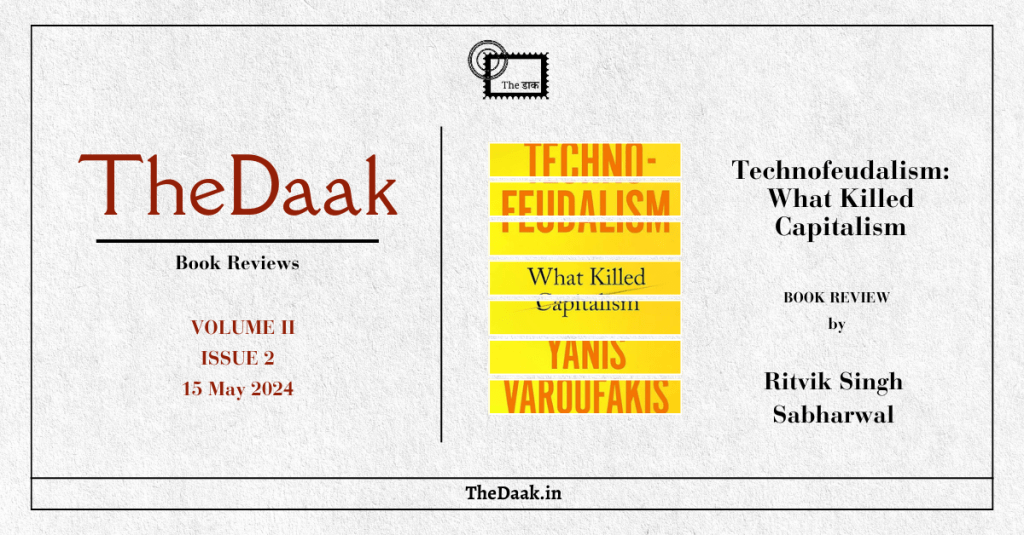

Technofeudalism: What Killed Capitalism by Yanis Varoufakis, London: The Bodley Head, 2023; 304 Pages, 16.2 x 2.9 x 24 cm; ISBN – 1847927270, £16.99.
The book Technofeudalism: What Killed Capitalism seeks to present a revised account of the Marxist theorisation of historical materialist epochs. It is written by a prominent left-wing scholar and former finance minister of Greece, Dr. Yanis Varoufakis. The primary aim of this book is to explain the changes occurring within global capitalism due to unprecedented technological advancement. Its central premise is that Capitalism, the twin child of ‘Markets’ and ‘Profits’ is dead and is replaced by a neo-feudal arrangement, where data and the internet decide the flow of wealth and power. It begins with a discussion on the nature of labour and capitalism. It further discusses the history of Capitalism – from the end of feudalism to the beginning of the epoch of modern capitalism in the USA, wherein it served as a ‘Technostructure’ of business and banks operating on the State’s terms. Subsequently, the discussion moves onto the age of Global Capitalism that operated under the Bretton Woods system. It then shows how the collapse of Bretton Woods made way for the ‘Global Minotaur’ of the neoliberal US Economy, which consumed the world’s goods and capital and then repurposed them as ‘loans and shares’ back to the world (p. 43). Excessive speculation in the stock market, enabled by non-liquid loans and ‘derivatives’ caused the 2008 financial crisis, which killed this Global Minotaur.
Varoufakis goes on to assert that in the aftermath of the 2008 financial crisis, commodified data became Capital. The creation of the privately owned internet led to the emergence of ‘Cloud Capital’ consisting of algorithms and internet networks that influence the users’ preferences (p. 75). The harvesting of data into the ‘cloud’ became a central feature of the Global Political Economy. Technology users unknowingly provide data to platforms like Google, and receive no compensation for it, thereby becoming ‘cloud serfs’ (p. 83). The author theorises that the dominance of markets has ended, since tech-conglomerates produce or sell no concrete commodities. Rather, they monopolise the connection between the producers and buyers. These platforms have created ‘Digital Fiefdoms’ that are controlled by ‘Cloudalists’, who assign their digital might to ‘vassals’ who either do their bidding or go out of business due to being deplatformed (p. 88, 103). These economic fetters ensure that the data of users is extracted by the service provider vassals, and then used to fill the coffers of the ‘Cloudalists’. This system, where a few private entities have divided the global data cloud amongst themselves, is what Varoufakis calls ‘Technofeudalism’.
The author hypothesises that Technofeudalism has killed the capitalist premise of ‘profit’. Digital Fiefdoms don’t sustain on profit, since central banks bail them out whenever they incur crisis-inducing losses. Online platforms make money by collecting ‘cloud rent’ for hosting services on their platforms, which is not ‘profit’ since there is no productive process behind it. Cloudalist enterprises do not extract fees from consumers but mould their exposure to dictate the services they will use and the goods they will buy. Technofeudalism has also taken hold of China, the other big pole of the world economy. Unlike American Cloudalists, Chinese tech-conglomerates are openly embedded into the state system. The new cold war between the cloud realms of the USA and China has caused them to ask their borrowers to return their loans. This is disastrous for the Global South governments, who can default on their debts, which would force economic restructuring by the IMF and World Bank, opening the way for Western Cloudalists to take over their economies. Or they could enact economic austerity and increase prices of goods, pushing people into poverty. The author opines that the escape from Technofeudalism will not come via State regulation. There needs to be a democratisation of corporations by strengthening the voices of workers and a democratisation of money by central bank-issued digital wallets. In the end, people must make the cloud into a ‘public commons’ through an online cloud revolution.
This text presents a brand new, novel and completely radical theory of Global Political Economy. The idea that Capitalism will kill itself is not new, yet Varoufakis differs from other Marxists in that he argues that it is not socialism, but a dystopian data-centred technocratic system that has replaced Capitalism. Therefore, Varoufakis’s theory is a revisionist and heterodox take on Marxist Socialism. As a treatise regarding a new socialist theoretical framework in international relations and global political economy, this work is rooted in class binaries as well. The ‘cloudalists’ and ‘cloud serfs’ form one major binary, and the other binary is the dichotomy of ‘Internet Commons’ and ‘Private Internet’. From an international relations perspective, this book focuses on how the two great poles of Cloud Capital, China and the USA, are using their stranglehold on data to commercialise people’s information. Varoufakis also critiques in detail the Global South “‘mitator’ cloudalists, who seek to replicate the tech-conglomerate model in countries like India (p. 127). With technology becoming the central fulcrum of world polity, technofeudalism as a theory seems to become a very relevant and poignant perspective. While the idea that profits and markets are dead may seem outlandish, it is a fact that things like the Goldman Sachs ‘Non-Profitable Technology Index’ of 2021 showcase the economic viability of enterprises that make no profit and produce no commodities. In Varoufakis’s worldview, all governments and financial institutions, whether in the Global South or North, are in some way beholden to local or global tech-conglomerates. However, the extent to which the cloudalists control our world is yet to be empirically determined.
Without any equivocation, however, it can be stated that Technofeudalism is an extremely important body of work. From a qualitative perspective, its approach is clear and systematic. One need not have a broad understanding of political economy or history to grasp its central conceptions. Varoufakis has previously proven his mettle as an approachable and verbose yet loquacious narrative storyteller in works like The Global Minotaur (2011) and A Brief History of Capitalism (2013). Yet, this book exceeds his other works through its stylistic clarity and sheer depth of research. The author’s focus here is on creating a conceptual framework, for which he engages in a third-person dialectical conversation with his father. This style allows the reader a greater degree of engagement than a straightforward treatise discourse. For people who shy away from theoretical works due to their dryness, this work will not be a problem due to its ingenious usage of pop culture references. The author also gives an autoethnographic touch to the book by using his own experiences as examples and by incorporating myths from native Greece to elucidate concepts.
There exist a few areas for improvement that are noticeable in this book. First and foremost is the retroactive and normative nature of the theory of technofeudalism. Despite containing a properly structured framework with detailed models (found in the book’s many appendices), technofeudalism is largely a theory evolved in hindsight and therefore, lacks empirical and scientific prediction-making capabilities despite possessing great explanatory power. Secondly, technofeudalism is a concept limited only to political economy and, therefore has a major lacuna in that it is limited to the ‘base’ of processes and does not explore how a technofeudal system changes the ‘superstructure’. The author also does not explain or demonstrate the changes technofeudalism brings to the social and cultural ideology of world society. This further extends to the book’s lack of explanation as to how technofeudalism interacts with other social cleavages like gender, class or race. Varoufakis also showcases a degree of Anglo-Western centrism. Not only is Global South painted as a passive and second-tier actor in the entire process of technofeudalism, but all examples and references used in the book are derived from Western media exclusively. Furthermore, the book makes long unneeded deviations in a few places and then fails to connect those subsidiary discussions to the main ideas of the book. This is especially pronounced in the long discussion on private equity firms, whose actual connection to the technofeudal system is never explained conclusively, despite allusions found across the book to the fact that these firms play a key role in the system’s evolution. Lastly, as with many theoretical works, the solutions mentioned in the book to deal with the many inequities of technofeudalism are highly utopian, impracticable and improbable.
Despite its flaws, Dr Yanis Varoufakis’s Technofeudalism is an earnest, engaging, valuable and innovative book that presents a unique paradigm in global polity, world economy and international relations. The interdisciplinary nature and engaging style of the book make it an easy read. Although its primary audience is novices, experts will also derive great insights from this book. Its methodology is clear and informative as well. Such an important and knowledge-enhancing work is to be given a thorough reading by students of International Studies and Global Political Economy. This book is, therefore, a recommended must-read for both beginners and veterans in the field of social sciences.

Ritvik is a Postgraduate student of International Relations and a Political Science graduate focused on the fields of Political Philosophy & International Relations. Along with these disciplines, he is also interested in other disciplines such as History, Anthropology, Cinema Studies and Cultural Studies.



Leave a comment