
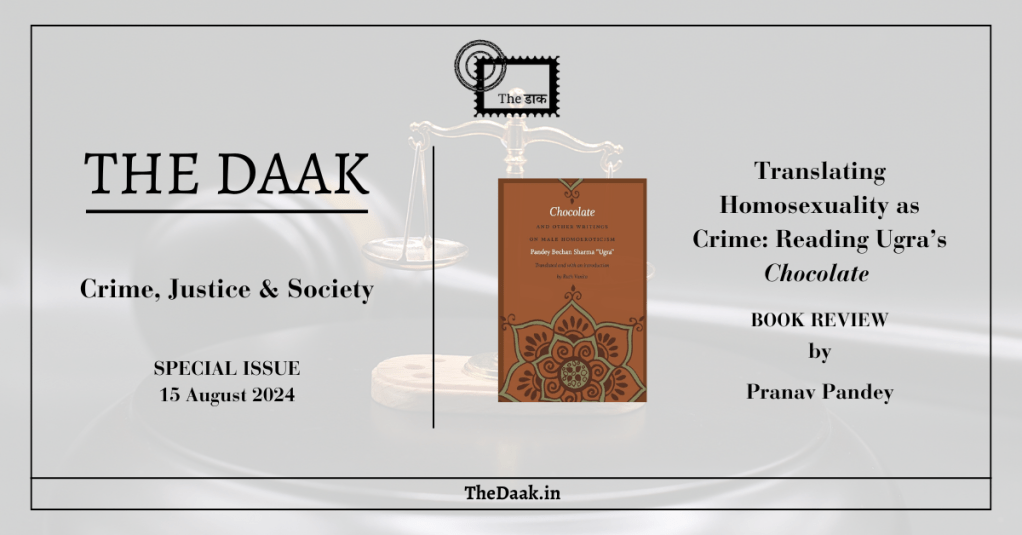

Book: Chocolate and Other Writings on Male Homoeroticism by Pandey Bechan Sharma, translated by Ruth Vanita, Duke University Press, 2009, 152 pages, ISBN: 978-0822343820, Paperback, Rs 2015.
One should not expect literature to be an exact mirror or have a one-to-one relationship with objective reality—the mimetic fallacy— but the historian or critic can find it extraordinarily useful. It is a response to reality, whether by reflection or reaction.
-Allan Pasco
It is often said that love knows no boundaries. However, love has frequently been one of the most contested topics. Love is not a rather simple idea or entirely a matter of personal choice. Instead, it brings with it society’s entrenched notions of caste, class, gender, and other boundaries, which are crucial for maintaining dominant hierarchies and structures. With the arrival of colonial powers in the subcontinent, the dynamics surrounding same-sex relationships in India underwent significant changes. The imposition of Victorian values and British laws criminalising homosexuality had a lasting impact on Indian society, contributing to the stigmatisation and marginalisation of same-sex relationships (xxxi). In 1860, Thomas Babington Macaulay, the first Law Minister of British India, criminalised “unnatural sexual behaviour” under Section 377 of the Indian Penal Code, making it punishable by life imprisonment, a term of up to ten years, or even death, along with a possible fine. (Mondal 2021, 3)
British colonial discourse redefined the fluidity of sexual expression in pre-colonial India by framing Indian homosexuality according to Western ideas of inherent degeneracy, portraying it as a sign of native perversion and inferiority. (Ruhnke 2016, 25-26) These efforts were also intertwined with British gendered perceptions of India as a feminine chaos in need of rescue by the chivalrous West (Banerjee 2003, 170). Consequently, Indian men became increasingly conscious of and concerned about the redefined notions of masculinity imposed by colonialism. These historical processes had a significant impact on society, leaving a lasting imprint on the literature of the period when the struggles against colonialism were brewing.
When examining homosexuality in Hindi literature, Bechan Sharma Ugra’s “Chocolate” is a work that cannot be ignored. Chocolate is a collection of eight short stories, first published in the magazine Matvala in 1924; it was later expanded to include three additional stories and published as a book in 1927. Including the titular story “Chocolate,” other stories such as ‘Kept Boy’, ‘Discussing Chocolate’, ‘We are in love with Lucknow’, ‘Waist Curved Like a She-Cobra’ and ‘In Prison’ explore themes of male homoeroticism. Ugra describes his work as “undiluted quinine” in contrast to “sugar-coated medicine”, claiming to engage in a crusade against homosexuality to expose and eradicate it (18). He argues, “If society preaches against and openly debates other sins, why should this sin not be preached against and criticised?” However, his critics felt these stories were poisonous. Banarasidas Chaturvedi, a famous author and editor of the literary monthly Vishal Bharat, categorised Chocolate as ghaslet (kerosene oil) literature due to its use of obscenity to appeal to specific audiences (xx).
Ruth Vanita’s translation of Chocolate is an important contribution as it preserves the text’s historical significance while making it accessible to a wider audience. In the introduction, she situates Ugra’s work at the intersections of literature, society, and politics of that period, highlighting how when Ugra was writing, the new Puritanism brought about by colonialism and homophobia was deeply entrenched across all sections of the national movement—from the Gandhian to the Hindu, the Muslim to the Communist—and thus among the urban, educated middle classes (32-33). Chocolate addresses many aspects of homoeroticism, but these are consistently framed within notions of unnaturalness, sin, deviance and crime. In many of Ugra’s stories in Chocolate, homosexuality is translated as a crime, with the legal system being depicted as responsible for eradicating it. For conflict theorists, crime often aligns with the attempts of the dominant culture to legalise itself and label any deviations as illegal. Accordingly, ‘the most powerful in society create definitions of normalcy and deviance that are favourable to and serve to protect their interests’ (Black 2014, 2). Thus homosexuality, being deviant from cis-heteronormativity, is labelled as a crime and stigmatised to maintain the status quo and reinforce the power of dominant cultural norms.
While Ugra’s work reflects puritanical homophobia, the effect of his writings cannot be interpreted in such a simplistic manner. During the first phase of nationalism, when British standards increasingly influenced Indian society, there was a concerted effort to reform society according to Western norms. Many of the stories in Chocolate reflect these sentiments, highlighting the attempts to save young boys from the perceived dangers of homosexuality. But despite his harsh stance, Ugra’s work provided a rare space for the discussion of male-male eroticism, offering a glimpse into a taboo subject in a repressive era. In a way, the silencing of non-heteronormative expressions due to colonial impositions and criminalisation is countered by Ugra’s active engagement with the subject. Homosexuals are not silent but have a voice in Ugra’s writings. This is evident from Vanitha’s observation that many male homosexuals received his work with delight. (18).
However, reading Ugra’s Chocolate from the twenty-first century can indeed be disturbing, as it challenges contemporary progressive politics. Ugra astutely warns us, “It is hard to find a speaker of or a listener to unpleasant truths.” The titular story, “Chocolate,” sets the tone for the rest of the collection by firmly establishing the author’s position to expose the perceived evils of homosexuality that society fears to confront. The story centres on Dinkar Babu, who is deeply in love with a boy named Ramesh, referred to as ‘chocolate’—a term used for “innocent, tender, and beautiful boys of the country, whom society’s demons push into the mouth of destruction to quench their own desires.” The author argues, “This chocolate disease is spreading in our country faster than plague or cholera. Society sees it all but pretends to be blind. People oppose prostitution and are angered by widow remarriage, but will not even mention this. Why?” (13)
Paul Boyce had identified that although prosecutions for sodomy were rare, “criminalisation nevertheless establishes a moral climate of sorts, with concomitant effects for same-sex sexual practice of that time” (Boyce 2006, 89). Ugra’s other stories, in turn, present even more brutal portrayals of homosexuality within this framework of legality and crime. In ‘Waist Curved Like a She-Cobra’, the protagonist calls the police during a party hosted by his homosexual friends to “straighten them out” (43). The notion of the police and legal system as guardians of morality—though often portrayed as ineffective—can be seen throughout Ugra’s stories. The protagonist, unable to find a solution on his own, ultimately relies on the police to intervene. Ugra’s focus shifts to a prison setting in his story “In Prison,” where he suggests that the legal system seems powerless to control or eradicate homosexuality, as he depicts criminals engaging in homosexual acts within jails. The author argues that when the system—whether it be the police or the judiciary—is itself helpless against this, the solution lies in religious and humanistic education.
In “Dissolute Love,” Ugra tells the story of Kalyanchandra, who is in a homosexual relationship with a boy. When the boy is caught by the police, he accuses Kalyanchandra of introducing him to the “sinful act.” Overcome with guilt, Kalyanchandra commits suicide, confessing that he had sown the seeds of “hell in his heaven” (66). In “We Are in Love with Lucknow,” we encounter a teacher who coerces his students into engaging in homosexual acts in exchange for passing them in their examinations (30). The story suggests that such sins warrant capital punishment rather than mere imprisonment In Ugra’s stories, the victims are often younger boys who fall into traps set by older men, whose lives become entangled with the legal system or are marginalised from the society. Criminalisation further intensifies this stigma, deepening their marginalisation. These portrayals, deliberately crafted to argue against homosexuality, complicate the reader’s ability to sympathise—whether with the immediate victims or those affected by broader societal stigmatisation.
It is interesting to note that stories beginning with expressions of same-sex love often culminate in the revelation that such love is neither natural nor accepted, and is portrayed as a crime within legal contexts. Those who profess this love are frequently depicted as exploiters leading society into morally questionable acts, and thus deserving of marginalisation. What remains evident in these stories is the persistent theme of love. Despite its often negligent or twisted portrayal, the concept of love itself endures. However, this idea of love soon fades as the author shifts focus to homosexuality as a crime deserving punishment.The Stories of Chocolate are not a feel-good, light read for leisure. Rather, they serve as a historical artefact, preserving and reflecting upon its era. The book is not entertaining; most of the stories lack development or character arcs and often read more like preaching, propaganda, or extended advertisements. It is also quite disturbing that none of the stories portray female homosexuality. One must ask why this is the case: Is Ugra himself avoiding a discussion on female homosexuality, thus contradicting his aim to address the “crime” openly? Or is it because talking about female homosexuality is taboo since society is often reluctant to acknowledge female sexuality as a matter of public discourse? Nevertheless, The Stories of Chocolate remains important as it preserves social mentalities across generations.
Bibliography
Banerjee, Sikata. “Gender and Nationalism: The Masculinization of Hinduism and Female Political Participation in India.” Women’s Studies International Forum. 26.2. (2003): 167-179.
Black, Pamela. “Conflict Theories of Crime” in The Encyclopaedia of Criminology and Criminal Justice edited by J.S. Albanes, 1-5. Wiley Blackwell: 2014.
Boyce, Paul. “Moral ambivalence and irregular practices: Contextualizing male-to-male sexualities in Calcutta/India.” Feminist Review. 83.1. (2006). 79-98.
Mondal, Abir. “Section 377: A legal and political outlook of India” Runas Journal of Education and Culture. 2. 1. (2021): 1-14.
Ruhnke, Lauren. “Constructing Native Homosexuality in British India.” Maneto Undergraduate Research Journal. 1. 1. (2018): 88-101.

Pranav has completed his Masters in Modern History from Centre for Historical Studies, JNU.
Email id: pkp.sbz267@gmail.com
 TheDaak review
Leave a comment