
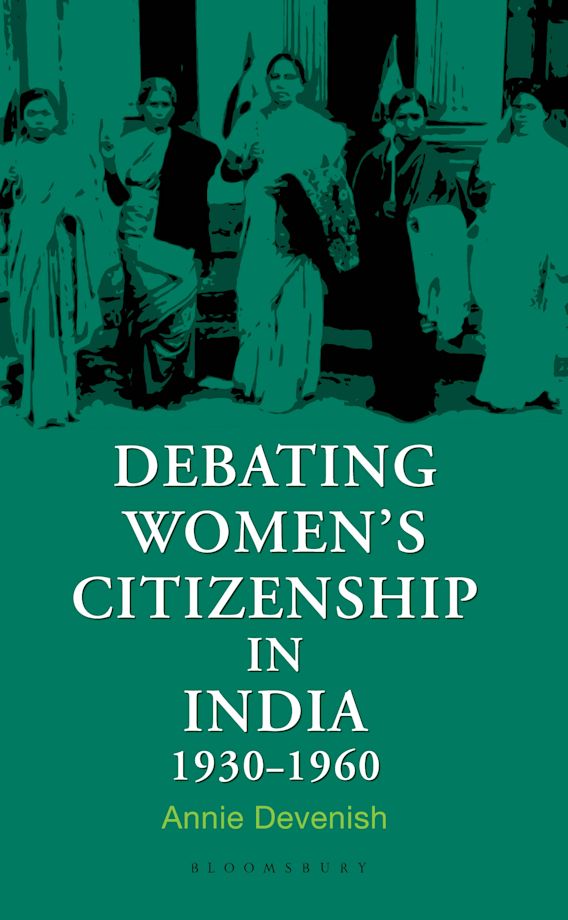
Book: Debating Women’s Citizenship in India 1930-1960, Published By: Bloomsbury Publishing, Bloomsbury India, 2019, ISBN: 9789388271967
By Geeta Kumari
The book tries to fill an essential blind spot in the contemporary history of women in India, especially after independence. Most of the works in this timeline are either related to the Indian independence struggle or the building of the Indian nation-state after independence, which accounts for a lot but is less representative of women as citizens. The author explores the question and history of women’s citizenship and their manifestations through various ways available to them at the time.
The book is divided into seven chapters and argues that each activity or protest by women was a manifestation of their claim for citizenship. The introduction shows how women in India became political citizens with Gandhi’s support. They began asserting their rights as equal human beings, establishing the women’s rights movement and leading to the emergence of women’s organizations in India.
Chapter one further discusses the emergence of women as political citizens and explains how it unfolded through certain acts, decisions, and initiatives taken by women leaders present at various sessions of the Indian National Congress. These include the Karachi Resolution, the Report on Women’s Role in Planned Economy, 1939 (WRPE), which for the first time recognized domestic work as an important contribution by women to the larger economy, and the Indian Women Charter of Rights and Responsibility, 1945. The discussion in the chapter expands the understanding of how the right of citizenship for women was earned by the struggles of prominent women leaders and organizations during these times. It also tries to understand women’s assertion and expression of citizenship by taking into account two different streams of doing politics by women’s organizations – social service and political struggle. The author claims that service and struggle are the means for the deprived and powerless to claim citizenship.
The second chapter argues that Indian women fought for ‘sexless citizenship’(the constituent assembly debates and then the constitution itself propagated being an Indian citizen first beyond gender, caste, class, religion, and community, and women leaders part of these institutions agreed to this philosophy) by framing the constitution, contesting elections, and participating in elections as voters. These are the manifestations of the active participation of women in the early days of India’s independence. Women’s organizations strived to ensure Indian women’s political participation, but no numerical data or references were made. The author argues that the paternal nature of citizenship put forward in the debates of the Constituent Assembly (CAD), in fact, sidelined the woman’s question and, as a result, the caste became the site of “state paternalism” (p.113). In the course of the state’s interference in caste, caste reservations were established. Still, gender was overshadowed, and women also demanded to be part of the nation as “sexless citizens” in it. Due to the state’s paternalistic interference in the caste question, disability and discrimination were recognized and addressed, but not regarding gender.
Chapter three attempts to analyze citizenship through service. Here the author argues that women in India remained and claimed active citizenship through acts of social service, a sacrifice. The act of social service helped the country gain freedom, and now the same would help women gain their “social economic emancipation” (p. 121). The chapter draws amply on different social work programs run by the All India Women’s Conference (AIWC) and the Central Social Welfare Board. Women became the leaders and organizers of these programs and used their political influences to make them successful. According to the author, these welfare extension programs were expressions of citizenship. This chapter focuses on different aspects of the assertion of citizenship by deprived sections of society. Most of the welfare programs mentioned in the chapter do not directly concern women. The chapter extensively mentions the work of AIWC (All India Women’s Conference) and its patrons working in the field of social service but does not talk about how and which of these initiatives benefit women. Only place the author talks about women being involved are as social servants not as beneficiaries of these programs. While AIWC (All India Women’s Conference) continued its work and focused on women’s education even after independence, it remained one of their most talked about agendas in the magazine ‘Roshni’ even after the 60s.
The subject matter of chapter four is the experiences of refugee and rescued women during and after the partition of India. Here we see some of the rescued women did not want to return to their specified homeland due to reasons related to family honour and societal pressure but were forced to do so. They became the site for “underpinning the Indian State’s legitimacy as protector and guardian” (p. 150). This chapter describes two kinds of citizenship: the “paternal” variant provided by the state and the “maternal citizenship” provided by rescuers such as Rameshwari Nehru. Where the latter opined that the moral code of society and the fact that these women are unable to return to their original families remained; hence the state must take care of them. This view about the rescue of abducted women makes it different from the higher ground taken by the state in its paternalist citizenship.
Chapter five gives a historical viewpoint about the struggle of and by NFIW (National Federation of Indian Women) as an organization, its origins and movements started by it. It is argued that women asserted citizenship through participation in agrarian struggles and other political mobilizations.
The sixth chapter provides a history of the family planning movement in India and argues that family planning has never been an issue of women’s empowerment but has always been a tool to solve economic problems in India. Family planning is a well-researched area in India and worldwide, but a gender lens has been missing from that work, and the author tries to cover the missing part.
Chapter seven sheds light on the important arena of Indian women’s important roles in international institution-building, the women’s movement, and its ethos.
The book is an essential intervention concerning some gaps in women’s history in contemporary India. It could also be used as a sort of a reader for studying how women’s history was a continuous process and how it was creating its path by using different mediums of expression over time, contrary to beliefs that it died out after participation in the freedom struggle. Perhaps, very few books like this accumulate so many vital topics on women’s questions for this period. The year 1974 was celebrated as the year of women, and in the same year, the ‘Towards Equality’ report was also published. It was first of its kind report on the status of women in independent India. This report is usually considered an emerging point and reason for the women’s movement in independent India. Annie Devenish’s book significantly undermines this myth. The book asserts that the women’s movement was always active and alive in different forms before and after the independence of India. It found new paths of assertion and representation after they won freedom for their country with their fellow citizens.
While there are times when the book seems to be going off from its central argument of women’s citizenship and leaves some related questions unasked, some tangential subjects were discussed; for instance, the history of the term ‘disability’ is traced in chapter 2, social services in chapter 3, and community development initiatives by the government. All these are valid discussions and give a perspective and understanding of the book’s time period. But it is an extended period; not everything can be put in one text. How social services is an expression of citizenship is an ongoing argument in the book. There was no need to explain its history and different understanding of social service as an act in the middle of the chapter. It felt like the author had a lot of resources and a lot of things to say; hence a lot of aspects have been drawn out to be documented by a historian. However, this makes the book lose the plot sometimes. It could have been crisper. Questions on caste and class positions of women working in the two prominent organizations and their areas or location of work taken as the prime examples to explain citizenship through ‘service’ and ‘struggle’ are left halfway through ‘Roshni,’ the mouthpiece of AIWC (All India Women’s Conference) (March 1955, issue), e.g., discusses at various points, the lack of reach and establishment of AIWC as an organization in villages of India. The author also mentions the importance of villages in social services programs. Gandhi said the same but failed to discuss AIWC’s (All India Women’s Conference) intervention, which was limited to middle-class women and the population. The book lacked an insight into ‘Roshni.’ it could have substantially gained in its arguments from the magazine. Nevertheless, the book gives fresh perspectives on the women’s history of modern and contemporary India. For the new-generation historians working on the feminist movement and women’s history in India, this book will help to start working on the period, ask those unasked questions, and explore this vast period of Indian women’s history left unexplored to a great extent.

Geeta Kumari is a PhD scholar at Centre for Historical Studies, Jawaharlal Nehru University, New Delhi. She works on women representation in independent India. She reads historical fiction and spy thrillers.


Leave a comment