
THE RIGHT TO SEX

Amia Srinivasan’s book ‘The Right to Sex’ is written to make the reader uncomfortable. As the title suggests, the book’s focus is ‘Sex’, written to question the critical assumption that sex as both an identity and an act is ‘pre-political’. Though in practice, both are political acts of discipline. Srinivasan sets this contextual and theoretical lens in the West and critically examines the themes of gender, racism, class, consent, pornography and sex work.
The debates on each theme in the book are no longer archaic. Srinivasan takes a unique lens and style of writing. The book is divided into six chapters; each situates a current debate revolving around sexuality and academically engages with critical challenges. As Srinivasan details in the fourth chapter, the focus is not on an institutional/structural response but on locating how an individual is implicated in the structural problem of disciplining sexuality. The book continues to dwell on the political acts that create private desires and acts for human beings.
The book begins with the practical challenge and academic response to the discourse on false charges and allegations. In the aftermath of the #MeToo movement, sexual harassment and assault charges were levied on men in powerful positions. These were acts that were public secrets; everyone knew, but no one acknowledged them until they had to. Most critiques of the movement levied the charge that #MeToo was dismantling not only patriarchy but also legal principles of due process and innocence until proven guilty. Srinivasan studies the discourse of the response of both ‘guilty’ and ‘not guilty’ men.
Other than acknowledging that the legal category of guilt could not respond to questions raised by #MeToo, she poignantly writes that the response indicates the fear of powerful men that they could no longer rest upon the state’s presence to protect their right to sex. The feminist movement has resulted in a political achievement where women can no longer be silenced. The quantum of women being raped is more than men being falsely accused; why does the latter hold greater cultural value? Srinivasan locates the answer in the growing demand and the state’s acceptance of women’s testimonies as is, given these powerful men now actively fear the institutional and legal responses to their acts, the failure of which had historically oppressed marginalized sections of the society. Thus, the concern is not of legal precepts but the recognition of the institutional failure of those very precepts.
The second theme the book explains is the contention around porn. New-age technology and massive unemployment during COVID-19 saw many young individuals participating in the porn industry. Here, the author recognizes that any response has to account for the fact that our current generation is a constituent of individuals whose sexual awakening happened directly or indirectly through porn. Given the cultural role the industry has come to play and its impact on further disciplining sex itself, instead, the response should be to reimagine sex education with an embedded sexual imagination.
In the third theme, the book reflects upon the difference between the position from which different bodies deal with the politics of desirability. Historically located politics have created specific bodies to be more sexually desirable, be it the trope of ‘petite east Asian women’ or the ‘Caucasian blonde’. Men who cannot access sex speak of their claim on these bodies, evidenced by public school shooting incidents to incel groups online. Srinivasan locates an alternative in the language of empowerment that redefines the very understanding of who is sexually desirable. The author focuses on the politics of the body, which is sexualized and disciplined into being made desirable. She points to the politics of LGBTQIA+ flag, expanding the conversation to all bodies are beautiful.
The fourth chapter is very interesting both in the writing style and content. The chapter gives 88 numerical points to respond to the ontological and epistemological questions revolving around political contentions on sexuality. Most importantly, the chapter responds to the critique that any solution to structural problems of sexuality that rely on the individual would again result in the equation of moralism and sex.
The fifth theme, and the most enticing of the chapters, problematizes consent. How empty and futile structural responses of affirmative consent could be? Not only does Srinivasan substantiate her concerns with examples from universities, but her focus also remains on teacher-student relationships. The author’s philosophy training kicks in when she makes an astute point that other than practical power difference, the relationship between a teacher and a student has a ‘metaphysical’ and ‘epistemic’ power differential. She draws an equivalence between a teacher-student and therapist-patient relationship. This equivalence relies on the assumption that the onus, like in therapy, lies with the teacher. For Srinivasan, this is because the lens of meaning-making employed by the teacher and therapist impacts that of the patient and student. While her larger discomfort with top-down approaches to certain legitimate or illegitimate relationships/ desires is a common thread throughout the book, this equivalence is paradoxical. The author begins this chapter with the aim for the reader to recognize that students are not feeble, irrational bodies. But her equivalence creates a relationship between the student-teacher, which can move towards a position of passivity, where the agency is constructed from the teacher’s lens. Her position and her solution still stand, though the equivalence seems false.
The sixth theme of the book is the carceral response to sex work. She wants feminists to acknowledge that the symbolic and the lived concerns of sex work are opposites. The decision must favor the latter if the debate is between making life better in the future pitted against a few bodies today. Srinivasan critiques the position of carceral feminists in banning sex work and institutionally excluding sex workers from the ambit of society. She points out that this position comes from the same lens as considering particular bodies more important than others.
All the themes are not to be read as separate disjunct debates on sexuality but as critical challenges that 21st Century feminism must respond to. The book’s last paragraph points to the inherent ‘paradox of powerlessness’: “collectivized, articulated and represented powerlessness can become powerful” (Srinivasan, 2021, p. 178). Feminists need to recognize that these challenges are the result of the power they have held. With this power comes the responsibility to respond to these challenges, which Srinivasan herself poignantly does.
HEROES LIKE US

Book: Heroes Like Us, By Thomas Brussig, Translated by John Browhnjohn, Published by Farrar, Straus and Giroux, 2000, ISBN: 0374527601, 262 Pages
By Deepak
Thomas Brussig’s Heroes Like Us (in German: Helden Wie Wir , 1998) is a satirical take on the socio-political landscape of East Germany and the events which led to the fall of the Berlin Wall. The protagonist and the narrator of the story, Klaus Uhltzscht, arguably in his fancy sits opposite a New York Times journalist, as the latter has come to interview Klaus because of his claim that he is solely responsible for the fall of the Berlin Wall. The reader witnesses the indulgent and entertaining narrator Klaus as he tells tales from his childhood, adolescence, and adulthood. An insight into his familial and school life is given to comprehend the making of a man whose phallus broke down the Berlin Wall.
Klaus presents himself not only as an indulgent but also as a notoriously delusional character. Through all the blown-up, grotesque tales that are related to Mr. Kitzelstein by the fanciful narrator, the lines between history and/or memory and its official account begin to blur. As Klaus sits in the position of the interviewee, he assumes total charge of the reins of the representation of history and evidently molds it as per his whims. The sentiments of the author, Thomas Brussig, and the narrator-protagonist, Klaus Uhltzscht, seem to come together and fuse into one single monologue about the complacency and the cryptic, mute revolt of the Mutti-Generation (mothers’ generation). Critiquing the solidarity of Christa Wolf, one of the most well-known authors from East Germany, with the Hungarian Revolution of 1956, the synchronized voice of the narrator and the author express: “I mean, how can one fairly assess the politics of a writer who has seldom if ever made an unambiguous political statement? Know what she says about Budapest 1956? That we sat in front of our radios filled with “concern”. Meaning what? Did anyone sit in front of his/her radio filled with relief? Did Ulbricht? Did Adenauer?” That both men – the narrator and the author – are bitter about the disinterested people of the GDR is also manifested in the sarcasm-filled narration that runs through the pages of the novel. By default, the illusion of power is bestowed upon men through the random, unmerited lottery of birth. The synergy of the author’s and the narrator’s voice give a sense of being robbed of this illusion as with the progress of the narration the title becomes more of a resentful question: Heroes Like Us?
The two find themselves in a paradoxical situation, wherein they are simultaneously powerful and powerless. Having been born in the “lesser” of the two German states, the more “feminine” one, these men feel they are constantly emasculated. This becomes evident and manifests in the towering, controlling figure of the narrator’s mother. The mother becomes the embodiment of the surveillance state and must “sanitize” not only the physical space in which the family resides but also the inner mind of the family. Hence, the german word Sex should become Sechs (meaning: six, pronounced almost similar to sex). The state qua mother becomes a panopticon and instills in the average citizen a fear of being always in a state of being watched, so much so that Klaus is taken over with immense guilt as in his teenage years he has wet dreams and buys new sheets with his meager pocket money. On the one hand, Klaus is a symbolic representation of the GDR citizens who were the victims of the all-powerful, all-watching communist state and hence becomes a meek spectator of his own life. However, on the other, he takes on control of his life in his later years and becomes a master of his narrative, which is often filled with disgusting deeds done with delusions of a madman, he finds himself an active element in the web of power. Sarcasm becomes a tool, a coping mechanism, with which this hollow entitlement becomes manifest. A critique of the East German people when his phallus is about to commit the heroic feat gives us a sense of this paradox: “It was a pathetic sight, Mr. Kitzelstein. There they stood, thousands of them confronted by a few dozen border guards, and they didn’t dare make a move. They shouted, “We are the people!,” the principal slogan of recent weeks, and somehow it hit the nail on the head. They were indeed “the people.” Who but “the people” would have stood there in such a docile, diffident way, shuffling from foot to foot and hoping against hope? This was how I knew them of old: timid and tractable and programmed to fail. I pitied them, somehow, because I was one of them. I was one of them. […] People of that kind often have undersized dicks, take it from one who knows.”
The ideals of the East German communist state become manifest in the delusions of Klaus as he feels he is the chosen one. He is convinced that he is chosen to save the life of the commander-in-chief Michael Gorbachev, thus becoming his right hand. The fact that Klaus can talk much about his imaginary achievements yet somehow fails to write more than a paragraph of his autobiography in two years further highlights the paradoxical power dynamics in which the narrator is trapped. The official narrative of history is propagated and mediated mostly by written texts. In that Klaus’ story must only stay content with remaining at the periphery and perhaps not actually finding a space in the New York Times, his masculine claim to voice and power is again robbed from him. The question however is that: he does speak, but is he getting heard?
It may not be too far-fetched to argue that, if anything, the novel presents a desperate cry for recognition from the men who feel that they have become powerless, emasculated, and effeminate because they were born into a particular state. Klaus Uhltzscht’s voice thus brings into language the concerns of these “helpless” men. Perpetually emasculated and infantilized by the means of surveillance, censorship and curbs on their freedom, these men develop a feeling of resentment towards the state qua mother. In this backdrop. it becomes strikingly interesting to notice that the brunt of the narrator’s resentment is directed toward the Mutti- and not the Vati-Generation (father’s generation). A revelatory aspect of the collective memory is brought forth herewith, in that such an accusation could very well have been directed against the Elterngeneration (parents’ generation), which would have been a more gender-neutral identifier. Having taken this particular nuance from the language of the narrative, it becomes clear that in the larger cultural landscape gender not only forms the structures of power, but also memory and history. Gender is highly powered, as power is highly gendered.
Although Klaus Uhltzscht and Thomas Brussig are two different entities, the former is a creation of the latter. Hence, the distance between evades at times, telling us that, in its totality, the novel is the voice of an author coming to terms with his past through the character that he has built. The novel is a conversation with the collective memory of East Germany through means of sarcasm, media, gender archetypes, and grotesquerie. At least, that’s one way of seeing it.
THE OTHER BLACK GIRL

The Other Black Girl by Zakiya Dalila Harris, London: Bloomsbury Publishing Ltd. Rs 599,1st edition published 2021
The Other Black Girl was all over booktube and booktok in the summer of 2021. In fact, even after more than one year of its publication, the book still manages to be one of the top recommendations. It was a pleasant surprise to see the marketing team of a major publishing house really putting its weight behind a book like the Other Black Girl. The book revolves around the protagonist Nella who, as a Black woman working in corporate America, has to deal with office politics and microaggressions at her workplace. She works as an Editorial Assistant at a reputed publication in New York. She happens to be the only black girl in an otherwise predominantly white office space. It is no coincidence that Zakiya Delilah Harris— the author- also worked in the publishing industry for three years before she published her first novel. It is interesting that a novel that is so critical of the publishing industry and highlights the race problem that it has— lined up to publish this debut novel and is now adapted for television by Hulu. In a way, it is meta since characters in the book also talk about the commodification of blackness at certain times in American history.
Zakiya’s Book defies genres in many ways and yet manages to be relatable to a large audience. Zakiya, in interviews, has acknowledged how her experiences of growing up in a predominantly white suburb inform the character of Nella. The microaggressions and racism that Nella has to put up with at the fictional Wagner publishing house seem all too real but are dealt with satire, sensitivity and a plot seething in mystery. As the only black woman in her workplace, Nella is an expert at code-switching and has to work hard to ensure that she doesn’t come off as an angry black woman or someone who is too sensitive to issues of race. It is, therefore, no surprise that when the other black girl in the book Hazel makes an appearance, Nella expects solidarity and sisterhood. This is where I believe the book’s brilliance shines— in showing how the protagonist deals with the emotions of having another black woman at her place of employment, Nella’s character is fleshed out even further. While she is a likeable character, she is not made bland. The envy that she feels towards the other black girl for not having to jump through the same hoops as she has had for years shows Zakiya’s ability as a writer. The two main characters have a complex and prosperous relationship with each other. Hazel, the other black girl, is made of all the things Nella feels she has been lacking in her life as a Black Woman. Hair is a constant reference in the book and as a character in its own right and has a major plot of its own. Both women first connect through discussions on their hair. Nella, who has been raised in the affluent suburbs of Connecticut, feels somewhat envious of hazel’s long hair, and she has always known how to care for her since she was raised in Harlem surrounded by other black women. The discussion that black women have on topics related to their hair and their lives is not translated for the benefit of the white audience. While the two characters bond over their natural hair care journey, Nella is always conscious of being less black than Hazel for having a white boyfriend, not growing up in a black neighbourhood or having deep roots in the black community as Hazel does.
The book also has a subplot around the lives of two black women who were a writer—editor duo at Wagner books 30 years before Nella joined the publishing house. Kendra Ray and Diana were close friends in the 80’s. Their story belonging to a different timeline might at first come across as confusing but the second half of the book does justice to Kendra’s storyline. The subplot highlights how even after decades have passed and so much has changed in every industry and field; some things remain the same. Issues of race and gender fall under this category. Both Nella and Kendra are separated by 30 years and, in different circumstances, have to face repercussions for speaking their minds and for just being black in a white workspace. Another interesting facet in the story is the friendship between Nella and Malaika on the one hand and that of Kendra Ray and Diana on the other. While the sisterhood between Nella and Malaika’s characters grounds them, the childhood friendship between Kendra and Diana is more complicated. In the case of Nella and Malaika, their friendship seems like the only safe space for Nella to air out her grievances without being dismissed as too sensitive. Malaika is her sounding board who assures that her feelings are valid and that the micro-aggressions at her workplace are not imaginary.
The book brilliantly shows the tokenism of the white workspaces. It’s satire cuts deep into the token hires by industries that continue to be deeply exclusionary while patting themselves on the back for being Trail Blazers in terms of diversity hires and progressive woke culture. One outstanding feat that the Other Black Girl manages to achieve is being true to its audience. It doesn’t talk down to its readers but is also unapologetically honest in portraying the performative nature of white liberal antiracism initiatives. The Other Black Girl captures the conversations around privilege and alienation with depth. The character of Nella is complex yet relatable, and she wants the reader to root for her.
On the other hand, the book manages to keep the reader guessing and on the edge of her seat. Hazel, as a character, does not become a caricature at any point since it is shown very clearly how women are often pitted against each other. The idea that there can be only ‘one minority’ hire shows how solidarity between members of the oppressed communities within these corporate offices becomes complicated. The ambition and competitiveness of the two women keep the reader invested and engrossed till the very end.
CASTING THE EVIL EYE

Casting the Evil Eye: Witch Trials in Tribal India by Archana Mishra, Goli Books, 2003, ISBN: 81-7436-214-2, Rs. 350
Hoi Tichum Bhardoo Tichum,
Saedai Teroloi Uotaang Idei Kaer,
Mass Vando Banga,
Hoi Rurar Mai Bhardoo Suar Mai,
Saedai Jugdoi, Naachur Ruar Mai
This is one of the many songs that can be heard while visiting a tribal household, hummed by tribal women engrossed in their daily household chores, either de-husking the grains using “Dhenki”(made of wood) or engaged in agriculture.
The book is a marvellous attempt by the author to throw light on the subject of witch-hunting which is less or never talked about. Today’s least opposed or concerned form of violence contradicts our modernised world. Witch hunts and witch trials manifest that two worlds exist, ignorant of each other. One world is our world of modernity, technologically sound, elitist, capitalist, urbanised and developed while the other is where women are being murdered in the name of belief and religion. A murder without guilt and remorse. A murder, where the victim is criminalised while the criminal is portrayed as the victim. ‘Casting the Evil Eye’, reflects the tribal society of Jharkhand and the need of tribal feminism. It questions the existing theories and norms of feminist scholars according to whom women’s empowerment comes through economic, political and civil rights.
Given that tribal villages and their houses represent a fair amount of tribal women who cannot be broken easily both mentally and physically. These women are already engaged in economic and political spaces; they have an adequate amount of representation and work both inside and outside the household. They are not dependent on their male counterparts and have sexual freedom, yet their empowerment becomes a curse. This again questions the notion of women’s empowerment that mere economic and political freedom of women is not enough to guarantee them a violence-free life.
The book transcends the boundaries of non-fiction and enters the realm of fiction through the narration of its case studies which transforms into stories of heart-wrenching circumstances faced by tribal women of Jharkhand. The book unfolds and hunts down the new forms of traditionally implicated forms of violence, which many believe or will believe if the story is foretold that witches or witch hunting only exists in fairy tales or in horror shows. The concept of witches and witchcraft is known to everyone. We have seen in movies, read novels, and heard stories even as folktales where we clap when the witches are burned down. But, we fail to recognise the violence in it. The author in this book highlights not only the plight of women who were portrayed as witches but also the whole process of ‘witch-making’. The witches are not born; they are made into witches or ‘Dain’. As Namita Gokhale writes in the book’s foreword, ‘Dain’ refers to a female witch with etymological roots in Diana, the huntress-goddess of ancient Greek. She asserts that in the beginning, God was a woman, and the concept changed slowly with gender hostility and power relation.
Mishra writes in her book about the ‘myth’ of how women become a witch by following rituals according to the people/folklore. But, she emphasises the concept of ‘White Magic’ and ‘Black Magic’, where white magic refers to good magic only attributed to men, who are called ‘Ojhas’/‘Shokhas’(witch doctors) have the power to identify and brand a woman as a witch. In contrast, black magic is attributed to women or the ‘dain’ (witches). The book also has chants and mantras used by both the Ojhas and the witches. Those chants will look like any other song or poem. If read carefully, both ‘Ojhas’ and ‘witches’, in some parts, could be seen praying to the same god, still one is treated as sacred, and the other becomes profane.
The ‘Evil Eye’ concept is about ‘Buri Nazar’, which most of us are familiar with. Evil eye or a bad eye can lead to death, bad harvest and diseases. And the rescuers are the Ojhas, who are considered as godfathers. Therefore, the villagers submit to his whims and fancies, and he acts as he wishes. The Ojhas are met with all the demands like supplying rice, meat, liquor and even sexual favours from women to escape his wrath. The killing, lynching, and decapitation of women labelled as witches or Dains get sanctioned by their kin and villagers. And those who kill them are worshipped as ‘Heroes’. These crimes are associated with gender conflict and power relations. What scares women is not death but the process of humiliation, the never-ending terror which will haunt them in the name of witchcraft. How they are hunted down is scary for them. They are forced to parade naked in the village with heads tonsured, their breasts being cut off, sexually assaulted, gang raped, teeth being broken, beaten, hot water being thrown at them; made to drink urine and eat human excreta, human flesh, drink the blood of animals and they fear the murder of their family. Death is only a mercy and easy punishment to accept.
While it takes us to another question of who are these women who become targets? Women who are single, widowed, both young and beautiful, as well as old, having property or earning a living become the target of jealousy within their circle and even by Ojhas. As highlighted by the author in one of the case studies of Chutni Mahto or Chutni Devi, a fine example of courage and determination. She was recently awarded Padam Shri for her exemplary work among victims of witch-hunting. She is a witch-hunting survivor. She was branded as a witch and not only humiliated and ostracised from her husband’s house but as the author says, “she was forced by the villagers to swallow human excreta and urine to get rid of evil spirits”. The author further analyses the category of crime it should be dealt with since “it was neither murder nor rape or dowry death, but something much worse”. Can anything be more degrading and inhuman than being made to eat human excreta? It’s a very intriguing question posed by the author.
The book is an illustration of writing that crosses academic and non-academic boundaries through its case studies and the power of narration. The author here works as an observer and detached narrator, presenting the field experiences and stories encountered as she is on her journey “into the land of witches” in Jharkhand. The narrative technique is a blend of journalistic style with a pinch of ethnography. The book reflects tribal land, culture, past, and present and is an introspective journey of their future lives. Lastly, in search of justice, she delves into the legal aspect where the state comes into play. Here, the state is being portrayed as a resort for providing relief, compensation and solution to the victims. In the end, as I come from the ‘Land of Witches’, the state of Jharkhand, I was left with a feeling of remorse, pain, fear, hopelessness and shock for both the victims and the criminals who are mere pawns in the hand of religion and Ojhas/Shokhas (witch-doctors). Mishra’s book is a work of empathy and elaborated documentation of the women tormented in the name of witchcraft and witch craze. It is not only about the stigma these women face, but it is also about superstition, hidden patriarchy, ignored forms of violence, and constant fear of being attacked anytime and anywhere.
References:
Casting the Evil Eye: Witch Trials in Tribal India. https://www.exoticindiaart.com/book/details/casting-evil-eye-witch-trials-in-tribal-india-ide921/
PARTNERS OF ZAYNAB

Diane D’Souza, Partners of Zaynab: A Gendered Perspective on Shia Muslim Faith, The University of South Carolina Press, 2014
This book examines the gendered expressions of Shia Islam. How women from the dominant Ithna Ashari, or Twelver, Shia group organize and experience their religious lives is the main area of focus for the author. In order to achieve this, Diane uses female narratives and understandings as a starting point, primarily relying on the experiences of women who reside in Hyderabad, a city in southern India, home to one of the country’s largest Shia communities. The book is an example of putting primacy on the lived experiences of people located in religious tradition over the canonically imagined religious tradition. Thus, the book offers an anthropological account of Muslim rituals and also examines how gender influences the knowledge of Shia faith and practise through the use of literary sources like poetry, sermons, hagiography, and historical texts. This ‘gendered’ lens is crucial because the majority of Shia research and writing, whether by Muslim religious scholars or academics in the domains of religion or social science, predominantly reflects the male expressions and beliefs.
The book raises and attempts to answer three questions.
First and most important, how do pious Shia women nurture and sustain their devotional lives within a patriarchal culture? The author finds the answer in the study of female piety in relation to religious stories, holy setting, ritual performance, female leadership, and iconic symbols. The study goes beyond the typical depiction of Muslim women as merely a background in the male- centered events and offers glimpses of female leadership in a variety of contexts, including the stories of Fatima, Zaynab, and Hind, present-day memorial services and supplication rituals, and also the establishment and management of an unique women’s public shrine. Shia women employ ritual to support, nurture, and draw strength from others, whether the relationships are localized in social or familial networks or extend beyond, thanks to ties to the Prophet’s family. These and other studies of the rich religious lives of women have shown how women actively create spaces and rituals that vividly reflect Shia devotion. The author employs five main entry points into female religiosity—religious narrative, sacred space, ritual performance, female leadership, and iconic symbol as well as elements for each that influence women’s piety in order to explore this subject.
The second question the book answers is what new insights into Shia faith are gained through an understanding of the gendering of religious practice? This question yields some fascinating findings. The author explores and analyses the female narratives and stories about crucial historical events. Stories which help one understand the significance of those events for believers. The story of succession over who will succeed the Prophet is transformed into a tale of loyalty and faithfulness rather than of gaining or losing control; the Karbala events shed light on what bravery and willingness to stand up for truth means in the face of tragedy and betrayal moving beyond a focus on martyrdom as the only way to demonstrate one’s commitment to one’s faith. The focus placed on bearing witness to the truth, which defines not only the historical deeds of Fatima and Zaynab but also a critical female ritual role in forming masculine religious identities, is particularly illuminating. Shia traditions that are quite popular have female roots, which provide fascinating insights into power and
gender dynamics within the community. The exploration of male and female cooperation in rituals with separate gender-based zones of authority or at religious places run by men or by women is also fascinating. It is obvious that there are gendered streams of ritual and belief that have a significant impact on how believers perceive, comprehend, and shape the fundamentals of Shia faith in addition to a large shared world of meaning and activity.
The third question it answers is how unexamined gender assumptions complicate the scholarly dichotomy between normative and popular religion and ask what alternatives might be considered for conceptualizing the diversity of religious behavior?
In answering this question, the book presents the argument that the prevalent normative religious tradition has marginalized and devalued women’s religious expressions, therefore undermining our understanding of religion in general. Islam that is normative (or alternative) is best described as the result of a dominant social group, while Islam that is popular is linked to individuals who have a limited capacity to define standards authoritatively. Therefore, the dichotomy best captures the power and privilege in a particular society. It demonstrates how women frequently express their visions, sources of knowledge, and authority outside of officially sanctioned religious institutions. It would be more accurate to state that this scenario currently limits our ability to see and accept them rather than that it diminishes the power of female visions.
The book tests the presumption that normative Islam is beneficial in helping us understand the beliefs and practices of Muslims. It asks what form normative religion might take if the religious practices of underrepresented believers, including Shia women, were to be prioritized?
The author examines this dichotomy in terms of gender, and argues that women’s religious behaviors are most often associated with the ‘popular’ or ‘folk’ categories, whereas normative or orthodox religion most predictably encompasses men’s perspectives and activities. This is due to the fact that religious authorities and textual sources have historically been dominated by men. In other words, elite men have generally held the power to define what is and is not religion, and they tended to downplay, ignore, or even dismiss as illegitimate many aspects of female spiritual expression. This position is supported by a gendered explanation of human nature, with religious scholars claiming that God created females with a weaker, more emotional nature than the stronger more rational males. For them men are thus inherently superior to women, including in religious knowledge and practice. Associating women with marginal or incomplete religious activity demonstrates how the emphasis on men as the only normative actors in a male-defined religious world made it
difficult to even acknowledge that women had religious lives, let alone independent ones worthy of study.
Through the anthropological studies the book demonstrates that women’s ritual activities express central theological ideas of their own. The books discusses the works of Jacques D. J. Waardenburg (1979) and Abdul Hamid el-Zein (1981). Leonard Norman Primiano (1995) in trying to forward a method to bring out a nuanced understanding of the religion that goes beyond the normative religious paradigm dominated by the religious elite to a more inclusive and grounded understanding of religion and religious experience.
SILENCE IS MY MOTHER TONGUE

Book: Silence is My Mother Tongue by Sulaiman Addonia, London: The Indigo Press, 2018, 204 pages, £12.99, ISBN 978-1-9996833-2-0
Set in the backdrop of a Sudanese refugee camp, Addonia explores themes of war, violence, sexuality, and dreams through his book, ‘Silence is My Mother Tongue’. The story is based on the life of the protagonist, Saba, a strong-headed woman and her older mute brother, Hagos, who have fled Eritrea to the designated Sudanese camp along with their mother. The special relationship between Saba and Hagos, as she plays his voice for others and being a body that he dressed each day, raises inquisitive eyes in the camp. The war with Ethiopia has not only forced them to leave their homes and belongings, but Saba’s ambition of joining a university after school to become a doctor, also stayed back in their home country. The book begins with Jamal’s cinema in which each character has the freedom to dream and aspire, a life that the camp withholds through the hands of the aid workers, midwife, trial committee and others, that bends into social norms. The camp life is a makeshift arrangement of families residing together in huts wherein Saba befriends other girls like Samhiya and Zahra, the latter becoming the final motivation for Saba to flee the camp after being assaulted by her businessman-husband, Eyob’s son, Tedros. The book is not just a mere description of the everyday life at the camp, but provides a deep insight into the complicated morals that dictate a society in which the notions of gender, power, intimacy, and sexuality seem to prevail universally, yet can be challenged silently.
Addonia explores the intricate web of gender norms and societal expectations of a woman from her birth until her death through Saba’s eyes. The fixed duties of men to carry out physically challenging tasks outside the house and women’s obligations towards household chores sustain its universality and applicability even in the camp, where Saba is expected to cook food and do laundry, while Hagos must get ration from the aid center. Back at home, “he carried out domestic chores, bought her clothes and shoes, took care of her hair, all while she focused on her studies”. However, the role reversal between the siblings depicts Hagos’ contentment towards their home and Saba’s desire to stay outside of the confines of their hut. Regardless of their individual preferences for doing their chores, their mother’s disapproval of the same matched the social expectations of them as Saba often heard the conversations between her mother and the midwife that insulted her as “being manly”. Nonetheless, she often turns a deaf ear to all these claims and relentlessly follows her dreams to learn English at the camp, takes a job at Eyob’s house and even at a prostitute’s house, earning to save enough for being able to go to school after leaving the camp. Yet, her personality does not reflect upon all women in the camp, as trials in the camp always blamed women for any act of seduction, relieving the man of any punishment, let alone guilt, while confining the woman to “the backroom of life”.
The author unravels the several ways in which women bear physical violence throughout their lives, the happening of which multiplies significantly when in a refugee camp. Although Saba’s character is portrayed as a bold and unbending woman, she experiences sexual assault along with her brother during their early years at the hands of their uncle, an incident that intertwined their lives silently. “You are both mute now, he said to Saba and Hagos. You hear?” It is ironic how Hagos’ muteness is imitated by Saba during these times, yet making their bond inseparable and complicated for everyone else to comprehend at the camp, to the extent that Saba is put to trial and a virginity test for having incestuous relationship with Hagos. Unfortunately, it is a woman who has to bear the brunt of all unfavorable actions of men’s sexual desires throughout the book. Towards the end, Zahra is ‘defiled’ to a near fatal condition by Saba’s step-son, Tedros, as his ego is inflated due to Saba’s relentless defiance towards him. The affirmation of a man’s dominance over a woman’s body through sexual control is replicated yet again when Saba gives in to the demands of the nomad for rescuing Zahra and herself from the camp. Such instances assert that violence over a woman’s body can foster a man’s ego and justify his actions, which sadly, is also upheld by women in the camp such as the midwife, who routinely tests Saba’s status of virginity through her fingers.
Nonetheless, even though Addonia highlights the prevalence of gender norms that are entrenched universally, the book is a brave attempt at challenging the binary sexual standards through its characters. Not necessarily fitting into the category of queers, but incidents of physical intimacy have been shown between Saba and her friend, Samhiya or with Nasnet, the prostitute. The desire of an intimate feeling that transcended the social boundaries of the confines of marriage is witnessed between Saba and Jamal, her silent admirer, both having felt this reciprocation towards each other. Unconventionally, upon getting married to Eyob, she takes Hagos along with her to the marital hut as a pre-condition to the wedding, through which she becomes aware of the secretive physical relationship between these two men. This moment of war and life in exile is a victory for her and Hagos as she says “his words might have been caged forever inside him; his love was not”. There exists an underlying yearning throughout the book for women’s emancipation and freedom from the universal rules of their subjugation towards men and worldly obligations. Zahra’s mother, a soldier in the war wrote to her, “I am here to bring back my country, where my daughter will have the same rights as someone else’s son”.
Silence is My Mother Tongue is an example of a writing that does not bend traditionally to the rules of gender, sexuality and identity completely, making characters complementary to one another, wherein while one follows, the other stands out to challenge them, in the cinema frame that captures the beginning of the book. Addonia is fearless and inspired through his own experience of his life in a war-ridden camp during his early years, reflecting the reality of a refugee memoir through the eyes of its multiple characters.
DEBATING WOMEN’S CITIZENSHIP IN INDIA (1930-1960)
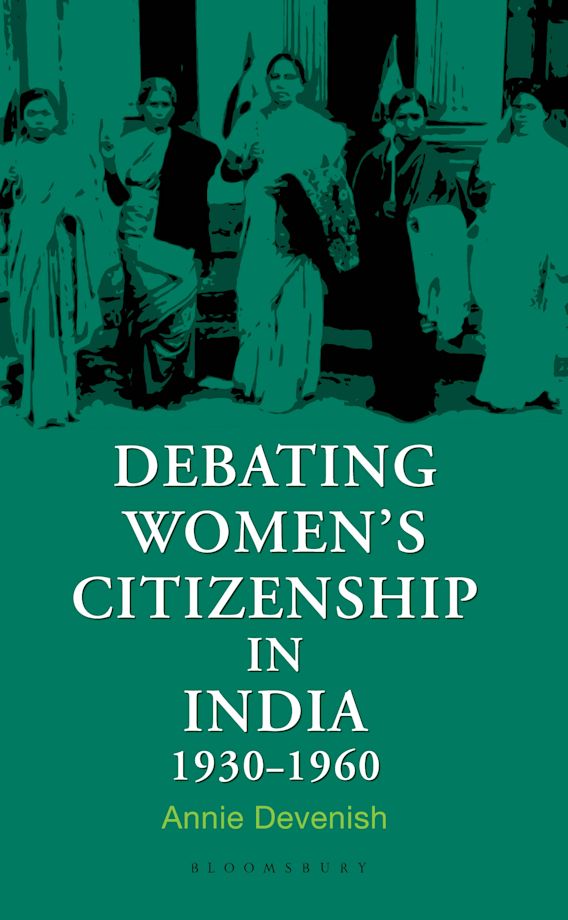
Book: Debating Women’s Citizenship in India 1930-1960, Published By: Bloomsbury Publishing, Bloomsbury India, 2019, ISBN: 9789388271967
By Geeta Kumari
The book tries to fill an essential blind spot in the contemporary history of women in India, especially after independence. Most of the works in this timeline are either related to the Indian independence struggle or the building of the Indian nation-state after independence, which accounts for a lot but is less representative of women as citizens. The author explores the question and history of women’s citizenship and their manifestations through various ways available to them at the time.
The book is divided into seven chapters and argues that each activity or protest by women was a manifestation of their claim for citizenship. The introduction shows how women in India became political citizens with Gandhi’s support. They began asserting their rights as equal human beings, establishing the women’s rights movement and leading to the emergence of women’s organizations in India.
Chapter one further discusses the emergence of women as political citizens and explains how it unfolded through certain acts, decisions, and initiatives taken by women leaders present at various sessions of the Indian National Congress. These include the Karachi Resolution, the Report on Women’s Role in Planned Economy, 1939 (WRPE), which for the first time recognized domestic work as an important contribution by women to the larger economy, and the Indian Women Charter of Rights and Responsibility, 1945. The discussion in the chapter expands the understanding of how the right of citizenship for women was earned by the struggles of prominent women leaders and organizations during these times. It also tries to understand women’s assertion and expression of citizenship by taking into account two different streams of doing politics by women’s organizations – social service and political struggle. The author claims that service and struggle are the means for the deprived and powerless to claim citizenship.
The second chapter argues that Indian women fought for ‘sexless citizenship’(the constituent assembly debates and then the constitution itself propagated being an Indian citizen first beyond gender, caste, class, religion, and community, and women leaders part of these institutions agreed to this philosophy) by framing the constitution, contesting elections, and participating in elections as voters. These are the manifestations of the active participation of women in the early days of India’s independence. Women’s organizations strived to ensure Indian women’s political participation, but no numerical data or references were made. The author argues that the paternal nature of citizenship put forward in the debates of the Constituent Assembly (CAD), in fact, sidelined the woman’s question and, as a result, the caste became the site of “state paternalism” (p.113). In the course of the state’s interference in caste, caste reservations were established. Still, gender was overshadowed, and women also demanded to be part of the nation as “sexless citizens” in it. Due to the state’s paternalistic interference in the caste question, disability and discrimination were recognized and addressed, but not regarding gender.
Chapter three attempts to analyze citizenship through service. Here the author argues that women in India remained and claimed active citizenship through acts of social service, a sacrifice. The act of social service helped the country gain freedom, and now the same would help women gain their “social economic emancipation” (p. 121). The chapter draws amply on different social work programs run by the All India Women’s Conference (AIWC) and the Central Social Welfare Board. Women became the leaders and organizers of these programs and used their political influences to make them successful. According to the author, these welfare extension programs were expressions of citizenship. This chapter focuses on different aspects of the assertion of citizenship by deprived sections of society. Most of the welfare programs mentioned in the chapter do not directly concern women. The chapter extensively mentions the work of AIWC (All India Women’s Conference) and its patrons working in the field of social service but does not talk about how and which of these initiatives benefit women. Only place the author talks about women being involved are as social servants not as beneficiaries of these programs. While AIWC (All India Women’s Conference) continued its work and focused on women’s education even after independence, it remained one of their most talked about agendas in the magazine ‘Roshni’ even after the 60s.
The subject matter of chapter four is the experiences of refugee and rescued women during and after the partition of India. Here we see some of the rescued women did not want to return to their specified homeland due to reasons related to family honour and societal pressure but were forced to do so. They became the site for “underpinning the Indian State’s legitimacy as protector and guardian” (p. 150). This chapter describes two kinds of citizenship: the “paternal” variant provided by the state and the “maternal citizenship” provided by rescuers such as Rameshwari Nehru. Where the latter opined that the moral code of society and the fact that these women are unable to return to their original families remained; hence the state must take care of them. This view about the rescue of abducted women makes it different from the higher ground taken by the state in its paternalist citizenship.
Chapter five gives a historical viewpoint about the struggle of and by NFIW (National Federation of Indian Women) as an organization, its origins and movements started by it. It is argued that women asserted citizenship through participation in agrarian struggles and other political mobilizations.
The sixth chapter provides a history of the family planning movement in India and argues that family planning has never been an issue of women’s empowerment but has always been a tool to solve economic problems in India. Family planning is a well-researched area in India and worldwide, but a gender lens has been missing from that work, and the author tries to cover the missing part.
Chapter seven sheds light on the important arena of Indian women’s important roles in international institution-building, the women’s movement, and its ethos.
The book is an essential intervention concerning some gaps in women’s history in contemporary India. It could also be used as a sort of a reader for studying how women’s history was a continuous process and how it was creating its path by using different mediums of expression over time, contrary to beliefs that it died out after participation in the freedom struggle. Perhaps, very few books like this accumulate so many vital topics on women’s questions for this period. The year 1974 was celebrated as the year of women, and in the same year, the ‘Towards Equality’ report was also published. It was first of its kind report on the status of women in independent India. This report is usually considered an emerging point and reason for the women’s movement in independent India. Annie Devenish’s book significantly undermines this myth. The book asserts that the women’s movement was always active and alive in different forms before and after the independence of India. It found new paths of assertion and representation after they won freedom for their country with their fellow citizens.
While there are times when the book seems to be going off from its central argument of women’s citizenship and leaves some related questions unasked, some tangential subjects were discussed; for instance, the history of the term ‘disability’ is traced in chapter 2, social services in chapter 3, and community development initiatives by the government. All these are valid discussions and give a perspective and understanding of the book’s time period. But it is an extended period; not everything can be put in one text. How social services is an expression of citizenship is an ongoing argument in the book. There was no need to explain its history and different understanding of social service as an act in the middle of the chapter. It felt like the author had a lot of resources and a lot of things to say; hence a lot of aspects have been drawn out to be documented by a historian. However, this makes the book lose the plot sometimes. It could have been crisper. Questions on caste and class positions of women working in the two prominent organizations and their areas or location of work taken as the prime examples to explain citizenship through ‘service’ and ‘struggle’ are left halfway through ‘Roshni,’ the mouthpiece of AIWC (All India Women’s Conference) (March 1955, issue), e.g., discusses at various points, the lack of reach and establishment of AIWC as an organization in villages of India. The author also mentions the importance of villages in social services programs. Gandhi said the same but failed to discuss AIWC’s (All India Women’s Conference) intervention, which was limited to middle-class women and the population. The book lacked an insight into ‘Roshni.’ it could have substantially gained in its arguments from the magazine. Nevertheless, the book gives fresh perspectives on the women’s history of modern and contemporary India. For the new-generation historians working on the feminist movement and women’s history in India, this book will help to start working on the period, ask those unasked questions, and explore this vast period of Indian women’s history left unexplored to a great extent.
FRONTIERS IN THE ECONOMICS OF GENDER

Edited by – Francesca Bettio and Alina Verashchagina, New York: Routledge, 2008.
‘Frontiers in the Economics of Gender’ edited by Francesca Bettio and Alina Verashchagina is an anthology of thirteen essays which pertain to the various contours of economics of gender. It critically traces the historicity of gender in economics and evaluates the existing theoretical framework by incorporating gender.
Marcuzzo and Rosselli1 have attempted to brush off the ‘dust of obscurity’ from women whose contributions to economic sciences, like any other science, have been systematically neglected. Economics, which claims to be value-neutral and whose theoretical frameworks have extensively relied on the operation of a free market, has actually managed to keep women out of it. Economics as a field stands on the pillars of androcentric biases: for example, its basic assumption is about a ‘rational man’. Assessing history of economic thoughts through a gender lens uncovers many examples of how prejudice had creeped into greatest minds like Marshall, Malthus and Keynes. Historically, professionalization of subjects, here Economics, have been dictated by prevailing gender norms (p.9). So it’s natural that the subject which has evolved over the years conforms to an ideal of masculinity.
Likewise, the existing narratives of historical events are gender biased. As men have held more political, economic, social and cultural power than women in all past societies, they have been the subject of dominant historical writing (p. 21). In her essay, Hudson2 asserts the ways in which gender-oriented research can challenge the existing economic understanding. Given the divide in the public-private sphere, the first thing that can be done to uncover the gender impact on historical writings would be to encourage more research on private everyday lives across generations and even in present times (p.22) i.e. to investigate a sphere which remained confined to women. This doesn’t mean that an attempt would be made to fit women into the conventional narrative, rather it implies a fundamental rethinking from the very base, across generations and time. This essay is located in the literature of feminist challenge to accepted economics. The assumptions that underlie modern economic analysis make it difficult to examine decision-making which is conventionally embedded in patriarchal power relations. Other examples of gender-oriented research in demography, ownership of capital and investment, provisioning and consumerism, etc. have been pooled to establish the body of this essay, pointing out how feminist economists have advocated for a ‘methodological shift’ which is broader and inclusive.
Such gender deconstruction of history would imply questioning the very idea of ‘knowledge’, ‘power’ etc. which have historically been associated with a male identity. More light has been shed on this context in the last chapter ‘Gender and the political economy of knowledge’ by May.3 Even while the number of women enrolling in higher education has increased over time, there hasn’t been a corresponding increase in the proportion of female faculty members in educational institutions (p.267). There exists much resistance to women being the producer of knowledge. May points out how institutional factors have reinforced gender segregation in academia. Institutions of higher education barring women from their faculty has been cited as an act of ‘status maintenance’ (p.276).
Mainstream economics is hugely based on the assumption of methodological individualism, i.e. ‘individual’s’ behaviour and decision-making are driven by self-interest. For example, it is assumed that a family is unitary and the head of the family is altruistic (Becker, 1981). But this is not necessarily true as we know that the allocation of household income and resources can be gender-biased given the male-dominance that prevails in our society. In order to counter such biases, the second section establishes novel theoretical frameworks to incorporate gender into microeconomic and macroeconomic analysis. Cigno4 has tried to establish that marriage as an institution is inherently biased against women. In a marriage, two possibilities can be arrived at: either specialising in gender-defined work or non-cooperation between the couple. A woman can only avoid being exploited by her husband by refusing to specialise in child care and retaining control over her own earnings. The underlying assumption is education would increase the recipient’s earning capacity. Given the prevalent gendered division of labor, naturally it is assumed that a woman would tend to cooperate after marriage. Assuming this as a disincentive, girls end up acquiring less education than boys. Incentive lies in increasing her endowments through dowry. But if education could affect a person’s domestic bargaining power, the argument for giving a daughter money rather than education becomes weaker (p.56). This conclusion seems fitting since education can only provide agency if it translates to viable jobs and confer women with some sense of entitlement.
Chichilnisky5 explains the phenomenon of women being underpaid and undervalued in a rational economy via the interaction between the institutions of family and market. Unpaid domestic work performed by women remains unaccounted for and outside government regulation. Given the gendered obligation of women to households, firms perceive them to be less reliable, hence lower wages. Historically, wages of women have been lower than men which reinforce the gendered construct of division of labor (Becker 1985). Basically, inequalities at home lead to inequality in the market and vice versa. A better solution is possible which would ensure equity in households and firms. But this doesn’t happen in real life because of missing contracts between these two institutions (p.72). Adding another dimension to the issue of gender wage gap, in chapter 11, Eckel6 states that it can be well-induced by how women are perceived. It puts forward questions like, if women and men earn different wages because of differences in their preferences, the way others perceive them, or in the ways they are treated by others within a social context (p.225). Through experiments, it’s shown that women are more ‘altruistic’ and hence would accept lower compensation, are ‘risk averse’ which implies that they have lower reservation wage. These aspects can greatly affect wage negotiations. The neoclassical framework for wage determination does not account for such ‘perceptions’ and ‘stereotypes’. But it is very important that we consider people in their social and historical context because identities have a bearing on human behaviour.
In the essay ‘Ghosts in the machine’7, authors emphasise the need to introduce gender into macroeconomics. It criticises the neoclassical paradigm for its inability to incorporate cooperation and conflicts within the household. Subsequently, a Post-Keynesian two-sector model has been developed to analyse the flow between household production and the commodity sector to bring out the fact that even the act of social reproduction and care-giving requires investment, which has systematically been neglected in macroeconomics. Household as an economic entity has been further analysed in the subsequent section adhering to two dimensions – economics of care and intra-household bargaining. By conceptualising care, Nancy Folbre8 has tried to point out the complexities involved in care work. Care work involves human emotions and it’s highly substitutable, generally leading to lower remuneration. This chapter ends with a note on the requirement of further research pertaining to this context. Similarly, Lundberg9 explains through general bargaining models that women attending to child care end up having lesser command over resources outside the household which results in their less bargaining power in the process of household decision-making.
The next section pertains to labor market debates, and provides empirical evidence on disparities across Europe in context of wage gap and occupational segregation.10 Through a comparative study across the EU nations, it has been concluded that the extent and the structure of the gender pay gap does vary across the countries. Therefore, in order to rectify the pay gap there is a need for a country-specific approach and it has to be targeted at certain groups: older women, segmented markets, part-time workers, and also for highly educated workers in some countries. In the next essay,11 it has been stated that the relation between segregation and gender pay gap has changed. This further reinforces the idea discussed in Chichilnisky’s essay ‘The Gender Gap’ empirically. And if the household bargaining approach is correct, the same gap perpetuates an unbalanced division of labor within households. In the last essay of this section,12 economic position of women has been surveyed in the context of the transition economies of the Former Soviet Union and Central & Eastern Europe. This empirically argues that given the role of women in the household, risk and uncertainty involved in market reforms can put women in a position of disadvantage.
Through novel and inclusive theoretical frameworks, this book is an attempt to incorporate gender into the sphere of economics and it outlines the drawbacks of mainstream economics. In other words, it’s a combined effort to make economics more human, and in order to do that it draws significant elements from the works of prominent feminist economists. One thing that can be pointed out is, it’s a story of the Global North. This needn’t necessarily be a drawback of this book but the discussed framework of analysis can be used for the Global South because it’s a possibility that the outcomes would vary.
Notes
1. Marcuzzo, Maria Cristina, and Annalisa Rosselli. “The history of economic thought through gender lenses.” In Frontiers in the Economics of Gender, pp. 19-36. Routledge, 2008.
2. Hudson, Pat. “The historical construction of gender: reflections on gender and economic history.” In Frontiers in the Economics of Gender, pp. 37-58. Routledge, 2008.
3. May, Ann Mari. “Gender and the political economy of knowledge.” In Frontiers in the Economics of Gender, pp. 283-301. Routledge, 2008.
4. Cigno, Alessandro. “A gender-neutral approach to gender issues.” In Frontiers in the Economics of Gender, pp. 61-72. Routledge, 2008.
5. Chichilnisky, Graciela. “The gender gap.” In Frontiers in the Economics of Gender, pp. 73-92. Routledge, 2008.
6. Eckel, Catherine. “The gender gap: Using the lab as a window on the market.” In Frontiers in the Economics of Gender, pp. 239-258. Routledge, 2008.
7. Akram-Lodhi, A. Haroon, and Lucia C. Hanmer. “Ghosts in the machine: A Post Keynesian analysis of gender relations, households and macroeconomics.” In Frontiers in the Economics of Gender, pp. 93-114. Routledge, 2008.
8. Folbre, Nancy. “Conceptualizing care.” In Frontiers in the Economics of Gender, pp. 239-258. Routledge, 2008.
9. Lundberg, Shelly. “Gender and household decision-making.” In Frontiers in the Economics of Gender, pp. 132-150. Routledge, 2008.
10. This has been explained in two separate essays: Dolton, Peter, Oscar Marcenaro-Guttierez, and Ali Skalli. “Gender differences across Europe.” In Frontiers in the Economics of Gender, pp. 153-182. Routledge, 2008. And 2. Bettio, Francesca. “Occupational segregation and gender wage disparities in developed economies: Should we still worry?.” In Frontiers in the Economics of Gender, pp. 183-207. Routledge, 2008.
11. Bettio, Francesca. “Occupational segregation and gender wage disparities in developed economies: Should we still worry?.” In Frontiers in the Economics of Gender, pp. 183-207. Routledge, 2008.
12. Malysheva, Marina, and Alina Verashchagina. “The transition from a planned to a market economy: how are women faring?.” In Frontiers in the Economics of Gender, pp. 208-236. Routledge, 2008.
References:
- Becker, G. S. (1981). Altruism in the Family and Selfishness in the Market Place. Economica, 48(189), 1-15.
- Becker, G. S. (1985) Human Capital, Effort, and the Sexual Division of Labor, Journal of Labor Economics , 3 (1): 33–58.
INDEPENDENCE

Book : Independence by Chitra Banerjee Divakaruni, India, 2022, 288 pages, 978-93-5629-458-5,₹ 699
Independence as opposed to swaraj, freedom and for that matter, liberty has a historical specificity. The commonsensical mind would go to the event(s) of 1947. The event of the birth of a nation, eulogized by some as India’s destiny and others as her awakening.1 What is it then that this book does to the narrative of independence? What do we hear there that we had not heard before?
I must admit, this story will not blow your mind away. In fact, in terms of ideas, there is nothing here that an eclectic reader would not find elsewhere. What is interesting and new here however is the sheer ease with which the author has humanized historical events immediately preceding and succeeding the year 1947. While the strength of the book is easy narrative, lucidness, and the capacity to bring characters alive, it has to be most ardently admired for building a world around and from the perspective of women. Women have been subjects, both of critical enquiry as well as of powerful sympathy, but they have hardly ever held the narratives in their hands. In this book, we see the country and its independence from the eyes of these women. It is through their failures and triumphs and their longing and suffering that the nation comes to life. In this book, like the author’s other writings, she has remained committed to how real and believable these women are. How deeply aware one becomes of the hard and real choices that the women located at crossroads of history have to make. How family, love, and responsibility are understood in the larger context of the nation, duty, and sacrifice. How free will is not free at all, and how in the larger scheme of projects of destiny and awakening, women as people tend to pay a lot more and sometimes in silence than everyone else. The beauty of the characters is that not once has the agency been taken away from them. They are not passive recipients of their fate. As active agents of change, Devakaruni’s women are constantly reflecting and engaging with the ever changing and challenging world around them. Such a book should have been written a long time ago. I am grateful to the author that she wrote it.
One of the many interesting things this book does is that it sews together the public and the private. The public life of a transient region and its politics are intricately woven around the stories of three women. These women, until recently, have remained passive sculptures whose stories were carved out outside of them. To have an account of pre-independence, and the transition to a new country through the minds, thoughts and even hearts of women characters is deeply satisfying. Like many other iterations of independence, this story also moves around the events of partition, love, loss. The narrative subtly raises the question of freedom without actually ever uttering the word. When Priya wants a medical degree and is denied admission due to inherent bias in the colonial administration, what is denied to her? When Deepa is in love and struggles to find acceptance in her country of birth, what is denied to her? When Jamini stays back and takes the dutiful domestic role, in the hope of getting a man’s love, what is denied to her?
The narrative develops as a dialectic between the nation and its humans. The human story pans out, becoming writ large nation story. This narrative is created by a creative blend of songs of freedom and motherland. The author ties the themes of aspirational women with that of an aspirational country. The notions of seva and duty are embodied in the characters of Nabhkumar, the dutiful doctor who served humanity, Somnath, the dutiful friend who fulfills his promise to take care of Nabhkumar’s family and remains unwavering in his task, Rashid, whose poverty of income is nothing in comparison to Mamoon’s poverty of character and Raza, who remains committed to both Muslim League and Deepa’s love. Somnath and Amit remain steadfast on their commitments to secularism even when it proves to come at great costs. Through these humans, the author pens the larger story of the country and people called India. It brings the nation out from its abstraction into its reality.
We will take care of each
Independence, Devakaruni, Banerjee Chitra., 2022, pp283
Through the narrative, the author has also posed certain interesting questions that could be useful for not only a feminist reading but also for the coexistence of many myriad identities and communities in the idea of India. The author raises the question ‘who shall take care of others and in turn of the nation once the founding moment is long gone?’ The founding moment and founding fathers are beautifully metaphorized in the figure of dying Nabhkumar as the father of three daughters. The sacrificial, truthful and hopeful father leaves them mid-sentence “take care…….” which the surviving parties interpreted till the end as their responsibility to protect others. It is only much later, after much blood is shed, is it to be understood that the country was never once left for one party to save or own. The message always was to “take care of each other”, that as distinct genders, groups, races, and religions, we were supposed to take care of each other. Chitra Banerjee leaves us therefore with much food for thought, and a sublime hope in a politics of taking care of each other. Stories that revisit the past, through the lens of women and for that matter, those at the margins have a remarkable capacity to help the readers to understand the long-hidden and often forgotten latent histories that have existed all along.
State and archival histories reduce human beings, their sufferings, and joys to either numbers, recalled as events, or as part of museums and catalogs. But the citizens of India in these moments have lived an experience of life the narration of which is often not found in state histories. The number of people dead and missing is just statistics. Stories written such as these bring the lives of people out from mere statistics to become the life and breath of a country. They put flesh and blood into the lives of historical events. One finds oneself pining for homeland with Priya, one shares Deepa’s rootlessness and anxious loss of identity, one understands and even sympathizes with Jamini despite her flawed, jealous self. One is angry and even scared for them. One wants to shake Bina away from her wilful sadness. But as the author thinks aloud through Deepa’s character
“when men go off to be heroes, do they realize what it does to the women they leave behind.”
Independence, Devakaruni, Banerjee Chitra., 2022, pp30
One is angry at Bina for letting her daughters go. One is angry at the world for Bina’s suffering. Bina is angry at the world for her loss, she is angry at herself for not being able to save her husband. Those who are left behind at home waiting for those who left to be heroes. Those who remain in waiting, who survive the re-inaction of death and loss over and over again. Those who stand up and force themselves to smile, to live through abject poverty of both resources and love, are they not heroes?
The entire span of the narrative in terms of chronology is not more than two years, but by the time you turn your last page, it would seem that ages have gone by, that nothing has remained as it was when you began. You live that life with Deepa, Priya and Jamini. You feel the deep sense of loss, their loss, a nation’s loss. And yet you know they will be alright, we will be alright, the nation would be alright. They will, as they have themselves. They will take care of each other. We will take care of each other.
Notes:
1. Nehru’s famous tryst with Destiny speech, that finds mention in Divakaruni’s story as well.
About the author:

Jigyasa Sogarwal teaches at Department of Political Science, Hindu College, University of Delhi. Her research areas include Political emotions and institutions.


Leave a Reply