
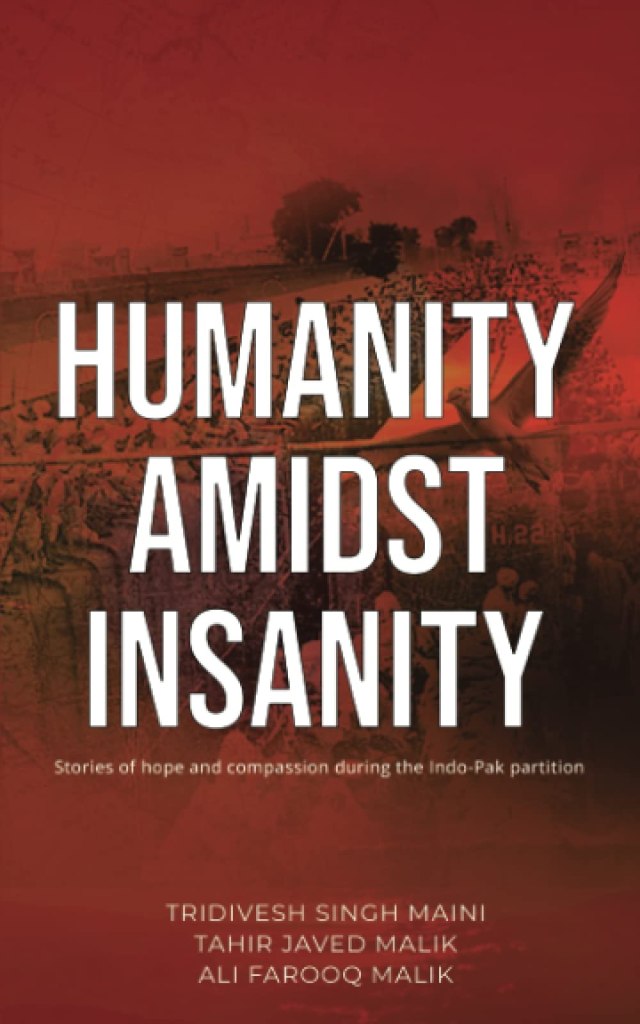
Book : Humanity Amidst Insanity : Stories of hope and compassion during & after the Indo-Pak Partition by Tridivesh Singh Mani, Tahir Malik & Ali Farooq Malik , New Delhi, UBS Publishers & Distributors, Published 2009,148 pages, Soft Cover- 5 in x 8 in, ISBN:978-8174766304, ₹ 200
Humanity Amidst Insanity
“It is during our darkest moments that we must focus to see the light.”
– Aristotle Onassis
The book “Humanity Amidst Insanity” is authored on the principle quoted above, highlighting the humanity and kindness shown by individuals on both sides of the border during the 1947 Partition – one of the darkest chapters in the history of the Indian subcontinent. What might appear as a collection of stories of hope during the Partition is actually a cross-border ethnographic effort to mine instances of perhaps the most infallible virtue of humanity – compassion. The authors, Tridivesh Singh Mani, an Indian academician of repute, and Tahir Malik and Ali Farooq Malik, both renowned Pakistani journalists set out on the quest to find such positive experiences through the process of interviewing survivors of the Partition in both the countries.
What strikes a reader the very instant they grab hold of a copy of the book, is how ‘bare-bone’ it is. There is neither page after page of social commentary, the book itself a light 150-pager read, nor any precarious wording. The language in fact is surprisingly lucid and straight-forward for a theme that is usually riddled with philosophical undertones. That is not to say that philosophy does not direct the flow of the book, as the constant journeying for tales of compassion centralizes the mission of the text. A reader is not wheeled along on this journey of discovering the ‘light’ side. They are allowed to set out on it on their own with a map. The plots on this map are actually a set of questions and queries made to the interviewees, the answers to which unlock the much larger tapestry of unity, commonalities, trauma, nostalgia and decades of generational memory on both sides of the border. One such question asked to almost all the partition survivors was whether they were aware at the time of the partition that the division was permanent or not. Most of the interviewees’ accounts reflect that almost everyone thought they were coming back, either having purchased property right before fleeing and even taking the house keys along, or having buried treasure or left their assets to someone trustworthy for safekeeping till they returned. The authors are able to connect this with the attachment these survivors have with their ‘watan’ or homeland. As a reader sets out to discover these, making frequent trips to observe experiences on both sides of the border, they start to question the demarcation itself.
That moment of questioning brings to light the relevance of the book, which in the words of the authors, is an ‘important’ work for the current generation of South Asians, the generation that has not grown-up with stories of Partition, but are seeing displacement all around them. But why positive experiences? A reader is plagued with this question early on in this text, thinking that an over-emphasis on such good, humane and brave acts during an otherwise depraved period runs the risk of trivializing the actual history. The authors understand the readers’ dilemma, and furnish the significance of such positive experiences, and show how it connects to the larger theme of the book. Not for once, however, do the authors try to downplay the inhumane acts committed during the Partition, and all the suffering that was caused. An alternate view is offered which acknowledges that human beings are capable of both good and evil. Almost all of the interviewees recalled their own versions of the horror they witnessed, alongside the positive experiences. In no way is this a literature which denies the massacre that took place during the Partition, but by highlighting the positive experiences in the same temporal space as the horrors, it creates a niche of its own amongst other Partition literature.
This ethical antagonistic duality is one of the things which the book gets a good grip on, allowing it to lead the narrative. One of the critical intentions of looking for good in the darkest of times is the idea that it sets out a ripple effect of kindness and compassion that helps ward off the adverse effects of depravity. Humanity is struggling to find optimism as the world steeps deeper in a poly-crisis environment of war, unrest and calamity. This book allows them to attune their senses in seeking out individuals stepping up to help others, often risking their lives in that process. Such experiences can catalyze change, inspiring individuals to take action. The authors manage to extrapolate the usually clandestined compassionate, humane and apolitical side of the ghastly Partition and set forward a more hopeful and inspiring vision for the future. One such ‘humane’ experience in the book highlights accounts of shared compassion amongst Sikh refugees coming into India, and Muslim refugees moving towards Pakistan helping each other by sharing water and nursing wounds.
The operating theme of finding the positive side of humanity in times of depravity also fits into the concept of waiting in exile. Waiting in exile is as much a physical act as it is a mental and emotional state and can be quite difficult and disorienting. Positive experiences, such as the ones collected in the book, offer a glimmer of hope and inspiration for the ones feeling detached from their identities. Even the interviewees stated how these experiences helped them find hope and strength to find stability, identity and momentum in a new homeland, a new country – one that felt like an exile. These experiences help individuals find a sense of community and belonging and demonstrate the commonalities that exist on either side of a border or conflict. This book focuses on building bridges in a highly polarizing world which is busy erecting higher walls.
One of the strengths of the book is that it is not a typical historical account of the partition. Majority of the book consists of interviews of individuals from both sides of the borders. The observations of the work therefore face some of the challenges that any other compilation of oral history faces. While the individuals are selected from different educational backgrounds, places of origin, age, caste, gender et cetera, their recollections still bear more nostalgia and bias than fact. The authors have tried to untangle much of such bias, and showcase some advantages of relying on oral history. Constructing a narrative based on people’s experiences allows for a more free-flowing understanding of events by deconstructing the rigid time frames of history. Finding cultural anchors and affinity also becomes easier, as was the case of tracing the significance of ‘watan’ on both sides of the border. Therefore, this approach provides a unique and compelling perspective on a significant historical event.
However, a few flaws in the book disorient the reading experience. While the feature of the work is the laborious cross-border collection of positive experiences from survivors of the partition, it gets a bit washed out in terms of the insights and observations put forward by it. Some portions of the book, such as the section on why certain cities were picked to collect experiences from, tends to read like a journal research paper at times. However, since this forms the methodology section, it can be avoided. The book also does not delve deeply into the complex political and social factors that contributed to the partition and its aftermath. While this may be a deliberate choice by the authors to focus on individual experiences, it may leave some readers feeling that the book oversimplifies or overlooks important aspects of the partition.
Overall, “Humanity Amidst Insanity” is a thought-provoking and uplifting book that offers a fresh perspective on the partition of India and Pakistan in 1947. While it is not a comprehensive account of the Partition, it perhaps remains one of the very few accounts that tends to focus on positive and humane experiences during an otherwise politically charged and depraved event. Its coherent writing and narrative driven experiences bear resemblance to chapters from The Diary of Anne Frank offering a wider appeal to the book. It delivers a valuable reminder of the power of human connection and compassion, even in the face of extreme adversity. As the world descends into longer and disorienting periods of instability and insanity, that sentiment holds the potential to breed much required strength in the hearts of humanity, that all hope is yet not lost.

Sarthak is pursuing his Masters’ from the Jindal School of International Affairs, and is an avid bibliophile.


Leave a Reply