
Concept Note: CRIME, JUSTICE AND SOCIETY
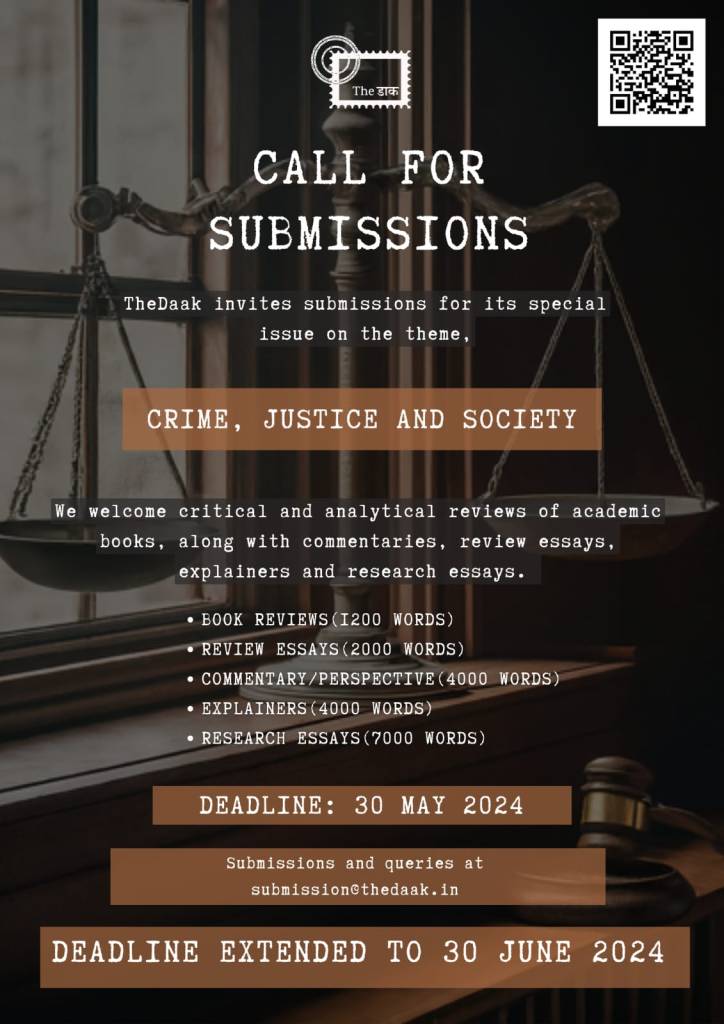
TheDaak invites submissions on the theme ‘Crime, Justice and Society’ for its special issue due to be published on 15 August 2024.
The ideas of ‘right and wrong’ and ‘crime and justice’ can be perceived as basic standards underlining the evolution of human societies. Across time and age, society, state and religion have tried to construct rules, norms, laws and procedures to regulate, control and discipline human conduct. This regulation is attempted by levying moral and legal sanctions along with physical punishment for causing intentional harm and suffering.
Suffering is true of all human existence, but the suffering caused at the behest of another to cause deliberate and tangible harm has been the paramount concern of all the rule-making systems. Thus, the basic principle of living in a society was laid down, which was to preclude harm, suffering and pain; and ‘safeguard ’ the rights of humans along with fostering order in the society.
Every religion, guided by its own understanding of morality, decided the boundaries of what it deemed to be acceptable, the unacceptable and the unfathomable ; and the supreme temporal authority decided upon punishment. Religious authority therefore guided the principles of crime, criminality and justice during the medieval period. In contemporary times, justice is premised on the legitimate use of violence by the modern state, protecting law and maintaining order. In the process, ideas of morality and criminality have developed an intricate web of complex relationships.
Historically, crime and punishment have been employed not only to discipline a particular understanding of the people but has also tried to build a homogeneous people, be this exclusion based on race, class, caste, gender, sexuality, among others. In medieval Christendom, believing in anything different from catholic Christianity was criminal; in Victorian England, homosexuality was a crime; in modern America, being black was a crime. One’s being, based on their ascriptive identity of birth, was deemed criminal. Globally, the legal system has seen a shift from religious dictum of immorality being the guiding principle for criminal law, to criminality moving outside the ambit of the question of religious morals and being judged based on the current political milieu.
Justice and its delivery system have always been central tenets to the State’s existence and the proof of legitimate power it wields. In pre-modern times and thought, the enactment of justice was a public performance. The courts of emperors and kings used spatial arrangements, natural elements, and architectural features to orchestrate a spectacle conveying not only the principles of fairness in dispensing justice but also the displaying of the monarch as the earthly embodiment of divine justice. Similarly, this tradition continued with the advent of the modern state, where the enactment of justice is characterized by grandiose architectural structures, expansive and complex bureaucratic systems, and codified structured legal frameworks.
The all pervasiveness of law and legality and its centrality in the structure and functioning of the modern state is near complete. It regulates every aspect of human life, from basic civil regulations of public and private life to defining what constitutes or does not constitute a criminal act.
However, the modern state has recognised its limitation as the gatekeeper of justice and society in preventing crime. Real justice has become a sine qua non with the absence of injustice, by relying on criminalising intended pain, harm and suffering. In the legal system crime can only be punished when the intention has been translated into action.
Punishment in the legal system relies on precepts of retribution and deterrence of criminality. The victim is most often, by design, therefore completely invisiblised from the judicial process. Rehabilitation and restoration then end up being just two lip services that judicial and legal systems tend to do, but no coherent steps seem to have been taken towards the same. While these challenges of the system and the state are more pronounced today, they have also become all pervasive. The system of jurisprudence using tools like precedence and evidence attempts to create a system bound by the historicity of law and legality itself.
It is the heinous and the exceptional crime and pathological criminality that the state finds hardest to understand and control. Infact, the state designs by both simultaneous censure and support ‘what is criminal and what is not’. The legal juridical system has tried extraordinary punishments, debated psychopathology but continues to face challenges. One of the telling responses of the judicial system, unable to curb criminal behaviour, has been to deem it as a result of deprivation and social inequality. Where does the idea of justice then exist in a tandem between the state and the regulation of crime?
TheDaak hence is announcing its special issue on ‘Crime, Justice and Society’. We are seeking submissions on this thematic exploration that aims to unravel the complexities surrounding the interconnected concepts of crime, punishment, law, justice and society and provide a platform for diverse voices to share their perspectives. These include, but are not limited to:
- Perspectives of Crime and Criminality
- Sin, Wrong and Crime
- Evolution of the concept of Crime and Justice
- Social and Economic offences with an emphasis on Privileged Class Deviance
- Prominent criminological thought currents
- Penology with an emphasis on marginalised sections of society
- Victimology
- Comparative criminal jurisprudence and justice systems
Please send your papers, essays and book reviews, review essays to submission@thedaak.in. The deadline for the same has been extended to 30th June 2024. This issue is due for publication on 15th August 2024.
- Book reviews (not more than 1200 words);
- Review essays (not more than 2000 words)
- Commentary/Perspective (not more than 4000 words)
- Explainers (not more than 4000 words)
- Research Essay (not more than 7000 words)
Editorial Team
TheDaak
 TheDaak review