
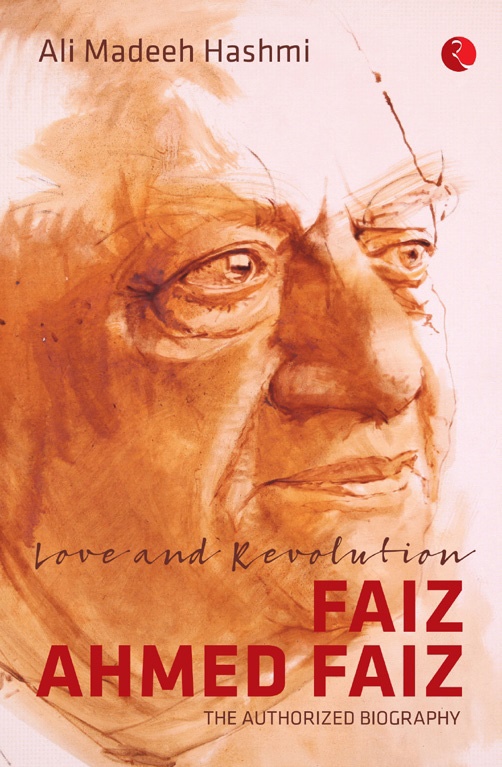
Book: Love and Revolution: Faiz Ahmed Faiz: The Authorized Biography by Ali Madeeh Hashmi, New Delhi, Rupa Publications India, Paperback, Published: 2016, 310 Pages, ISBN: 9788129145468. Rs 495.
“Transcending national boundaries, Faiz Ahmed Faiz was, in his lifetime, a poet of many lands and became, in his death, a poet of the world.”
For a young academic, writing a review of a book like this is not an easy exercise. The dryness that the crass professionalism of academia induces in its practitioners essentially blunts their literary sensibilities. Reading Hashmi’s closely witnessed and lucid account of South Asia’s one of tallest literary figures- Faiz Ahmed Faiz was a much-needed creative interruption, not only to change the reading palette of the reviewer but also to revisit the times that ran parallel to the fascinating life of an intriguing figure like Faiz.
The best thing about this book is that it does not read ‘heavy’ in comparison to the figure that it seeks to portray. Ali Madeeh Hashmi being the grandson of Faiz Ahmed Faiz has perhaps seen him too closely and therefore could successfully present him with all his human characteristics in all their shades, a quality that is usually absent in other character sketches written about Faiz. This is a story that slowly yet engagingly narrates the tale of how a young boy Faiz Ahmed Khan, an amateur poet who begins with poetry as a means to come to terms with his unrequited love, rose to become the FAIZ AHMED ‘FAIZ’-one of the most celebrated poets of the Indian subcontinent and an invaluable asset for the progressive and left movement across the globe.
The book begins with the funeral of Faiz Ahmed Faiz. Usually, biographies begin with the birth but this one begins with death. Such a beginning is not unintentional: it symbolizes how great poets like Faiz and that of his league do not have an end and even an end is a beginning of their afterlives- as eternal figures who break the notions of time and space to become immortal. Hashmi is a psychiatrist by profession and he rightly says in the beginning that his profession might creep into the descriptions, narrations, and analysis of Faiz’s life events, feelings, and actions at different points which becomes very evident in his attempts during his writing to find out why something has happened the way it has happened. The vivid descriptions of Faiz’s personality reveal many intricate details of his life which are not known otherwise- his love for cricket, his guilty pleasures in scotch whiskey and cigarettes, his serene attachment to his mother and a taste for afghan delicacies like Gosh-e-Feel. It is interesting that at several points in the biography, the author tries to present a larger socio-political scenario of the times about which he is writing, joining the dots with the specifics of Faiz’s life to whatever was happening around him. For instance, while discussing the times of his birth, the chapter begins with the history and the political economy of this city named Sialkot where Faiz was born.
The way Faiz’s life story has been narrated does not kill the ‘suspense’ at any moment, rather the author builds it incrementally to the levels where knowing what the reader craves for feels equivalent to the act of quenching one’s thirst searching for water for too long. People across the globe know that Faiz was a communist but when did he became one and why? Most people assume that one becomes a communist during one’s days at college or university; and for Faiz since he studied at an institution like Government College Lahore, one would automatically assume that it must be his life here that introduced him to leftist ideas which would encourage him to choose this ideology. However, as the author reveals, it was not Lahore but Amritsar that not only exposed him to communist ideas but also enabled him to participate directly with the grassroots labor movement of his times. Everyone’s life has a city that changes their fortunes, which city did change Faiz’s destiny? Though he would call Lahore his love and the city of lights, it was Amritsar that brought the hundred-and-eighty-degree shift to his life- “Faiz lived in Amritsar for about six years (1935-40). He often described this as one of the happiest times in his life. This was where he was first introduced to leftist ideas, where he became involved in the All-India Progressive Writers’ Association, and where he met and fell in love with his wife, Alys” (p.76).
While writing the biography of a poet especially one as great as Faiz Ahmed Faiz whose life revolved around Nazms, Sher, Ghazals, Marsiyas, etc. the biographer also needs to have a tight grip over poetry and various literary traditions not only of her own times but also of the person’s whose biography she attempts to write. In this case, it must be said that Hashmi even while being a psychiatrist by profession has a deep knowledge not only about poetry in general which becomes very evident in the sections wherein he discusses the making and aftermath of Faiz’s very first masterpiece ‘Naqsh-e-Fariyadi’ (which holds his most popular creations like ‘Bol ki Lab Aazad Hein Tere’ and ‘Mujhse Pehli si Mohabbat’), but also of the larger socio-political impulses of those times- from World Wars to anti-imperial mobilization, Hashmi describes it all with adequate accuracy, depth and in complete sync with Faiz’s personal life.
The beauty of this text also lies in the manner in which Faiz’s letters to his wife Alys (which he wrote from Jail after being charged with the Rawalpindi Conspiracy Case) have been creatively used. Some lines here and others there- Faiz’s emotionally penned down words from the toughest time of his life remain sprinkled throughout the text around which the author knits the narration of his grandfather’s other important life events. The text must be credited for its attempts at de-deifying Faiz and as a consequence humanizing him. It is also to the credit of the writer that while writing about his grand-father he puts forward certain familial details which if concealed would not have made much difference but since they have been revealed have definitely shed light on the slippery streaks in Faiz’s ideology. For instance, events surrounding the marriage of Faiz’s elder daughter Salima. While Faiz chose Alys as his partner for himself against several odds, when it came to his daughter’s marriages, he appears to behave slightly traditionally in his approach as is evident from his words mentioned in the book- “there is a certain way of doing everything in an established social system other than the boy and girl liking each other. The parents should agree as well. In society, waywardness causes disharmony. Some basic principles cannot be ignored for a young couple, what better than to have their elders’ blessing as well as live for each other. This is what marriage means in socialism.” (p.217)
However. one thing that bothered me as a reader while reading this text is the constant back and forth with the timelines and repetition of certain incidents of Faiz’s life which became very confusing at some points. Probably it is because the author wrote different chapters of the book at different times and hence the biography lacks the sync between different phases of Faiz’s life. At certain moments it feels as if one is constantly juggling with the several socio-political events around the world while also trying to situate Faiz’s personal and professional life in relation to them. But interestingly, one can only wonder at the writer’s awareness of the political history, progressive literature as well as Socialist and Marxist thought which defined the contours of Faiz’s political activism and literary career.
Based on the kind of life one lives, especially someone like Faiz who constantly remained under the public gaze, there are perceptions and rumours that tend to surround one’s personality. Sometimes these rumours crystallize into how that personality is received by the world while living and how it is remembered after death. The last two chapters, especially ‘Man and the Myth- I and II’ felt as if the author is trying to clear the dust that surrounded Faiz’s personality since he himself is not here to clear it up and even if he were alive would not bother to do this. But everyone needs a defence and one can find it here in the form of this book. It reaffirms what the world outside knows about Faiz but it also reveals what the world does not know. However, this defence might be a side-product of what the author actually intended to produce through this text- a humane, raw and real account of Faiz’s life. One can definitely read it without being burdened with excessive dry detailing and therefore it still feels like more than a biography, a beautifully crafted story- of a grandfather by his grandson.

Khushbu Sharma is a Research Scholar at the Centre for Political Studies (CPS), School of Social Sciences, Jawaharlal Nehru University, New Delhi.


 TheDaak review
Leave a reply to Narendra Bhardwaj Cancel reply