
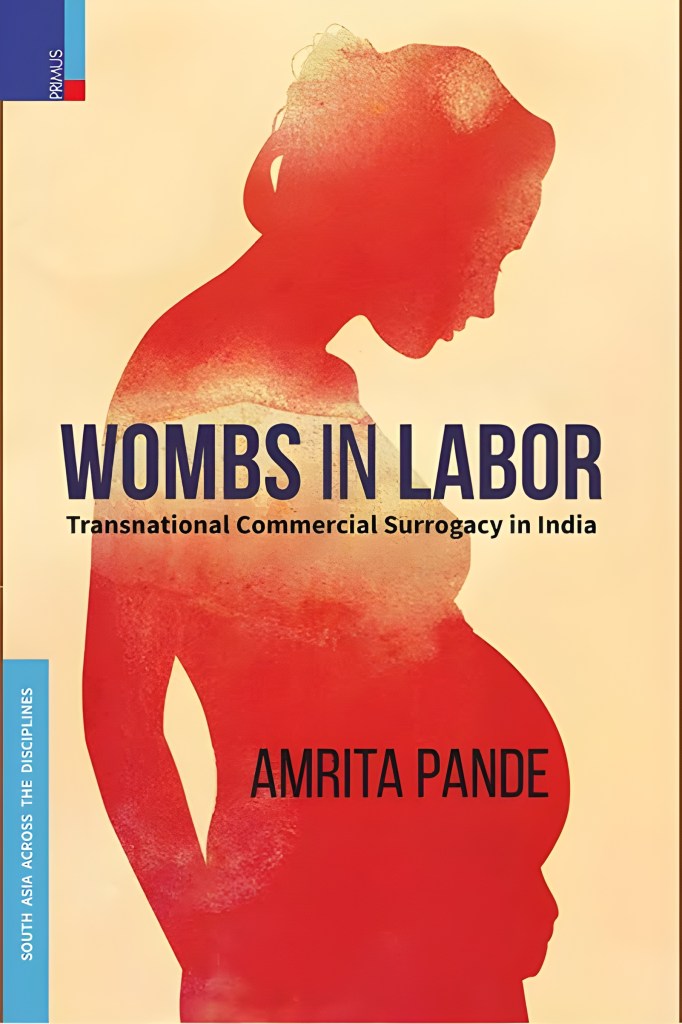
Wombs in Labor: Transnational Commercial Surrogacy in India. Amrita Pande. New York: Columbia University Press, 2014. xi + 252 pages. Paperback, $28.00.
Amrita Pande’s Wombs in Labour: Transnational Commercial Surrogacy in India is an ethnography of commercial surrogacy in India. It includes notes from the author’s diary from a journey to a surrogacy centre, which she alludes to under an assumed name to avoid any potential backlash. It is helpful since it shows us the legal landscape in India before and after commercial surrogacy was legalised in 2015. People who focus on the industry’s inherent irregularities in India contend that surrogacy should be rigorously prohibited or regulated. The author instead advocates for a better understanding of this complex labour market. She notes that a United Nations investigation from July 2012 indicated that roughly 3,000 reproductive institutions in India made $400 million per year alone from commercial surrogacy before the practice was made illegal.[1]
Pande stayed at a surrogacy hostel while conducting her field research, where she spoke with the surrogates, their families, the matrons, and the brokers. Some participants chose to be published under assumed names, while others chose to keep their true identities. Pande investigates the approach to maintaining control over their bodies and conceptual fate in her meetings and shows how surrogates are more than the victims of disciplinary power. A few women are forced to start businesses by their families, but other women bargain with patients and clinics to acquire access to technology and networks, regardless of how close they are.
The book’s introduction begins with the author identifying the inspiration behind her writing. The main part of the field notes describes the surroundings of the hostel’s substitute living quarters. Author notes the appalling living conditions of the surrogates. Bound to reside in the maternity clinic for tackling any medical emergencies, they are parked in a small room with hardly any leg space to move. For successfully carrying their pregnancies to term, the surrogates are prevented from residing with their families, romantically interacting with their partners, or working.
Pande notes that her pregnancy during her field work made for the basis of several interesting conversations. There is one in which a surrogate participant observes that the difference between herself and the author is that she will not get to be with her child while Pande would get to nurse the child she will give birth to. Behind this conversation, lies the deep emotional pain of not being able to love and nurture the child whom the surrogates nourish in their wombs for nine months. Postpartum depression is a reality for many mothers, but the impact on surrogates is entirely unknown and the psychosocial aspects of the same need to be considered given the nature of physical and social distance between the mother and the child.
The book discusses the behaviours of patients and doctors. It also engages with how brokers operate. Pande dispels the stigma associated with surrogacy and argues that the idea is not new in society[2]. Instances from 19th and 20th century US and methods of conception alluded to ancient Indian epics including Puranas are also discussed. She argues that the lack of awareness around technologies contributes to surrogacy being confused with sex labour.
The first chapter “Pro-Natal Technology in an Anti-Natal State” describes how a state that previously provided low rates of medical exposure to expectant mothers has unexpectedly embraced pro-natal technology as a result of the rising use of commercial surrogacy. The author discusses infant mortality, maternal health, and how labour management became a major topic in Indian colonial and national debates during the late 19th and early 20th centuries. Family planning and the monitoring of reproduction are covered in another subsection. This subsection discusses family planning practices such as contraception, tubal and vaginal reversals, and two-child norms. Although the government took drastic measures to control the population’s makeup, these ‘undesirable groups—such as the poor, the illiterate, and rural residents—were the ones who were least aware of the negative effects of an expanding population’ (p.73). The author also discusses the irony of population control and reproductive tourism, where on the one hand, the Indian government is attempting to control the population by enacting policies like family planning,, and on the other, science and technology are conducting research on IVF, test tube babies and commercial surrogacy.
In the chapter three, “When the Fish Talk about the Water”, the author draws from her fieldwork. There is a possible correlation between working women surrogates and the degree to which they have control over the surrogacy process in comparison to home-makers. She argues that this is particularly true of second-time surrogates who have more information on the procedure.
The chapter titled “Manufacturing the Perfect Mother-Worker” focuses on how ideal surrogates are built and are not in a ready-made form. An ideal surrogate is ‘inexpensive, submissive, charitable, and nurturing’ (p. 125) and should see themselves as both a worker-producer and a mother-reproducer in order to become the ideal mother-worker.
The chapter “Embodied Labour and Neo-Eugenics” emphasises the value of surrogates’ manual labour and renegotiations during the different stages of pregnancy, from the antenatal to the postpartum stage. Chapters on “Disposable Workers and Dirty Labor” and “Disposable Mothers and Kin Labor” are devoted to the language-stereotypes connected to surrogacy. A common misconception about surrogates is that they are ‘disposable and dirty workers’ and ‘disposable mothers.’ (p. 266) Contrary to this, surrogates portray themselves as virtuous, impoverished mothers.
The paradox of the commercial aspect of surrogacy and the role of God and divinity in surrogates’ lives is also highlighted. Intended parents refer to the surrogate as an ‘angelic gift giver,’ (p. 173) but in reality, they are the ‘needy gift receivers’.
On the one hand, these surrogates’ voluntary developments of surrogacy pledge their respect and capacity for self-awareness, but on the other, they perpetuate specific gender hierarchies. In Wombs in Labour, another noteworthy instance of surrogacy is examined. By creating kinship bonds with the baby and the intended moms, surrogates defy the conventional wisdom that surrogates are disposable mothers. In order to use their bodies for labour, the surrogates delay sterilisation and other reproductive decisions, defying orders from the government, their husbands, and their families. Concerns about women crossing the lines between non-market and market, reproduction and production, are reflected in the ambiguity and stigma surrounding labour markets like commercial surrogacy. These conflicts are so deeply ingrained in how these industries operate that it is challenging to distinguish work from concerns about ethical standards. The second half of the chapter discusses new agreements for prenatal and postpartum care, policy of opting for caesarean sections to reduce attachment to the infant, and birth control choices in order to become a surrogate. These renegotiations are carried out to ensure the surrogate’s continued emotional and physical wellness.
Pande while expressing her views on surrogacy regulation and bans, as well as the ongoing debate over the Assisted Reproductive Technology (ART) and surrogacy bill [(ART) clinics in India in 2005, and in the more recent draft ART Regulatory Bill in 2010][3] poses a question ‘Do the lives of surrogates, in fact, get transformed?’
She answers these questions by confronting the gendered divides by conceptualizing commercial surrogacy as ‘embodied labour,’ (p.195) analyzing the social and historical context in which these boundaries are dispersed. ‘Wombs in Labour’ complicates the victimization stereotype associated with identifying commercial surrogacy as labour, prone to exploitation like other forms of labour, and at the same time recognising the women as labourers. Although it could have included some interviews with the parents who would receive the infants via surrogacy to observe their perspective and experiences surrounding this process, the book is exhaustive with its substance and never once veered from its main issue. The book provides much-needed information on commercial surrogacy, particularly in a place like India where there is a prevalence of considerable misleading conversations around surrogacy myths.
[1] India seeks to regulate its booming “rent-a-womb” industry
[2] Zelizer, V. A. (1985). Pricing The Priceless Child. Princeton University Press.
[3] THE ASSISTED REPRODUCTIVE TECHNOLOGIES (REGULATION) BILL – 2010

Rana Abhyendra Singh is currently working as a Research Assistant in the Department of History at Banaras Hindu University. He has completed his post graduation in Sociology at South Asian University, New Delhi, in 2022. With a keen eye for research and a strong passion for understanding the complexities of society and its functioning, he is dedicated to expanding his knowledge and exploring the intricacies of the human experience. Connect to him @ राणा अभ्येन्द्र सिंह | Facebook


 TheDaak review
Leave a comment