
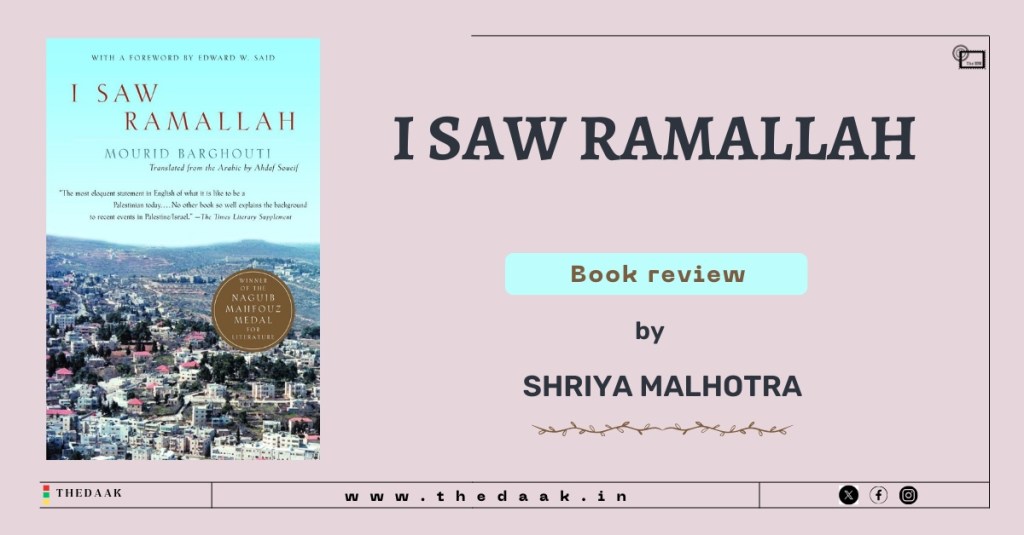
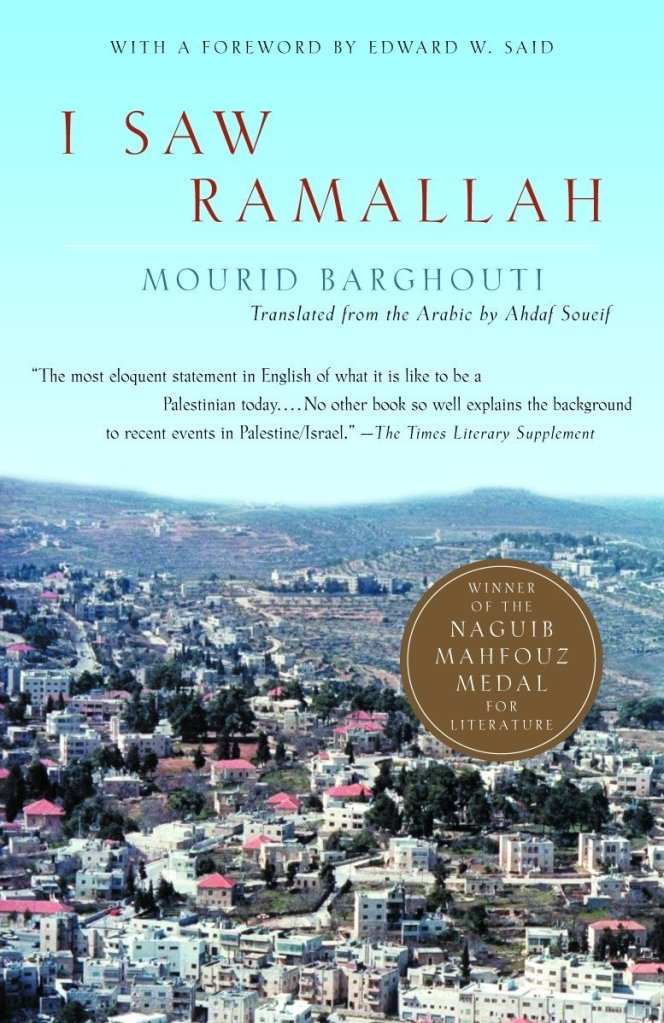
I Saw Ramallah by Mourid Barghouti, New York, Anchor Books, 2000, 184 pages, 8 x 5.5 inches, ISBN 978-1-4000-3266-2, Rs. 1,115.
I Saw Ramallah is a first person account of living in perpetual spatial and temporal displacement. The author – a Palestinian poet – reflects on the ways in which assorted forms of change and violence overtime have reconstructed the lives of generations living in the occupied territory. His beautiful observations and descriptions subtly reveal how one group’s vision of a utopia has manifested into a simultaneous, but opposite reality for others: an everyday lived dystopia, rooted in a tormented history. Imminently accessible, thoughtful and historical, it is a timely book for context given the escalating violence by the Israeli state against Palestinians — a violence which manifests in multiple ways, hurting even those it purports to protect.
In I Saw Ramallah, Mourid Barghouti reconstructs his visit to Palestine after 30 years in exile, following the 1967 Arab-Israeli war. Organized into chapters inspired by place and personal memory; his is a deeply existential and historical account of the land: a story of time and displacement that is bound by the tremendous personal loss of family and homeland due to an illegitimate occupation.
Barghoti’s gentle, elegant impressions and treatment of a homeland ridden with trauma and violence builds an honest portrait of a dystopia guised as national design and security. His story is told in solidarity with the everyday experience of Palestinians, whose daily lives remain scrutinized, surveilled and restricted by Israel:
“Occupation prevents you from managing your affairs in your own way. It interferes in every aspect of life and of death; it interferes with longing and anger and desire and walking in the street. It interferes with going anywhere and coming back, with going to the market, the emergency hospital, the beach, the bedroom, or a distant capital” (pp. 48).
Set in a situation of ever-diminishing freedoms following the occupation of Palestine in 1948, the book lays bare the inner turmoil related to displacement and dispossession from one’s homeland. While visiting the village of his childhood, it becomes apparent how memory can become idyllic, and that what exists now is a significantly changed and grim reality on multiple levels: state, family and individual.
Faced with bureaucratic procedures and other forms of hidden violence that restrict his visit to his homeland, he ponders how this will affect future generations of his family from accessing the land they once called home. As the book progresses, it becomes apparent that returning to his homeland is less joyful or familiar, and more fraught with immense loss, change and benign everyday harassment.
Barghouti’s observations of his homeland’s transformation carry the reader through a landscape of on-going conflict while focusing them on the realities of everyday life. Dystopia in this case is mediated by the reality of the occupation. The securitization of Israel, which has built a near constant surveillance system that restricts and spies on Palestinians while compromising their safety and privacy as part of constructing a Zionist utopia.
He astutely notes the divisive materiality of new architecture and urban planning for Jewish settlements which has changed a once familiar landscape. Both the visible and invisible borders of life as a Palestinian returning to an occupied homeland emerge through his anecdotes: how standard routines, freedoms and the connection of self and place have completely changed under occupation, weaponized as tools of harassment and control, including the uncertainty of waiting.
Alluding to the absurdity of these harassments is a hidden violence of trauma rooted in seemingly benign state formation. And yet in spite of the injustice his family personally feel, he acknowledges the complexity of the situation Palestinians and Israelis find themselves in:
“The long Occupation has created Israeli generations born in Israel and not knowing another ‘homeland’ created at the same time generations of Palestinians strange to Palestine; born in exile and knowing nothing of the homeland except stories and news…(It) has succeeded in changing us from children of Palestine to children of the idea of Palestine” (pp. 62-63).
He notices the divisiveness of new buildings and housing constructions, Israeli barriers and flags, signs in a new language he is unfamiliar with — and the connectivity enabled by other infrastructure. This includes networks like the telephone, holding his family together across their newly occupied and fractured land. It sits in sharp contrast to the visible neglect and stagnation of his village, which remains more or less unchanged. Perhaps most significant about his writing is that it very poetically leaves a lot to be looked into.
The unfathomable trauma and violence experienced in the region due to colonial mapmaking, the unspeakable injustices which are committed in the name of politics and state ideology, rooted in colonialism and politicization of beliefs, the collapse of a peace process and the recent unending nightmare aimed at Palestinian people are issues Barghouti manages to convey while focusing on the complexity of dispossession. This ability is rooted in an undervalued skill: paying attention to the changes of his land, and to the lived experience in the absence of freedom.
Barghouti‘s is a unique story for the details of its recollections, but it is part of a broader, fractured narrative: the collective story of violent loss, oppression, and dispossession that is Palestine. His book is a gem, akin to the works of poets like Mahmoud Darwish — among so many other Palestinians — who use the written word to resist forgetting their own history and identity. And use it to record the ongoing injustices that perpetuate their homeland.
As the world watches continued military aid for state-led ethnic cleansing, while the states with power and vested interests repeatedly veto against a ceasefire that could halt what has amounted to a live cast genocide by the Israeli state against Palestinians — including by starving people and destroying their health system — resistance as writing and through other forms of creative expression becomes a necessity.
References:
Mahmood Mamdani (2020), “Neither Settler, Nor Native” London: Harvard Press.
1 Post-1967 is described by Mamdani (2020) as a year after which jewish settlers and Palestinians came in close contact, and for the first time Israeli Palestinians began a struggle for equality—and broadly, towards political change (pp. 255).
2 It is important for readers to note that this was written, published and translated into English twenty years ago – a decade after the Oslo accords, which established a palestinian authority and sought to begin a peace process and the two-state solution. A homecoming or a return from exile at that time may have seemed a possibility. Since then, the possibility of a two-state solution has been abandoned. According to intellectuals like Mamdani, a post-Zionist political situation is necessary, driven not simply by the oppressed but also by oppressors who seek a different reality.
3 It is important to note that Zionism is not about religion; it is a political project, about power and about the creation of a Jewish state. Before the existence of Israel, Jewish people frequented the region and often even immigrated, drawn to the region and its historical significance. In the Zionist formulation of an oppressive political project, people are asked to raise questions justifying not just their religious beliefs and the extent of their conformism, but also those limited or not included in its protections. Mamdani eloquently explains this by saying: “Zionism is both a product of the oppression of jews under European modernity and a zealous enactment of European modernity under colonial conditions” (pp. 250).
4 The Israeli Kibbutzim is a modern utopian experiment in Zionism architecture. Utopia is understood to be a scheme for building a socially, economically and politically good society, in accordance with the supreme moral ‘good’. As a result, in Israel urban planning and urban development are part of the state’s toolkit which is used as a benign form of daily violence against Palestinians.

Shriya is a graduate of McGill University and The New School—currently exploring the intersections of art and policy. Her research interests include Art, Policy, Development, Climate Change, and Population Health.

 TheDaak review
Leave a comment