
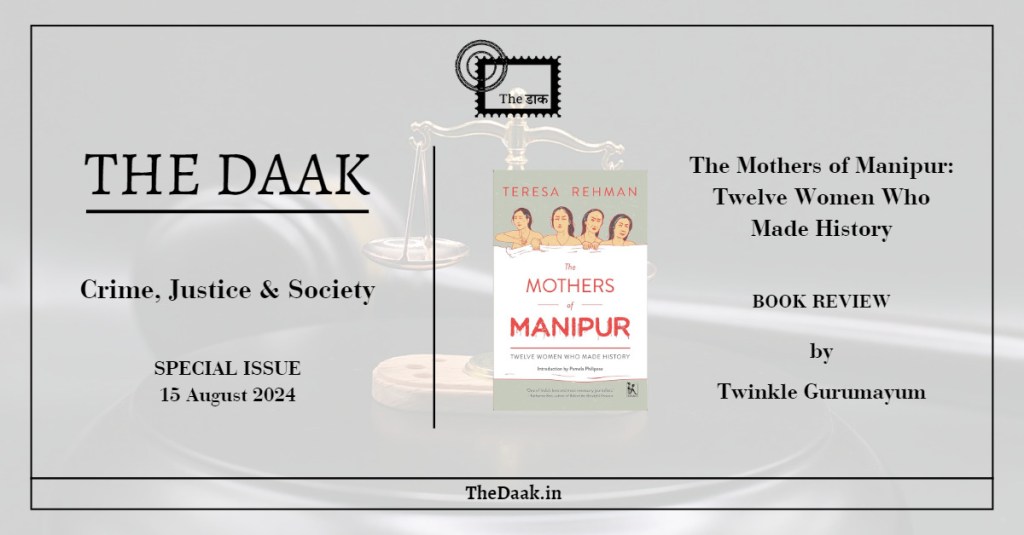
Book: The Mothers of Manipur: Twelve Women Who Made History, Teresa Rehman, Zubaan Publishers Pvt. Limited, 2017, 196 pages, ISBN – 9384757764, 9789384757762, Rs. 495
Since the 1980s in Manipur, numerous crimes and injustices have been carried out under the Armed Forces Special Powers Act (AFSPA)(1958). The AFSPA, a counter-insurgency act, grants authority to the armed forces in ‘disturbed areas’ to use force against anyone who violates the law or conducts arrests and searches without a warrant. Other than the alleged 1528 extra-judicial killings, one gruesome injustice was the case of rape and murder of Thangjam Manorama Devi. It was followed by the infamous nude protest by the twelve Ima (mother) before the holy Kangla Gate on 15th July 2004. It was a spectacle that sent shock waves worldwide.
AFSPA is a parliamentary act, that is, a state-sponsored privilege and simultaneously violates numerous international human rights laws, including the right to life, protection against arbitrary arrest and detention, and freedom from torture and cruel, inhumane, or degrading treatment. It also denies the victims the right to seek justice and compensation for the harm they have suffered. There were non-violent protests against the Act, in the form of bandhs, blockades and strikes, but they proved to be futile (Bhattacharyya 2016). The people of Manipur suffered many brutalities- unlawful arrests, killings, kidnappings, custodial torture, and sexual acts of violence, at the hands of the armed forces in the name of maintaining public order. Thangjam Manorama Devi’s murder was the breaking point for the people of Manipur. The heinous way Manorama was murdered drove the women to demonstrate through a naked protest. Manorama was one among the thousands who fell victim to the AFSPA. Manorama was accused of being a PLA (People’s Liberation Army of Manipur) activist and was picked by a group of 17th Assam Rifles cadres from her home at Bamon Kampu on 11th July 2004. The next day, her dead body was found, and she was shot 16 times in her vagina after being raped. The perpetrators evaded any responsibility or accountability on the pretext that she was a ‘suspected militant’.
Teresa Rehman’s book, The Mothers of Manipur: Twelve Women Who Made History, traces the stories of the twelve women who demonstrated against the paramilitary’s crime on that fateful day. Rehman is an award-winning journalist based in the Northeastern region of India. In her book, she narrates through interviews with the twelve women, how they came together to perform the naked protest and what happened to their lives in the aftermath of the protest. The book begins with a narration of the events that led up to the protest. The narration of Ima’s stories takes place through twelve chapters, each dedicated to one of them. Rehman highlights intricate details about all the accounts where she went to meet the twelve women, from the market to their homes, spending hours with them. As she visits each of them, she also brings out the opinions of the family members and dives into the narratives of their activism.
The pivot of the naked protest was motherhood. In protesting against state-sponsored crimes against civilian life and property, motherhood became one of the avenues to enter the political space. The protest sent a message that they were Manorama’s mother and, through the naked body of the mother, carried both the message of shame and forced the state to recognise the vulnerability of women in armed conflict. They challenged the full impunity that AFSPA granted to the armed forces despite their crimes. While capturing the emotions felt by the mothers in staging the protest, some of the Ima felt that disrobing was necessary to stage such a protest and felt no shame; others did so afterwards. However, none regretted staging the protest; they all viewed it as imperative for their concern for the future generation. Ima Ibemhal (Chapter 01) expressed how much enaphi (shawl-like, an upper garment) and phanek (sarong-like, a lower garment) mean to a Meitei woman. All these Ima and the Meitei women find modesty in adorning themselves with enaphi and phanek. The core notion of the protest was to shame the perpetrators back by taking authority over their bodies, bodies that reside in a place where they have no liberty.
Further, Rehman notes that violence had plagued the lives of the mothers, with a few of them growing up during World War II, like Ima Ramini (Chapter 02) and Ima Mema (Chapter 04). However, the violence caused by AFSPA is the most brutal in all its senses because their own country has allowed these brutalities. What do people do when the system put in place to protect them ends up attacking them? This Act has either directly affected their lives or has forced them to witness people who are victims of it. Ima Mema (Chapter 04) strongly opines that “The act is the cause of all our other problems, including social evils like drug and alcoholism, which is destroying our youths” (44).
The book achieves much in bringing to light the circumstances of a civil protest in the face of state brutalities. It should also be commended for bringing out the complex nature of the political movement itself. Rehman notes how the Meira Paibi (a women’s social movement against society’s injustices) were selective about their activism, highlighting their cause’s drawbacks. There are hardly any cases where Meira Paibi has protested against the underground groups for any gendered crime. This sense of solidarity only in specific situations undermines the claim that they are for all the women in Manipur (24). The book also highlights Ima Keithel (women’s market), which is the meeting place with Ima Ibemhal (1), and a place for mobilising. It can be arguably referred to as a public sphere exclusively for women. It is a space where women are exposed to all kinds of information, from political to the trivial. Whenever there is a protest in the state on any socio-political and cultural issues, women at Ima Keithel are known to be at the forefront of it. Ima Keithel is seen as a symbol of women’s empowerment. However, a considerable number of women who run the market are subjected to domestic violence at home. As observed by the local newspaper editor, Rajesh Hijam, “… If they are late, they are beaten up by their husband and often accused of having an affair. They also have to be home in time to cook dinner for the family. Often, their husbands snatch away their day’s earnings!” (3). This implies the deeply patriarchal structure of Manipur. It is interesting to observe how an image of women empowerment is being painted in the name of Ima Keithel, Nupi Lan (women-led war) and Meira Paibi, but the subjugation and oppression done in the confinement of the four walls of the home is hardly addressed.
Although the book is undoubtedly a biographical narrative and biographies are bound by the narrator’s perception, the narrator must be sensitive to the context of the culture that they write of. For instance, she writes, “…my mind goes back to Mahabharata, and the angry Draupadi..” (142), randomly linking the struggle of Irom Sharmila with Hindu mythologies. The Vaishnavite faith certainly influences Meitei society, but significant elements of it remain within the cosmology of the indigenous religion, which the author completely ignores. This was shown in how Rehman constantly describes the Vaishnavite practices and rituals performed by the mothers, but no mention of everyday practices relating to the indigenous faith was found. Total exclusion of the Indigenous faith’s practices does not capture the reality of a Meitei household – the ones to which the ema belongs.
In conclusion, Rehman has done an impeccable job of narrating the biographical accounts of the twelve mothers. This book is the first one of its kind where the focus is solely on the personal lives of the twelve mothers. Literature which exists around the protest has not taken into account in viewing them personally; they have clubbed these women as one whole. Rehman gets into the personal narratives and backgrounds of the twelve mothers and brings up what drove them to demonstrate such protest. The spirit of resilience and defiance shown on 15th July 2004 is reflected in the book. Her book has done a remarkable job of making the broader audience aware of the brutalities committed in Manipur by the draconian AFSPA.
References
Bhattacharyya, Rituparna. “Living with Armed Forces Special Powers Act (AFSPA) as Everyday Life.” GeoJournal 83, no. 1 (2018): 31–48. http://www.jstor.org/stable/45117478.

Twinkle Gurumayum is a PhD Scholar at the Special Centre for the Study of North East India, Jawaharlal Nehru University.


 TheDaak review
Leave a reply to Phillip Cancel reply