
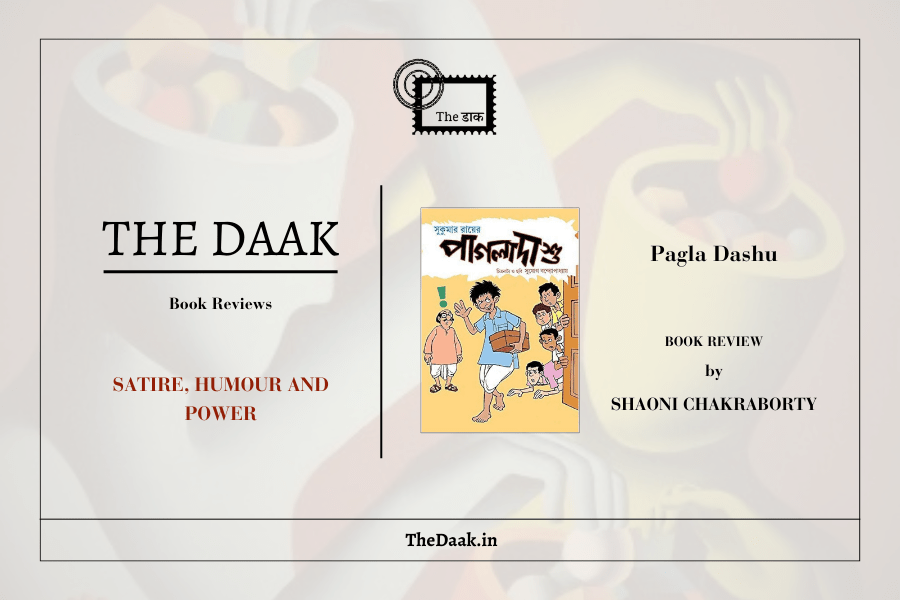
Pagla Dashu by Sukumar Ray, Ananda Publishers, Published: 1940, 63 Pages, 21.5 x 14 x 1.2 cm, ISBN-10: 9350402858, ₨. 225
Often underrepresented as a creator and propagator of children’s literature, especially because of works such as Abol Tabol and Ha Ja Ba Ra La, Sukumar Ray is, in fact, a masterclass satirist and a clandestine humourist par excellence. Pagla Dashu is a compilation of twenty short stories revolving around a school, its students, teachers, and staff, with the protagonist Dashu or Dashrathi who has been christened Pagla due to his regular monkey-business antics. These stories go beyond slapstick, employing satire as a subtle tool of correction. The first-person narrator often reiterates the quality of poetic justice being delivered to haughty and overt characters through situational irony with the characters falling into their own traps. Time and again, the protagonist Dashu has a role to play in these servings, but he escapes unpunished because most people, including authorities, dismiss him as a crackhead. Pagla Dashu is not a single character but an allegory for everyone who stood for the right and was called “mad.” Dashu is a spokesperson of Ray’s worldview of using ‘nonsense’ to instill sense in his community, commenting on the ever-increasing ‘babu culture’ of Bengali elites.
Edify with Eccentricity: The Plot and the Thought
While Shakespeare famously asked, ‘what’s in a name?,’ in Dashu’s case, the nomenclature is crucial to his characterisation. Sukumar Ray created the modern-day ‘brain rot’ caricature in the early twentieth century with his arrogant and airy characters that were caricatures of real people. Any kind of revolt against their stature seemed as crazy as the idea of armed rebellion against capitalism, meritocracy, authoritarianism, and worst of all, kakistocracy. Set in a culturally specific Bengali school premise, Pagla Dashu stories introduce characters as a part of an elementary class group of mates.
The characters can be further classified into the following strata: the narrator, nameless and without any contribution in the conversations and actions taken apart from actually penning the stories; the teachers (mastermoshais) who have a penchant for ignoring or even punishing disagreement and challenges; the student group who are a bunch of unruly, often notorious batch of schoolboys; the staff, primarily the gatekeeper, who is a Hindi-speaker and speaks Bangla with an accent, and minor characters such as the magician who bring twists but do not feature extensively or repeatedly in the stories. Every story introduces one prime victim and begins by describing their habits and characteristics in detail, giving a substantive idea about their haughtiness and the reasons behind their attitudes.
Then the plot proceeds to slowly dismantle their image from a praise-worthy individual to a laughing stock. This crazy, absolute bizarreness of publicly taking down the image of such know-it-alls with an undiagnosed yet brutal superiority complex is what gives the name Pagla Dashu so much more sense and poignance. Dashu’s claims lie not only in his capacity to outwit the haughtiest of his crowd, but also in his quiet rebellion against popular movements and power hierarchies, and taking a stand for himself and his fellows. When Dashu stands against every student in the school just to play a part himself or when he mocks rampant and overt curiosity, Dashu swims upstream and against the flow. In this sense, Dashu joins a long line of figures, both real and fictional, who have challenged convention and have been labelled “mad” for doing so. Sukumar Ray’s genius is not only in captivating the young audience with farce and comic timing, but also in engaging mature minds to think differently, critique prevalent normalcy, and fight against any wrong, even if the wrong is more powerful.
Every interrelated story in the Dashu series begins with the introduction of a character who is sitting upon their high horse for some miscellaneous reason or another. Duliram, for instance, is proud of his father’s job at a newspaper company, or Shyamchand for owning a chain-linked watch. Even something as trivial as Ramapada bringing Mihidana (a type of sweetmeat) to school and not sharing it without bitter spite. The narrator introduces Dashu with an interesting undertone of subtle respect for his eccentricity, as evident when he admits that though he is mostly deemed ridiculous, they are often in awe of his mischievous intellect at unexpected times. Pagla Dashu is an almost Robin Hood-esque character because his fights are not of individual revenge but of collective distaste of the entire class of students for a given character, such as Sobjanta (‘Know-it-all’) and Chaliyaat (‘Raffish’). In doing so, Dashu emerges as a quiet leader who is not just determined to protect himself but also to keep in mind the mass opinion of his peers, thereby making Dashu a silent hero.
A Scathing Sarcasm: Using Absurdist Nonsense as Criticism
Literature has always been a tool for criticism, be it through Pope’s Rape of the Lock or Swift’s Gulliver’s Travels to the modern-day meme culture. In India too, R.K. Laxman’s The Common Man comic strips have such a satirical, subversive, and corrective effect. Dashu’s paglami, or antics, are in fact, not simple humorous acts but a textbook instance of ludicrousness that somehow also manages to kindle a spark of thought within the readers. Bholanath, when put into perspective, might turn out to be the neighbourhood political aspirant who has an obsessive compulsion to showcase his meaningless knowledge and opinions, often at the cost of embarrassment or even self-sabotage. Shyamlal is the self-proclaimed best-selling poet of the world— more detested than admired for his literature with the exception of a handful of solid devotees— who ultimately gets trapped in his own make-believe greatness. The Spectator Papers by Addison and Steele follow a similar pattern of a mute observer as the narrator with every character he meets becoming a symbol for a section of society. The reason is that Pagla Dashu is the voice of burning, biting sarcasm against every structure of authority, including the systems of education, obedience, and socio-economic and political hierarchies. Although the setting of a school and its colourful shades of students might offer a source of pure entertainment, every character is symbolic.
The central thread running through the stories is, indubitably and unarguably, the dissection of power-structure hierarchies. The characters Dashu takes a stand against are not commonplace everyday men but influence society due to their economic and/or political affiliations through their families. All the characters introduced in the stories have powerful fathers who work with the British or as editors for some newspaper, some even claim to know wealthy Zamindars. Dashu’s rebellion against these nepotistic stars is a strong commentary on the strength of the common man. It also emphasises how it is alright to be crazy for the sake of getting justice. Therefore, a staunch disagreement and more noticeably, a public humiliation is Dashu’s means of crushing the authoritarian societal structure of traditional India where knowledge and wealth are concentrated in a few hands. For instance, Dashu’s blatant retort to the teacher in opposing Ramapada’s selective distribution of sweets is blunt yet true. If Ramapada can do whatever he wants with his sweets, Dashu can also do whatever he wants with his firecrackers, and when put through the lens of the rule of law and absolute freedom, it is a gem of a sarcastic rebuke. In contrast, other students are mere blind followers of the teachers, meek and scared by authority, who are satiated with a little validation from their larger-than-life hero figures.
The Archetype of an Antihero: Dashu’s Closing Statement
Consider the trope of Mulla Naseruddin or Gopal Bhad, Pagla Dashu belongs to a long lineage of tricksters who can confuse and discombobulate the most twisted of riddlers. In that crossroad of power and subversion of power lies the archetype of the anti-hero Pagla Dashu— not necessarily always virtuous, often morally ambiguous, yet impossible to ignore. As someone who is always eager to crush authority, stark and steadfast against the rampant idea of normalcy and blending in, and armed with the superpower of pranking every mortal in his presence including himself, Pagla Dashu is nothing short of an inspiration to the modern romantic of rebellion.
With the infiltration of Western standardisation and aping of everything that trends for seconds just to be accepted in society, Pagla Dashu’s adamant mischievousness and apparent insanity is the quiet torch-bearing force to revolutionising and democratising human civilisation. Dashu and his craziness form the combined epitome of comic, satirical, and playful genius with non-violent, subtle resistance that is unsettling at the least and eye-opening at the most.
Shaoni Chakraborty has completed her Bachelor’s and Master’s degree in English literature from Banaras Hindu University, Varanasi.
 TheDaak review
Leave a comment