
I
HUMOUR IN INDIAN LANGUAGES
Ridiculing the Sacred: C.N. Annadurai’s Needhi Devan Mayakkam as Social Satire

Book: Needhi Devan Mayakkam by C.N. Annadurai, Edhir Veliyeedu, 2023, (Reprint), 96 pages, 18 x 12 x 0.5 cm ISBN: 978-8196404697, Price: 120 INR.
by Kathiravan Annamalai
Realism reformed Tamil theatre by bringing the commoner to the stage. Unlike traditional Tamil theatre which was dominated by religious stories with extraordinary characters and celestial themes, modern realism brought theatre down to the streets through its engagement with ordinary people. The praises and eulogies dedicated to gods and goddesses were soon supplanted by the problems and plight of the ordinary people, leading to socially conscious plays. The Indian independence movement influenced the first phase of such social plays with the motto of disseminating nationalist consciousness. The second phase, the post-independence period, was shaped by the rise of the Dravidian Movement and its egalitarian politics. What makes the Dravidian Movement particularly unique is its union of art and activism. Against the social evils of caste discrimination, gender inequality, and linguistic and cultural erasure, they waged a battle not only in politics but also in culture and language. Using art as propaganda became one of the cornerstones of the movement, and the writers actively engaged in theatre and literature to construct a new Tamil-Dravidian identity instead of the one imposed upon them by the Aryan authority.
Influenced by Western dramatists such as Henrik Ibsen, George Bernard Shaw, and John Galsworthy, Dravidian playwrights revolutionised Tamil theatre by employing it as a propaganda tool. Among them, C.N. Annadurai stands tall as a pioneering playwright of social theatre and a master of satirical subversion. In his essay “Dravidian Literature: Radical Features and Worldview” (2021), Raj Gauthaman identifies Dravidian literature as rebel literature and specifically credits Annadurai for his attempts to mock the venerated and his emphasis on the ordinary. This approach of trivialising the sacred aligns perfectly with Mikhail Bakhtin’s observation in Rabelais and His World (1984) that “laughter is the antithesis of reverence,” an idea that pervades Annadurai’s plays. All his literary works challenged traditional reverence through satirical subversion. He understood that deconstructing the sacred at the linguistic level could extend to dismantling it at the cultural level.
Speaking at the first drama conference in Erode organised by the TKS Brothers Company in 1944, Annadurai stressed the importance of moving away from puranic stories to social plays. He advised the playwrights to depict life in a realistic manner, and utilise theatre as both an instrument of teaching and a channel of entertainment. Most of his theatrical pieces are satires that combine humour, songs, action, dramatic plot twists, and political propaganda that were served to the Tamil public as what George Bernard Shaw would call the “sugar-coated pill.” By making audiences laugh at what they had been taught to respect and revere, his plays achieved something far more radical than political propaganda—he destroyed the psychological foundations of authoritative culture.
The strategy of ridicule worked well for Annadurai because of the liberating nature of laughter. When ordinary people laugh at the pretensions of their ‘superiors,’ they symbolically rebel against authority. He recognised that once people lose their reverence for traditional authority figures, they become psychologically ready to question the system that elevated them.
Needhi Devan Mayakkam (The Lord of Justice Fainted, 1947), a courtroom drama that appeared in Tamil, stands as a perfect example of Annadurai’s subversive satirical approach. The play presents an unprecedented scenario: Ravana defends his actions before a divine court in a modern set-up and challenges his portrayal as the archetypal villain by the poet Kambar, who rendered the Ramayana in Tamil. He subverts epic tradition through his eloquent self-defense and witty counter-accusations against the ‘virtuous’ characters of the Ramayana and other puranas. By granting Ravana the right to defend himself, Annadurai immediately challenges the traditional narrative that presents him as irredeemably evil. This simple dramatic device presents spectators with alternative perspectives on familiar narratives, undermining the moral authority of classical texts.
The play’s most hilarious moments occur when Ravana rhetorically exposes the moral failings of traditionally venerated characters. He points out Rama’s abandonment of Sita based on public gossip, questioning how such behaviour makes him worthy of worship. There is also a section when Sita appears and warns the audience not to take Rama as a kind-hearted person. Annadurai also highlights the deceptions and violence committed by supposedly virtuous characters of the puranas such as Kotpuli Nayanar and Dronacharya, revealing their actions to be often worse than Ravana’s own. Talking about the subversion in Dravidian rebel literature, Raj Gauthaman writes, “…puranic characters beaten by brahminical supremacy such as Ravana, Iraniyan, Kumbakarna, Karnan, Duriyodana…[were] endowed with contrasting, noble qualities” (Gauthaman, 112). This subversion creates cognitive dissonance for audiences who are accustomed to accepting these characters as divine exemplars. Annadurai’s vision in providing the arguments in a satirical way helped his propaganda to reach the unlettered masses.
The comedy in Needhi Devan Mayakkam serves a crucial desanctifying function. Humour reaches its peak when the God of Justice faints not once but twice while hearing Ravana’s case. This also sheds light on how divine authority cannot withstand rational scrutiny. In other words, even the gods are not ready to face the contradictions in their own moral system. The image of a fainting deity inevitably strips away the sacredness of divine infallibility by reducing the divine to the ordinary. Kambar’s visible distress is equally comedic when called upon to defend his narrative choices. His nervous shaking while attempting to answer Ravana’s charges creates physical comedy that challenges his credibility as a literary authority. The great poet, traditionally revered as a cultural treasure in Tamil Nadu, appears petty and defensive when confronted with alternative interpretations of his work. Writing about the laughter that such works provoked, Raj Gauthaman points out, “the laughter provoked by this ridicule reveals a truth. More than that, experiencing this laughter and living through it is important. The aim of such lampooning is to break the unseen chains that bind the Dravidian people” (Gauthaman, 112). Annadurai achieves the same liberation through this play by making people laugh at what chained them.
The play’s satirical strategy achieves more than direct political argument by making the audience active participants in the cultural war. It should be noted that Annadurai wrote this play during the anti-Hindi agitations in Tamil Nadu when the North vs South talk was on everyone’s tongue. Through this satirical play, he made Tamilians aware of what to laugh at and what to assert. When people collectively laugh at the fainting God of Justice or the trembling Kambar, they participate in the destruction of Aryan symbols of cultural hierarchies. By empathizing with Ravana, the audience understands what it feels being misrepresented and demonised. This shared experience of irreverent laughter and rational thinking creates temporary moments of dissent. Once revered figures become objects of laughter, they lose their power to be ‘sacred’. Needhi Devan Mayakkam and similar works by writers associated with the Dravidian movement did exactly the same by desanctifying the sacred by laughing at it. This strategy helped in the creation of a cultural climate where theatrical laughter became a tool for social change and the democratisation of culture.
Through the amalgamation of satire and humour in his plays, Annadurai transformed Tamil theatre into a space where the impossible became possible—where the audience mocked the venerated and imagined alternative social arrangements. In other words, this theatrical revolution prepared the ground for broader cultural and political changes that continue to shape and influence Tamil society.
Works Cited
Annadurai, C. N. (2023). Needhi Devan Mayakkam. Edhir Veliyeedu. .
Bakhtin, M. (1984). Rabelais and His World. (Iswolsky, H. Trans.). Indiana University Press.
Gauthaman, R. (2021). Dravidian Literature: Radical Features and Worldview. In Dark Interiors: Essays on Caste and Dalit Culture ( Baskaran, T. Trans.). Sage Publications.
Kathiravan Annamalai is a Research Scholar at the Department of English, Pondicherry University.
Poonachi: Or the Story of a Black Goat

Book: Poonachi: Or the Story of a Black Goat by Perumal Murugan, translated by N. Kalyan Raman, Context, 2018, 184 pages, 14 x 2 x 21 cm, ISBN-10: 939507325X, Rs. 350.
by Kirti Advani
Poonachi is a story of a black goat who stands quaintly against the bright red cover and invites much intrigue even in just a cursory glance. The story follows the life of this goat, gifted by a stranger to an old couple, and how she navigates a harsh world – drought, survival, love, loss, and constant surveillance by her caretakers and the state. Through Poonachi’s life, Perumal Murugan subtly exposes the pain of the powerless and marginalised and the quiet violence of systems that shape and often break lives. Yet the novel is also filled with moments of affection, gentle humour, and resilience.
Poonachi is cloaked in the simplicity of a fable, an animal’s perspective on the state of the world and its seemingly innocent tone allows it to share biting critiques of bureaucracy, patriarchy, and authoritarianism. Murugan wittingly writes in the preface that he cannot write about humans, he absolutely cannot write about gods and so he writes about animals. He cannot write about cows and pigs without inviting scrutiny, so he writes about a goat.
Murugan writes a smart critique of the surveillance state by building a world where even the most basic and natural acts of life such as birth and speech are subject to regulation and scrutiny. In the very first few pages, the reader understands the extent of state control. The regime demands that all children and even animals be registered, tagged, and accounted for within a month of birth. This is framed as necessary for the social order. For there would be grave consequences if animals were to behave like animals. To graze on grass and to run around would seem like a natural state of existence for animals, however, the regime finds even this freedom intolerable. The absurdity of the logic is laid bare even as the narrative describes commoners lining up in harsh weather to fulfill this task of national importance. However, the citizens must not complain, fall sick, or cause disruption. Even discomfort must be borne in silence, as the regime has ears on all sides. The state is not a mere observer, neither is it a being that steps in to make the lives of its people easier. It is a living creature that produces precarity and enforces punishment for those who don’t observe its rules in silence.
This quiet compliance is explained with a sharp undercurrent of irony. The old man and woman who raise Poonachi are careful and constantly wary of the consequences of stepping out of line. The registration of the goat becomes symbolic of the larger structure of surveillance where nothing escapes the gaze of the state. People are trained to obey, endure and not draw attention. Through such episodes, Murugan illustrates how authoritarianism seeps into the very rhythms of daily life through routine, bureaucracy, and fear.
Poonachi’s identity as a female goat becomes central to her subordination. Her only taste of freedom, for the first and the last time, was when she accidentally ventures into the forest. But like a dutiful daughter she runs back to her parents, or at least to a doting mother. Though she is naturally spirited and fond of running, her freedom is curtailed once she develops an attachment to Poovan, a male goat. Following this moment, she is literally and symbolically tethered: a rope is placed around her neck, and she is no longer allowed to roam freely. Poonachi is soon subjected to forced mating with goats she dislikes. When she miraculously gives birth to seven kids, the villagers’ interest in her intensifies. The reverence of the womb is made explicit through the villagers’ obsession with acquiring the “miraculous” kids born to Poonachi. In this way, Murugan mirrors the subjugation of women in society where reproductive ability often determines worth.
Poonachi’s kids are taken from her without remorse and the income from their sale allows the old couple to live in comfort with luxuries they had never experienced before. Her milk sustains them and so her suffering is normalised. She is repeatedly referred to as a “miracle,” yet this designation masks the exploitation she endures. The parallels with the condition of women in many familial structures are clear: their sacrifices are often the foundation of others’ well-being, yet rarely are they acknowledged as autonomous beings deserving of care themselves.
As long as Poonachi is productive, she is treated with affection. But once she begins to falter, she is no longer considered as miraculous. In the end, the last drops of her milk are extracted before she succumbs to exhaustion and neglect. Ultimately, Murugan’s Poonachi turns to stone, perhaps to be turned into a deity for all those around her. After a life of suffering, what can one offer her except for worship? A reader can’t help but draw a parallel to her own world, where worship becomes a safe and convenient substitute for respect, to mourn without changing the system that created the need for the mourning, and to make the victim’s life a legacy.
Murugan’s account of Poonachi is also one of quiet resilience and defiant joys that persist despite oppression. Even within the confines of a world that seeks to tame her, Poonachi carves out moments of freedom. Early in the novel, she runs away and finds comfort in the forest. Later, she falls in love with Poovan and when she meets him again, she chooses to mate with him in secrecy. Every chance, however seldom they occur, she takes to live her life on her own terms.
Poonachi is a short book of a hundred and eighty pages only. It is a one-sitting read, as one starts to read Poonachi, one becomes so engrossed in the story that it becomes difficult to keep the book aside. Through the deceptively simple story of a little goat, Murugan immerses the reader in a world charged with human emotion and quiet devastation. Perumal Murugan, through Poonachi: The Story of a Black Goat, creates a world where a little goat is taken through a range of human emotions. Through his storytelling, Murugan forces us to think about internalised notions of enslavement, hegemony and oppression. Poonachi’s journey is a quiet and powerful commentary on the surveillance state and the structural violence meted out to the marginalised. Her transformation into stone at the end and the possibility of her deification is chilling. It suggests that society often chooses to worship the victim rather than confront the system that destroyed her. In doing so, Murugan invites readers to question not only the reach of the state, but also the stories we tell to make peace with injustice.
Kirti Advani is a student of Political Science and Literature.
Urdu Ki Aakhiri Kitab (The Last Book of Urdu)
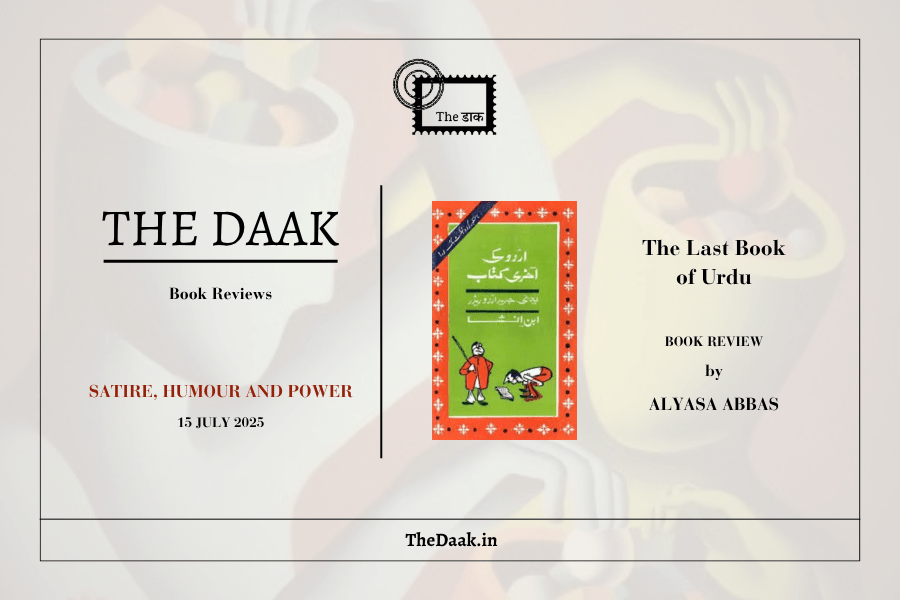
Book: Urdu Ki Aakhiri Kitab (The Last Book of Urdu) by Ibn-e-Insha, Daryaganj, New Delhi: Rajkamal Paperbacks, 2025 (12th Edition), 155 pages, ISBN: 978-81-267-0045-5, INR 250
by Alyasa Abbas
In Insha ji’s tongue-in-cheek humour, his anguish found wings. Ibn-e-Insha, who often addressed himself as Insha ji in his poems, penned down a book which feels fresh, hilarious, and relevant to this day, despite being first published in 1971.
This satire is based in Pakistan but applies to India in an intimate manner. In his disgust with the societal injustices throughout history, Insha Ji saw India and Pakistan as one civilisation and spoke to the common ills that must be confronted.
The Last Book of Urdu is a short book of many sub-themes bound, perhaps, by the theme of an omnipresent decay. In the author’s view, the decay is not time-based, where nostalgia for the glorious past guides the satirical criticism of the degraded present. Decay has always existed. It has manifested itself in all periods of history and areas of life – in political integrity, economic justice, and societal inequalities. But decay alone does not seem to be the cause of Ibn-e-Insha’s discontentment. That this decay can be stopped – even reversed – but continues to rot our lives, was the core of Insha Ji’s anguish. This was the fire which birthed his humour, humour which masked his anger.
Ironically named The Last Book of Urdu, this satire was written as a beginner-level school textbook with lessons in history, geography, grammar, maths, and science. Insha ji picked apart the absurdities of partition, the contradictions of the historical ruling dynasties, the rotting state of education in Pakistan, censorship, and societal antagonisms, amongst other things.
The author reasoned that each good starter textbook must begin with a prayer for self and the nation. He began writing a prayer about the nation of Pakistan. Then he asked…
“But who lives in Pakistan?
Like the Persians live in Iran, and the English in England, and the French in France, the Pakistanis must live in Pakistan?
No, Sindhis live in Pakistan. Punjabis do too. Bengalis as well. These people and those people as well.
But all these people and those people live in India as well. Then why did we create a separate nation?
We made a mistake. Sorry. Next time, we won’t create it” (p.17)
The author saw no logic in the partition of India and Pakistan on religious lines, when the people were bound more closely by shared history and culture than they were separated by religion. He brought this point back in the chapter on Geography where he tried to locate India and Pakistan on the map, physically and existentially.
Most chapters of the book have end-of-chapter review questions for the students which are hilariously absurd. For instance, after the chapter on the Mughal Emperor Shahjahan, one of the questions asked is – If Shahjahan hadn’t built the Red Fort, where do you think Bahadur Shah Zafar would have held his mushairas? (p 80). Insha ji had no twinkles in his eyes for the grandness of dynasties throughout history. Grand structures seemed absurd to him, even more so their utilisation for the personal fancies of the rulers.
The author essentially took all the tropes of a beginner-level school textbook and utilised them as satirical devices – simple explanation of phenomena, high-level overview of complex events and things, simple moral tales and so on. For instance, he took the principles of addition, subtraction, multiplication and division (jod, tafriq, zarb and taqsim in Urdu) and cleverly employed these words in their multiple meanings within and outside the mathematical context to highlight wealth hoarding, ethnic animosities, hypocrisy of charities, and corruption. For example, he wrote the following as the definition of Division (taqsim),
This is a very important principle of math. Taqsim means to distribute……It is very easy to distribute using this principle. Keep the rights with yourself, distribute responsibility to others. Keep the money intact with you, and distribute assurances and promises to others. (p.100)
Ibn-e-Insha’s humour stood out from the other giants of tanz-o-mizaah (satire and humour) at the time, such as Patras Bukhari, Mushtaq Ahmed Yusufi and Kanhaiya Lal Kapoor. His humour was intimately suffused with his politics. Insha ji was a part of the Progressive Writers’ Movement and used humour as a channel for the expression of societal ills and the propagation of progressive ideology. In comparison, Patras Bukhari, the legendary Urdu humourist, wrote essays with immaculate characterisations and brought out the humour through comedies of errors. After reading an essay by Patras Bukhari, a reader is likely to carry these characterisations in their mind with all their eccentricities.
On the other hand, reading Ibn-e-Insha is a different experience. His humour was often situated in the institutions of social significance such as police stations, newspaper houses, educational departments and so on. Insha ji was willing to sacrifice immaculate characterisation (relying on caricaturing instead) to highlight the fault lines in the institutions of society. In The Last Book of Urdu, Insha ji used a comical exaggeration of several historical figures such as the early Greeks, the various rulers of India and the British colonial regime. This exaggeration was apt because these people and entities influenced huge domains of the world and took their existence rather seriously. Insha ji’s exaggeration immediately made their beings un-serious and highlighted their contradictions and petty actions. Kanhaiya Lal Kapoor, who was a student of Patras Bukhari and another legend of Urdu humour, created similar caricatures to bring out the hypocrisies of middle-class life and the anxieties of partition, amongst other things. However, a notable difference between Kapoor and Ibn-e-Insha was that Insha was also a poet and often deployed poetic sub-sections in his prose. This can be vividly seen in The Last Book of Urdu, where a substantial chunk was written as free-verse poems.
Ibn-e-Insha was an eccentric user of language. As a poet, he was often seen as a spiritual successor to the doyen Amir Khusro due to his seamless amalgamation of dialects and playful style even in themes of separation and sorrow. His wasn’t the elitist Urdu poetry which prides itself on its incomprehension by the people.
In a separate section titled ‘Twice Upon a Time…’, classic children’s tales are re-told: The Hare and the Tortoise, The Thirsty Crow, Unity is Strength and so on. But, being a master of infusing humour into the matter while keeping the structure constant, Ibn-e-Insha retold these stories in a matter-of-fact manner without the romanticisation of moral choices made by the characters in these stories. This section reads more humorous than the rest of the book, in that it serves as a comic relief contrary to the ‘textbook’ format of the book.
The real marquee of the book is the textbook format. It allowed the author to capture multiple sub-themes in a single book without things seeming disjointed. In the chapter on history, he critiqued the hypocrisy of the kings and then moved on to the lesson on science, where he explored the human condition through the definitions of physical phenomena. He could swiftly switch to geography and speak about the nature of modern nation states, and then to literature to tell stories. And all of this has been woven in a completely coherent manner to take the shape of an introductory textbook.
In introductory textbooks, the educators endeavour to provide a lot of information in simple language which can be easily comprehended by children. Ibn-e-Insha saw this as an excellent opportunity. Writing these things as chapters of introductory textbooks prevented him from over-explaining things or using complex linguistics. Additionally, it is a work of remarkable creativity. One does not often see satirical works written as textbooks. Clearly, Insha ji saw children as the drivers of tomorrow’s change, and through his humour, he attempted to instil in them a conscience against evils which plague society.
One often thinks about humour and satire as having expiry dates shorter than other forms of writing. A satire is definitively rooted in the present context of the author and is inescapably political in nature. Humour, similarly, faces this constraint. Things which were considered funny a decade ago are not deemed funny today. Still, The Last Book of Urdu remains fun and reflective. Political satires often die with the death of their subject matters, but satires on longue durée human condition are important at every age. Ibn-e-Insha manages to achieve this feat in The Last Book of Urdu. As mentioned in the beginning, behind all the witty lines, puns, and cheeky remarks, there is a tone of anguish over the consistent human decay.
The relevance of the book in our present times can be exemplified further by the fact that it has been adapted to stage as well most recently in India by the Hoshruba Repertory led by Danish Hussain and co-performed by Gopal Dutt.
Alyasa Abbas is a data analyst by profession and a student of literature by inclination.
A Mayhem of Madness: Satire and Subversion in Sukumar Ray’s Pagla Dashu
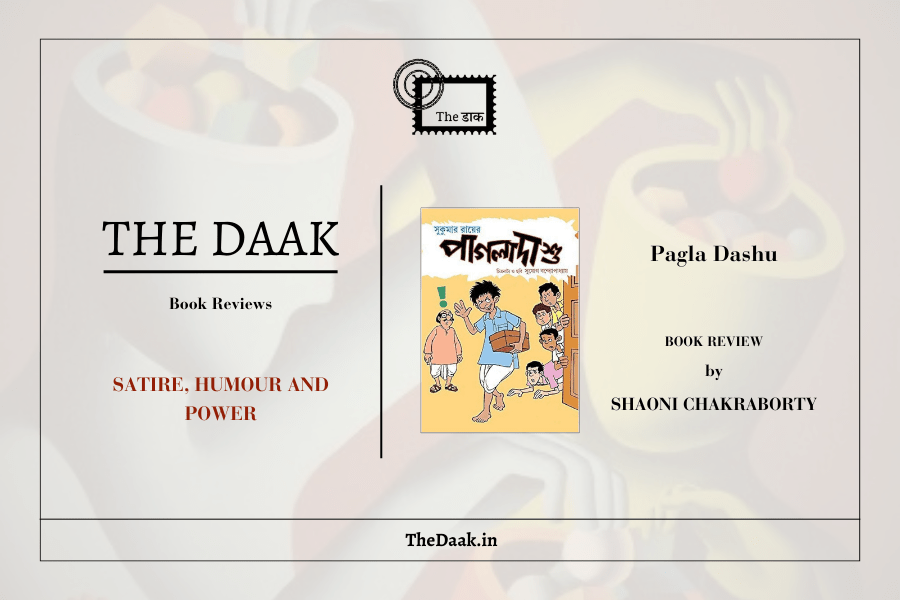
Book: Pagla Dashu by Sukumar Ray, Ananda Publishers, Published: 1940, 63 Pages, 21.5 x 14 x 1.2 cm, ISBN-10: 9350402858, ₨. 225
Often underrepresented as a creator and propagator of children’s literature, especially because of works such as Abol Tabol and Ha Ja Ba Ra La, Sukumar Ray is, in fact, a masterclass satirist and a clandestine humourist par excellence. Pagla Dashu is a compilation of twenty short stories revolving around a school, its students, teachers, and staff, with the protagonist Dashu or Dashrathi who has been christened Pagla due to his regular monkey-business antics. These stories go beyond slapstick, employing satire as a subtle tool of correction. The first-person narrator often reiterates the quality of poetic justice being delivered to haughty and overt characters through situational irony with the characters falling into their own traps. Time and again, the protagonist Dashu has a role to play in these servings, but he escapes unpunished because most people, including authorities, dismiss him as a crackhead. Pagla Dashu is not a single character but an allegory for everyone who stood for the right and was called “mad.” Dashu is a spokesperson of Ray’s worldview of using ‘nonsense’ to instill sense in his community, commenting on the ever-increasing ‘babu culture’ of Bengali elites.
Edify with Eccentricity: The Plot and the Thought
While Shakespeare famously asked, ‘what’s in a name?,’ in Dashu’s case, the nomenclature is crucial to his characterisation. Sukumar Ray created the modern-day ‘brain rot’ caricature in the early twentieth century with his arrogant and airy characters that were caricatures of real people. Any kind of revolt against their stature seemed as crazy as the idea of armed rebellion against capitalism, meritocracy, authoritarianism, and worst of all, kakistocracy. Set in a culturally specific Bengali school premise, Pagla Dashu stories introduce characters as a part of an elementary class group of mates.
The characters can be further classified into the following strata: the narrator, nameless and without any contribution in the conversations and actions taken apart from actually penning the stories; the teachers (mastermoshais) who have a penchant for ignoring or even punishing disagreement and challenges; the student group who are a bunch of unruly, often notorious batch of schoolboys; the staff, primarily the gatekeeper, who is a Hindi-speaker and speaks Bangla with an accent, and minor characters such as the magician who bring twists but do not feature extensively or repeatedly in the stories. Every story introduces one prime victim and begins by describing their habits and characteristics in detail, giving a substantive idea about their haughtiness and the reasons behind their attitudes.
Then the plot proceeds to slowly dismantle their image from a praise-worthy individual to a laughing stock. This crazy, absolute bizarreness of publicly taking down the image of such know-it-alls with an undiagnosed yet brutal superiority complex is what gives the name Pagla Dashu so much more sense and poignance. Dashu’s claims lie not only in his capacity to outwit the haughtiest of his crowd, but also in his quiet rebellion against popular movements and power hierarchies, and taking a stand for himself and his fellows. When Dashu stands against every student in the school just to play a part himself or when he mocks rampant and overt curiosity, Dashu swims upstream and against the flow. In this sense, Dashu joins a long line of figures, both real and fictional, who have challenged convention and have been labelled “mad” for doing so. Sukumar Ray’s genius is not only in captivating the young audience with farce and comic timing, but also in engaging mature minds to think differently, critique prevalent normalcy, and fight against any wrong, even if the wrong is more powerful.
Every interrelated story in the Dashu series begins with the introduction of a character who is sitting upon their high horse for some miscellaneous reason or another. Duliram, for instance, is proud of his father’s job at a newspaper company, or Shyamchand for owning a chain-linked watch. Even something as trivial as Ramapada bringing Mihidana (a type of sweetmeat) to school and not sharing it without bitter spite. The narrator introduces Dashu with an interesting undertone of subtle respect for his eccentricity, as evident when he admits that though he is mostly deemed ridiculous, they are often in awe of his mischievous intellect at unexpected times. Pagla Dashu is an almost Robin Hood-esque character because his fights are not of individual revenge but of collective distaste of the entire class of students for a given character, such as Sobjanta (‘Know-it-all’) and Chaliyaat (‘Raffish’). In doing so, Dashu emerges as a quiet leader who is not just determined to protect himself but also to keep in mind the mass opinion of his peers, thereby making Dashu a silent hero.
A Scathing Sarcasm: Using Absurdist Nonsense as Criticism
Literature has always been a tool for criticism, be it through Pope’s Rape of the Lock or Swift’s Gulliver’s Travels to the modern-day meme culture. In India too, R.K. Laxman’s The Common Man comic strips have such a satirical, subversive, and corrective effect. Dashu’s paglami, or antics, are in fact, not simple humorous acts but a textbook instance of ludicrousness that somehow also manages to kindle a spark of thought within the readers. Bholanath, when put into perspective, might turn out to be the neighbourhood political aspirant who has an obsessive compulsion to showcase his meaningless knowledge and opinions, often at the cost of embarrassment or even self-sabotage. Shyamlal is the self-proclaimed best-selling poet of the world— more detested than admired for his literature with the exception of a handful of solid devotees— who ultimately gets trapped in his own make-believe greatness. The Spectator Papers by Addison and Steele follow a similar pattern of a mute observer as the narrator with every character he meets becoming a symbol for a section of society. The reason is that Pagla Dashu is the voice of burning, biting sarcasm against every structure of authority, including the systems of education, obedience, and socio-economic and political hierarchies. Although the setting of a school and its colourful shades of students might offer a source of pure entertainment, every character is symbolic.
The central thread running through the stories is, indubitably and unarguably, the dissection of power-structure hierarchies. The characters Dashu takes a stand against are not commonplace everyday men but influence society due to their economic and/or political affiliations through their families. All the characters introduced in the stories have powerful fathers who work with the British or as editors for some newspaper, some even claim to know wealthy Zamindars. Dashu’s rebellion against these nepotistic stars is a strong commentary on the strength of the common man. It also emphasises how it is alright to be crazy for the sake of getting justice. Therefore, a staunch disagreement and more noticeably, a public humiliation is Dashu’s means of crushing the authoritarian societal structure of traditional India where knowledge and wealth are concentrated in a few hands. For instance, Dashu’s blatant retort to the teacher in opposing Ramapada’s selective distribution of sweets is blunt yet true. If Ramapada can do whatever he wants with his sweets, Dashu can also do whatever he wants with his firecrackers, and when put through the lens of the rule of law and absolute freedom, it is a gem of a sarcastic rebuke. In contrast, other students are mere blind followers of the teachers, meek and scared by authority, who are satiated with a little validation from their larger-than-life hero figures.
The Archetype of an Antihero: Dashu’s Closing Statement
Consider the trope of Mulla Naseruddin or Gopal Bhad, Pagla Dashu belongs to a long lineage of tricksters who can confuse and discombobulate the most twisted of riddlers. In that crossroad of power and subversion of power lies the archetype of the anti-hero Pagla Dashu— not necessarily always virtuous, often morally ambiguous, yet impossible to ignore. As someone who is always eager to crush authority, stark and steadfast against the rampant idea of normalcy and blending in, and armed with the superpower of pranking every mortal in his presence including himself, Pagla Dashu is nothing short of an inspiration to the modern romantic of rebellion.
With the infiltration of Western standardisation and aping of everything that trends for seconds just to be accepted in society, Pagla Dashu’s adamant mischievousness and apparent insanity is the quiet torch-bearing force to revolutionising and democratising human civilisation. Dashu and his craziness form the combined epitome of comic, satirical, and playful genius with non-violent, subtle resistance that is unsettling at the least and eye-opening at the most.
Shaoni Chakraborty has completed her Bachelor’s and Master’s degree in English literature from Banaras Hindu University, Varanasi.
Six Acres and a Third

Book: Six Acres and a Third by Fakir Mohan Senapati, translated by Rabi Shankar Mishra, Satya P. Mohanty, Jatindra K. Nayak, and Paul St-Pierre, Berkeley: University of California Press, Paperback, Published: 1 March 2005, 240 Pages, 216 x 140 mm, ISBN: 9780520242716, £27.00
Fakir Mohan Senapati’s Six Acres and a Third (translated as chha mana atha guntha in Odia) is a remarkable piece of Indian literature that exposes and dismantles the ideological structures of colonial law, caste oppression, gender subjugation, religious hypocrisy, and economic exploitation. This is achieved through a narrator who is irreverent, self-aware, and gleefully intrusive, and makes the reader complicit in, and simultaneously critical of, the world being narrated. His wit and deliberate exaggeration becomes the moral conscience and voice that makes readers question and rethink everything that was the norm, said or unsaid. At once comic and critical, this Odia narrative keeps the subaltern at the centre and paints a world under colonial rule where everyday becomes the arena of resistance. The novel’s protagonist, or rather its anti-hero, Ramachandra Mangaraj, is a local zamindar whose story isn’t told to glorify but to expose, not to celebrate but to satirise. Set in a small village in Odisha, the novel follows his morally hollow rise and slow, ironic undoing, as he usurps the land of the poor and manipulates religious, legal, and social structures to sustain his power.
A Satire on Power, Property, and the Illusion of Virtue
At the heart of the novel lies a profound satire on landed power. Mangaraj is introduced as a paragon of virtue, a pious zamindar who fasts regularly, donates to temples, and appears morally upright. But the narrator cuts through the surface when he mockingly and satirically uses laws, both legal and scientific, to dispute the evidence that contradicts Mangaraj’s piety. He shows how these can be circumvented to protect the powerful.
The novel’s core critique is that morality is a privilege the powerful can conveniently use when required and throw away when not, and virtue, like everything else, can be performed or purchased. This privilege that the powerful have is also seen in how religion is instrumentalised by Mangaraj and his ilk . Scriptures are not sources of ethical conduct or the embodiment of dharma, but mere rhetorical devices designed to serve and maintain the hierarchy of the elite.
Senapati does not, however, stop at this indirect critique. Gods themselves are pulled into the theatre of satire when the narrator exposes how even religious piety is opportunistic and transactional in nature. Gods were worshipped only when the fear of a mishap overwhelmed them and not out of genuine devotion.
On property, the novel critiques the control of circulation and satirises the delusions of feudal narcissism. Mangaraj ensures that no one else’s goods are sold before his, effectively monopolising not just trade but the social narrative of success, where social mobility and opportunity actively conflicts with the narcissism and greed of zamindars.
The Gendered Critique
Senapati’s narrator also recognises that women are consistently reduced to their physical features in both literature and life. The description of Champa, Mangaraj’s trusted household companion and an artist who is rumoured to be his mistress, is drawn on classical Sanskrit imagery. The narrator critiques the exaggerated way women are described in classical literature, often reduced to just physical attributes. His tone is sarcastic when he states that it takes a “broad-minded” person to describe women this way;when in fact, it takes a narrow and sexist mindset to do it. This is not flattery, it is mockery of a literary tradition that idealises women only to erase them.
The restraint in not discussing Champa’s story following her sudden disappearance at a time when Mngaraj’s reputation was questioned because of her, is rhetorical. Senapati is self-reflexive in describing a world where crimes against women go unpunished, not because there’s no guilt, but because there’s no system to recognise guilt. The lack of evidence to prove that Mangaraj is the likely culprit, despite circumstantial evidence, is part of the satire—a society obsessed with property will never see the truth if it doesn’t threaten the legitimacy of those holding them.
Caste and Narrative Reversals
Senapati extends his critique to caste hierarchies by questioning Brahmins and ritual purity. In the book, the vulture and the Brahmin both go for corpses, but one is sacred, the other is foul. The imagery is provocative, but its intent is ethical. The sacred is not inherently noble, it is just historically constructed to be so. This is reinforced by how Mangaraj dismisses Pandit Sibu, a Brahmin who bows before him. In that moment, wealth displaces birth. Brahminical ritual, once considered the highest cultural capital, now grovels before landed power.
Meanwhile, characters like Shyam, who is lower-caste, loyal and laborious, are granted narrative attention but no justice. Their suffering is absorbed into the economic machine, and only noted in passing. This, too, is deliberate. The novel reflects not only the injustice of the system, but also the selective memory of society. How opportunism of the wealthy is manifested under the veil of concern and advice.
Bhagia and Saria
The story of Bhagia and Saria in the book hits hard because it’s simple, quiet, and brutally real. They are a poor peasant couple who are the rightful owners of the six acres and the third. They don’t show up until halfway through the novel. This is an intentional choice on the part of Senapati, which says a lot about how society and storytelling treats the poor, by sidelining them. They’re tricked into giving up their land through legal paperwork they can’t read, showing how the law, instead of protecting the marginalised , helps the powerful. Saria dies silently from hunger and despair, and Bhagia fades into the background, eventually forgotten. Senapati doesn’t make their suffering dramatic; he lets the silence speak, making it a powerful statement. He’s showing us that people like Bhagia and Saria don’t just lose land, they lose voice, memory, and dignity. Through them, the novel quietly exposes the zamindars, colonial law, and the social systems that keep injustice running.
Colonial Modernity and Its Absurdities
Senapati ridicules the newly emerging English-educated elite with similar sharpness. In a particularly astute observation, the narrator remarks how modern babus prefer women who “gallop like horses” rather than “walk like elephants” (p. 57). Traditionally, the graceful walk of an elephant was a poetic metaphor in Indian literature to describe feminine elegance and dignity. But under colonial influence, the same was too slow, even old-fashioned, and instead agility, energy, and speed, like one of a galloping horse, came to be admired. Senapati uses this shift in standard to make a sharp point of how colonial modernity imposes irrational and often harmful standards.
This is also reflective of the broader trend that prevailed then: appeasing and adopting colonial tastes.
When the narrator quotes ‘Pandit’ Benjamin Franklin (p. 40), or when he critiques how ingrained the English language and culture was as a symbol of power and status by mentioning how the ‘new babus’ might not know the names of their ancestors but would readily recall who the ancestors of Charles The Third were, Senapati intends to question and expose the colonial superiority that the educated babus (especially the middle class) show, often at their own identity’s expense. The disdain is echoed when he describes the mythological figures in Mangaraj’s house wearing skirts with polka dots.
Irony as an Ethical Weapon
Senapati’s narrator is not a neutral third-person voice. He is a philosophical jester, a village chronicler, and a ruthless ethicist, all rolled into one. He tells the story with mock humility, not as a detached observer but as a part of the same village’s subaltern, as Chakradhar who finally inherits Manganraj’s land. He asks readers for the permission to speak, and pretends to be unsure of facts all while delivering the most biting truths.
Six Acres and a Third is a novel where satire becomes ethics, silence becomes critique, and storytelling becomes a form of justice. The narrator speaks directly to readers, mocking the rich by standing with the oppressed, offering them dignity and recognition. In doing so, the novel becomes a space where truth is told from below, making it a kind of moral and social justice through fiction. This piece is not just a tale of one zamindar and one plot of land. It is a story of how power speaks, and how the powerless are spoken over. And it is a call to listen differently.
Sanchita Dash is an undergraduate Political Science student with academic interests in foreign relations, public policy, and socio-political issues.
Humour and the Public Sphere in प्रतिनिधि व्यंग्य by Harishankar Parsai
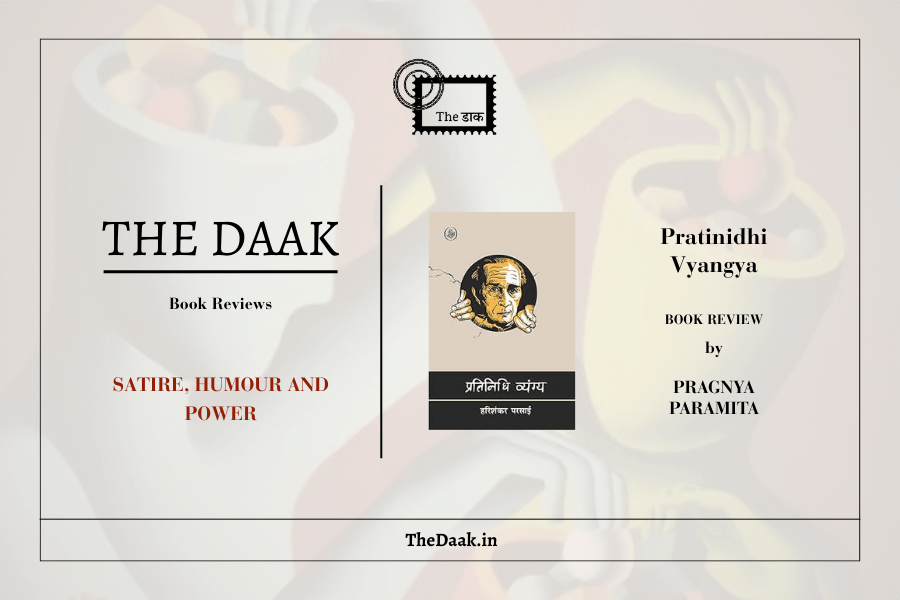
Book: प्रतिनिधि व्यंग्य by हरिशंकर परसाई (6th edition), Delhi: Rajkamal Prakashan, 2023, 148 Pages, 17cm x 12cm, ISBN: 978-81-267-0234-3,₹150
by Pragnya Paramita
प्रतिनिधि व्यंग्य (Representative Satire) by Harishankar Parsai, an eminent satirist from Madhya Pradesh, came across as a unique satirical style that employed a conversational tone making use of metaphysical conceits such as describing a republic as shivering in ठिठुरता हुआ गणतंत्र, or by personifying a disease as one’s uncle in अपना चाचा— एशियाई फ्लू , and so on. His humour substantiates some deeper, political decay within the conceit.
Parsai grew up during a politically turbulent time in India’s history and experienced its relatively newly acquired independence, witnessing paramount events in Indian politics. His writing serves as a critical lens for examining the various issues that plagued society at that time. Wrapped in satirical prose, the sense of bleakness engendered out of reading about instances of poverty, drought, middle-class aspirations, political failings disguised as development, and the undying hopes of the common man, is brought forth brilliantly in this collection of essays. Parsai’s brilliance lies in shedding light on a public sphere that is nestled in-between the nooks and crannies of small towns and villages; in short, in places that are rarely mentioned in terms of a socio-political analysis.
In using his satire to unfold the many vagaries of Indian society, he craftily makes use of normal day-to-day activities to critique the public sphere of a newly independent India. His essays effectively paint a picture of the thought process of individuals from all backgrounds, from rich merchants and political leaders to people who survive on a single meal a day. While pretending to discourage all forms of intellectual and emotional engagement with a social issue, it in fact leads one to a greater understanding of the ills of society, albeit indirectly. This is precisely how satire escapes censorship, by not taking a straight road to activism. Rather, it does away with the idea that there is a straight path to social justice and instead leads one through secret alleyways of protest tinged with humour. The significance of bypassing censorship is crucial in all ages, as it is reflective of the spirit of tolerance and, therefore, in essence, of democracy.
In “गुड़ की चाय” (Tea of Jaggery), he begins by stating that nowadays, while drinking a cup of jaggery tea, he feels that he is being martyred (p. 18). This statement can trigger criticism for contrasting martyrdom to something as common as drinking a cup of tea. Only Parsai’s wit and satire can protect him from the wrath that such statements might induce, as in the next line, he states, like a philosopher, we live and die from these small things. What seems like mindless babble, however, is a statement that emphasises the situation of being forced to consume jaggery instead of sugar. Does one not rely on the everyday comfort of little things to judge the quality of life one is living? In using this simple metaphor, Parsai paints a different picture of the independence struggle, wherein he mentions that those who were jailed for it are the ones who now drink their tea with sugar. While those who could not benefit from such political shows of triumph are the ones who take their tea with jaggery and lament about their place in the country (p. 18). Hence, he mocks this piecemeal nationality that he believes is undemocratic for the common man who now has to struggle for his basic needs.
But the best part of this satire is when he calls sugar a secular entity (p. 20). In true Parsai fashion, he states that sugar does not discriminate according to one’s religion, and is more secular than us because it disappears from the market on both Muharram and Janmashtami. In a warped sense of utopian communal harmony, he paints a picture that hints that dearth is equal for everyone, regardless of their religion. He states that it is easier to acquire an MLA than to acquire sugar, hinting that while basic food items are all drowned under the illegal hood of black marketing, politicians, on the other hand, are in abundance everywhere. While ending the piece, he mocks the concept of stability perpetuated by the privileged who believe in maintaining law and order at the cost of relishing the continuity of a situation that does not affect them.
So, in a sense, while critiquing the lack of sugar, what Parsai is actually criticising is the lack of accountability that is so easily doled out to people ironically in sugar-coated words. He mocks those who accept the resignations of life easily without voicing their anger while sipping the insipidity of their life down with a cup of jaggery tea. Thus, Parsai centers his argument on the public’s uncritical acceptance of life as meted out to them by government officials, and their innocence which fuels such wrongful acts of deceit.
Another notable satirical piece in this collection is “अकाल उत्सव” (Famine Festival), which runs along the lines of Jonathan Swift’s A Modest Proposal (1729). In this, Parsai describes a set of vivid dreams, from a pompous celebration of famine to dreams of famished people eating up politicians and hoarders who sustain such disasters to milk political and financial benefits. Parsai comments on the strange desire for human survival stating that the desire to live is like a glue, binding together the bones of man and essentially his will to survive (p. 93). This is a deeply philosophical and disturbing observation, simply because of its truth. He marvels at their will to live, and says that they eat up the wish to die to keep themselves alive. In this desire for death, they find nourishment. This paradoxical statement highlights the morbidity of the lives of those affected and who declare that even death would be better than living like this. Further, he sketches a scene where a political leader is delivering a speech at this famine festival, wherein he gives statements such as “Famine is India’s old tradition”, and says that even bravehearts like Dronacharya died of hunger (p. 94). In satirising these speeches, Parsai seeks to strip them of their false glorifications. He is critical of this clever turnaround manner of talking, and hence makes a mockery of it. At the end of his speech, before he goes to eat his meal of chicken, we
see the politician stating that it is his desire that everyone celebrate the famine festival with joy, and that even in dire times, we must remain happy.
Parsai’s exploration of this issue poses the question, why is one supposed to put on a pretense of happiness? Can happiness for the poor only be achieved in performative spectacles and never in reality? Parsai ends this commentary by stating, “मगर लोगों को उत्सव मनाने की आदत पड़ गयी है” (But people have gotten used to celebrating) (p. 96). Hence, he again puts the public sphere into the spotlight. This time it is a public sphere of the deprived, starved individuals who will sell their own soul to buy a garland of roses for their political representatives. Here, Parsai tries to draw attention to the idea of political spectacles which keep the common man from questioning a system that has mastered the art of deceiving the public.
The public sphere is invariably under scrutiny in all of Parsai’s satires, whether it is in lamenting the ways in which the voice of the public sphere is suppressed or whether it is to mock the fallacious cloak of honour that discourses in the sphere generate. For instance, in “दूसरों के ईमान के रखवाले” (The Protector of Others’ Honour), Parsai satirises the innate tendency of people to moralise others, claiming to be upholders of honour while being morally corrupt themselves. This reflects how the public sphere gradually assumes the position of being a staunch defender of honour, and proclaims itself as the protector of righteousness by turning a blind eye to its own problems and staking a claim in being the authentic, collective voice of society. In “पगडंडियों का ज़माना” (The Era of Footpaths), Parsai brings forth a poignant criticism about people using backhand ways to accomplish their objectives. He states that no one takes the straightforward road these days because it has been closed for years and everyone uses the footpaths to reach their destinations (p. 51). By footpaths, he actually means to imply the narrow, crooked path that people choose without hesitation over the road of righteousness which is full of hindrances.
The common man of Parsai’s satires makes up this public sphere and inherits the tradition of humour but ends up becoming the laughingstock of the entire story. In trying to mock the common man’s actions, he is also generating sympathy for the politically obscure belief system that thrive in the public sphere. This obscurity stems from an inability on the part of the public to fully fathom the conniving manner in which they are exploited, be it for sugar or for deciding the threshold of their morals. His aim seems to be one of instilling awareness through humour, using his satires and nondescript ways of talking about problems to highlight the vagaries of Indian society. Parsai’s dealing with the public sphere then has multiple objectives: one, to highlight the issues that plague it; two, to initiate an understanding of how collective thought is engendered in it, and three, to show that a public sphere is not without its faults, limitations, and dangerous practice of apathy.
Parsai’s mode of satire shines the spotlight on a class of society with a set of problems that when doled out as humourous situations do not invite serious scrutiny, but in fact, unearth the grave flaws present in society. Often, we overlook the sinkhole of our situation unless we are handed over a rope by someone who seeks to save us, realizing that all this time we were slowly drowning. However, sometimes, we believe wholeheartedly that we cannot drown if we haven’t yet drowned, refusing to believe in a narrative that makes our presence unpredictable. Parsai’s satire seeks to highlight this exact narrative, one that speaks of this socio-political muddle that all of us are entrenched in.
Pragnya Paramita is currently a first-year PhD research scholar at Delhi University’s English department.
Ghosts of Justice: Sunil Gangopadhyay’s satire of law, power and the absurd

Book: Lord-Healer of Lost Cases by Sunil Gangopadhyay, translated and annotated by Debolina Dutta and Oishik Sircar, in Routledge Handbook of International Law and the Humanities, Taylor and Francis, Oxon, 2021; pp. 208–226, ISBN: 9781003170914
by Debashrita Mazumder
What if one could tell the difference between truth and lies in a single glance? Splendid, wouldn’t it be? But the truth might become inconvenient to those who wield that power. In Beni Laskar’er Mundu (Lord-Healer of the Lost Cases), Sunil Gangopadhyay tells the fascinating story of a struggling lawyer in colonial Bengal who acquires the eerie ability to detect guilt through the agony of headaches and visits from the dead. What begins as a dark comic courtroom drama quickly unravels into a powerful satire on the violence of law, the colonial fetish for scientific rationality, and the control of native bodies and belief systems.
This review is based on the English translation of Sunil Gangopadhyay’s Bengali short story titled Lord Healer of Lost Cases, which preserves the cultural cadence of the original while opening it to a wider readership.
First published in 1972, the story remains alarmingly relevant in present-day India, where the instrumentalisation of law, the erosion of dissent, and the state’s interference in personal rituals continue to plague public life. Through the figure of Benimadhab Laskar, a stammering, sickly man and a reluctant prophet, Sunil Gangopadhyay raises uncomfortable questions about whether justice is truly served, or if justice is in the hands of the powerful and wealthy. He asks if knowledge is universal and singular, and lastly, what kinds of truths are permitted to survive. This story recounts the era when history was often rewritten and institutional memory was manipulated. It emerges as both a literary ghost story and a political parable.
Benimadhab Laskar is depicted as a comical figure rather than your typical hero. He would expectantly sit under a banyan tree in front of the court for clients to no avail. His fortune, however, changed soon when he mysteriously acquired the ability to sense guilt with uncanny accuracy through visions accompanied by excruciating pain and ghostly visitations. His predictions began to overturn court verdicts which unsettled fellow lawyers, colonial officials and even clients. Beni’s reputation began to spread which improved his financial position, but it also came with uncomfortable moral responsibilities. A very common phrase appears in the Spider-Man movie (Sam Raimi, 2002): “With great power comes great responsibility”. Beni’s afflictions were similar. When he refused to defend the guilty son of a powerful landlord, he was threatened. Consequently, Beni retired from his job, but then the British judge intervened not to protect Beni but to claim his skull for scientific study. However, Beni regained control of his life in death. His final act of resurrection is both prophetic and poetic. It was his warning against the hubris of the state and science.
Satire of Law, Science, and Colonial Knowledge
While the insistence of the British judge on preserving Benimadhab’s skull for scientific research may seem like a narrative tool for comic relief or even absurdity, a deeper interpretation may reveal a political gesture. The narrative showcases the colonial practice of turning bodies into specimens, stripping them of autonomy even in death. Colonial powers did not just have control over the land but also over each and every citizen’s body. In Confessions of a Skull by Kim A. Wagner, it is noted that British officials used skulls of executed Indian men, often labelled as “thugs”, as scientific specimens to be cut open for phrenological studies (2010). Phrenology was a pseudoscience that examined the bumps and the shape of one’s head to determine the personality traits of that person. This macabre practice, Wagner argues, blurred the line between justice and violence for the sake of science: “The interrogation of the seven men…was thus continued through their skulls at the hand of phrenologists”(2010, 27). In Sunil Gangopadhyay’s story, Benimadhab is subjected to a similar logic. The British judge Wilberforce rationalised Beni’s prophetic headaches as pathological.
The translator’s afterword in Lord-Healer of the Lost Cases urges the readers to rethink the judiciary from a postcolonial lens. India’s legal system claims to be modern and neutral, but it carries the baggage of colonialism and cultural biases. Beni’s death resulted in a tense game of tug of war between the colonial desire to dissect his body and the village’s demand for ritual cremation. Beni was not given agency over his own body even in death. This struggle over the body is not confined to the colonial archive. Contemporary regimes continue to regulate autonomy over a person’s body through medical neglect, forced cremations, and bureaucratic violence. The language of such authority may have shifted from racial science to issues of national security or legal concerns, but the underlying matter of control persists. In 2020, the police of Uttar Pradesh forcibly cremated a 19-year-old rape victim without the consent of her family. Similarly, in the case of Father Stan Swamy, a Jesuit priest and a tribal rights activist, who died in custody after being denied medical care under the UAPA, we see the unencumbered control of the authorities over citizens. These cases emphasise how bodies, living or dead, have always been subjected to forms of bureaucratic violence under the pretext of law and national security. In both fiction and reality, death doesn’t free you from the shackles of the state’s control.
Benimadhab Laskar: Anti-Hero, Ghost and the Subversion of Colonial Knowledge
Benimadhab Laskar is not your conventional hero. His powers are not rooted in strength, charm or courtroom strategy, but in the unasked ability for truth-telling which is triggered by suffering, visions and spectral visitations. Unlike typical heroes, he doesn’t embrace these abilities; his visions of guilt are burdens he must endure. Yet it is Beni, not the colonial court, who delivers justice with consistency. When Beni refuses to defend the guilty son of the landlord despite being threatened, it is his form of quiet, reluctant resistance that speaks louder than law.
The very presence of Beni destabilises the binaries that support colonial rationality, which are science vs superstition, reason vs belief, and modernity vs tradition. His knowledge of truth cannot be medically explained. And the British Judge Wilberforce attempted to do exactly that: to quantify Beni’s powers. Wilberforce becomes the embodiment of the colonial desire to dissect and control what it cannot understand, to extract meaning even from the dead. Yet it should be noted that this impulse didn’t vanish with the end of the empire. In independent India, free of British rule, modernity implies logic supported by Western concepts. Indigenous forms of knowledge are often dismissed as dogmatic, superstitious or simply as relics of an irrational past. Although we are free of colonial powers, our thought process is still deeply influenced by colonial reasoning, where the hierarchy of knowledge is arranged with scientific Western rationalism at the top and embodied or cultural truths at the margins. Wagner rightly wrote that this fusion of science and punishment was not neutral but deeply embedded in the logic of empire (2010). This continues to echo in the present.
Gangopadhyay’s story critiques not only colonial science, but also the concept that Western epistemologies are universally valid. The translator’s afterword by Debolina Dutta and Oishik Sircar notes that the story compels us to understand the law as a body of knowledge shaped by contradiction, hybridity and power. These critiques were echoed by Cameroonian political theorist Achille Mbembe in African colonial contexts, where the local beliefs and rituals were pathologised as signs of savagery, and a need to civilise them was invented. Similarly, Indian philosophers such as Sundar Sarukkai, in his co-authored work with Gopal Guru, The Cracked Mirror: An Indian Debate on Experience and Theory (2012), argue that Indian philosophy has long operated with logic distinct from Western rationalism. Beni’s visions may not be explained in Western science, but such forms of knowledge have been grounded in Indian experience and spiritual intuition.
Gangopadhyay doesn’t ask us to believe in ghosts. He merely asks us to question why we must confine our thinking or reject other possibilities of truth. It reinforces the postcolonial thought that rationality is not universal but shaped by culture.
Conclusion
Beni Laskar’er Mundu or the Lord-Healer of Lost Cases is a politically influenced ghost story. It is not the spirits of the dead that frighten us, but the injustices practised by the living. Sunil Gangopadhyay interrogates our understanding of law, reason, and justice through satire and postcolonial critique. In Benimadhab Laskar, we find a man who quietly bears the burden of truth. But he is also haunted. He doesn’t rebel; instead, he possesses moral clarity by refusing to bend the truth, even when threatened. He exposes the limits of colonial law and science. His knowledge is untranslatable to colonial logic/modern science. His character gives us a lesson that truth-telling often comes at a cost, especially in societies where power determines which truths are allowed to survive.
Written in 1972, this story remains unsettlingly relevant in contemporary India, where the law often fails the vulnerable, and even death is not free from state surveillance. This reveals the enduring violence of the state that demands control and conformity.
When Beni resurrects, although briefly, he delivers a final warning that the truth never remains buried. Beni Laskar’er Mundu not only entertains, but it also disturbs, provokes, and haunts. In a country where justice is elusive, stories like this should be written more often. We need stories where the dead speak so that we learn to listen. But we also need to listen to those who are not yet dead, those who whisper from the margins waiting to be heard.
Further Reading:
- Mbembe, A. (2001). On the Postcolony. University of California Press.
- Wagner, A. (2010). Confessions of a Skull: Phrenology and Colonial Knowledge in Early Nineteenth-Century India. In History Workshop Journal, 69 (1), 27-50. https://www.researchgate.net/publication/44641791.
- Guru, G., Sundar, S. (2012). The Cracked Mirror: An Indian Debate on Experience and Theory. Oxford University Press.
Debashrita Mazumder is a postgraduate in English Literature from the Central University of Gujarat.
II
HUMOUR QUESTIONING POWER
Tickling the Structure: A Review of Žižek’s Jokes

Book: Žižek’s Jokes: (did you hear the one about Hegel and negation?) by Slavoj Žižek, The MIT Press, Hardback, Published: 21 February 2014, 148 Pages, 196x133mm, ISBN: 9780262026710, ₹1305
by Bilal Khan
When one contemplates philosophical thought, it is a norm to think of a serious arbiter who is poised unconsciously on a couch, reading a manuscript of otherworldly knowledge. This image itself is what is more or less shaken by the Slovenian psychoanalyst and philosopher Slavoj Žižek. Unconventional and popular, Žižek has garnered a large following amongst academics and layperson alike, based on a technique he often uses: jokes. Žižek has time and again used jokes as a way to understand deep philosophical problems, appealing to an audience around the world. However, it is this manoeuvre itself that has given rise to some of the worst critiques the thinker has faced. Questionably, then, is it ethical or philosophical to joke about death, misery and politics? The scope of this essay seems too short to answer this question. The aim of this essay, then, is to produce a brief understanding of Žižek’s Jokes, an anthology edited by Audun Mortensen with a humorous afterword authored by Nicholas John Currie, also known as Momus, a Scottish musician and writer.
The anthology is a straightforward book of all the jokes Žižek has used in his works. With 102 citations from his work, the anthology does exactly what it is titled as: a book full of jokes made by Žižek. Through and through, the farcical nature of the content directs the book into a small guide on how to read Žižek. Even the introduction works against its own nature, where instead of providing the reader with a brief summary of the content, the document explains the profound linguistic prowess of jokes. As Žižek explains, a joke carries no author. This exclamation stands true for Žižek himself, where most of his jokes are borrowed from a mysterious source. The joke about a monkey who keeps washing his testicles in a glass of whisky seems to originate from Eastern Europe. One is left to guess if this was his invention or if this joke is actually told at weddings and ceremonies. The answer to this dilemma would be to say “both”. As he explains, jokes are always told originally, but somehow are always already heard. This, he claims, illuminates the contradictory nature of jokes, where they are individualistic yet collectively already in circulation.
What is visible from the book is the importance of jokes in philosophical thought which has remained as an object of inquiry within the field for some time now. The peculiarity of the Žižekian model is its uncanny adaptation of humour by the thinker in his work and lectures. Hence, the thinker is, ironically, not a thinker of jokes but the one who thinks in jokes. Therefore, it is common to find Žižek under the threat of being cancelled as he explores the obscene quality of jokes by uttering them in conference halls. Obviously, this unconventionality is only matched by his philosophical mentor, Jacques Lacan, who also saw jokes as crucial for understanding the unconscious mind.
Although Lacan did not use jokes extensively in his lectures, he did use peculiar oratory techniques to explain his points. Patricia Gherovici and Manya Steinkoler (2016), in their edited anthology Lacan, Psychoanalysis, and Comedy, explain how the Lacanian method of therapy inhabits a punchline. For context, Lacan’s clinical practice included a therapy method which was radically opposed to the standard “talking cure” methodology of 20th-century psychoanalysis. He introduced the concept of “scansion” in the therapy model, where he would stop or scand the session after the analysand (the patient) has uttered something of value to the analyst. Instead of continuing the process and giving the analysand the driver’s seat in the session, the Lacanian method asks the analyst to guide the session with a heavier hand. Gherovici and Steinkoler suggest that this method is very similar to dropping a punchline at the right time in a comedic skit. Much like one would say, “comedy is all about timing,” Lacan would argue similarly for the truths of the unconscious.
The connection of jokes to the unconscious mind goes back to Freud (1905) who wrote a book on jokes trying to piece together the structure of a joke similar to his work on dreams. This interconnection between jokes and dreams lies in their structure, which he calls the form. It is interesting to know that Freud has always asked his readers to focus not on the dream-content (manifest or latent) but on its form. He coined this mechanical process, transforming the dream-thought as “dream-work”, which is influenced by unconscious desires. This digression to the Freudian idea of form is necessary to link jokes and dreams, meaning that both are a roadway to the unconscious. As Gherovici and Steinkoler wittingly remark, “jokes offer a shortcut to the unconscious we can use in broad daylight” (2016, p. 1) Hence, Žižek’s anthology of just his jokes manifests not as a byproduct of his philosophical technique, but instead a significant modality or form of his political thought.
Let’s take the example of a perfectly vulgar joke from the book. A Mongol officer in 14th-century Russia declares to a peasant that he is going to rape his wife. However, the officer noticed a lot of dust on the road and proceeded to order the peasant to hold his testicles, protecting them from dust while he committed the act. After the deed was done, the peasant started jumping in joy, saying that he got the officer as he let go of the testicle while the act was happening. Thus, they are covered in dust now. This obscene joke appears in The Plague of Fantasies (1997), where Žižek seems to be comparing two significant responses to any political crisis which are coded as the “conservative knave” and the “progressive fool”. The joke is used to pass a witty comment on the latter, the leftist “social critics” who are happy at analysing the oppressive forces and taking away a small amount of their power for themselves. In other words, left critics have just dirtied the testicles of globalist capital order while the system is flourishing and raping the labour class. Some might argue that this is such a vulgar joke for such a generalised observation. However, this vulgarity and upfront obscenity is not the point of the joke. It is the well-timed punchline that appears after the peasant expresses joy. His absurd enjoyment while being subjected to abject horror becomes the necessary form a joke takes to explain repressed unconscious desires or contemporary political crises.
The Žižekian model of humour then runs counter to the mainstream liberal-leftist position that sees political incorrectness as a way of normalising dominating discourses. However, jokes are rarely about their content (sexism, racism and so on) and mainly depend on their form. The jokes that appear obscene then function as a shortcut to the repressed ideas of society. They, themselves, do not play a role in a discourse as much as they address and acknowledge discourses. Pushing this repression even further through cancel culture must be understood as inadequate to deal with the political problems of the time. Whatever is repressed returns in one form or another.
This position of using humour is well explained by Momus, who wrote the afterword of the book. Momus argues that Žižek’s constant use of jokes that concern famously difficult authors including Derrida and Lacan produces a specific effect on the reader. What he calls the “lightness of profundity” is explained as a moment of recognition where one sees these authors and their philosophies as approachable. In other words, humour renders them human for the reader to (mis)understand them. He also makes an interesting linking of jokes to lies which might help people to think of alternative possibilities of endings that are too certain and “true”. A lie then comes in handy to tickle you into a plethora of questions, ambiguities and vulgarities.
There is no serious conclusion to his review apart from laughing on every page because of Žižek’s unrelenting and R-rated humour. For this reason, Momus announces that Žižek is an old family uncle who keeps repeating his jokes at family gatherings. One might think this is at least better than Momus’ brother who thought of Žižek as “crazy, a hothead”. The anthology might appear as a coherent whole of folklorish jokes, but it is anything but coherent. It resembles a book of ramblings, sometimes, it takes the shape of a personal diary and sometimes, unshockingly, a tragic treatise on politics. As Momus writes, “comedy is a legitimacy crisis followed by the sudden appearance of a cornucopia”(p. 140) Žižek’s Jokes can only be understood as a surplus, an excess, and a cornucopia.
Bilal Khan is a Research Scholar specialising in Film Studies and Psychoanalysis, with a postgraduate degree in Literary and Cultural Studies from the English and Foreign Languages University, Hyderabad.
Humour and the Performance of Power in South Asia

Book: Humour and the Performance of Power in South Asia: Anxiety, Laughter and Politics in Unstable Times edited by Perera, S. and Pathak, D. N., New Delhi: Routledge India, 2022; pp. xx + 264, 234x156mm, ISBN: 9781032229975, ₹3,495 (hardcover).
Humour plays a vital role in South Asian culture and postcolonial critique as it serves as a powerful tool to navigate political instability, express dissent, challenge authority, and reveal social anxieties. It enables marginalised voices to subvert dominant narratives, fosters resilience through satire and irony, and provides critical insights into the complexities of power, identity, and resistance in postcolonial societies. Humour, understood as a complex and multifaceted medium, brings to light the dynamics of power, resistance, and identity in a region shaped by colonial legacies and ongoing sociopolitical disruptions, as is explored in Performance of Power in South Asia: Anxiety, Laughter and Politics in Unstable Times, an edited volume by Dev Nath Pathak and Sasanka Perera.
This collection explores how humour acts as a powerful yet complex social force in times of political instability, rising authoritarianism, and deepening social inequality within South Asia. It examines humour across various forms—print, oral traditions, folk performance, and digital media—amid rapid digital transformation. By bridging the past and the present, the volume highlights how humour has evolved in contemporary South Asia, while also grounding it in the region’s colonial histories through a close analysis of laughter.
Inside the Pages
This edited volume comprises eight different chapters contributed by scholars from diverse disciplinary backgrounds and is organised thematically to explore humour’s deployment specifically as a tool that offers political critique, social commentary, and performative resistance. The essays together explore satire’s colonial genealogy along with vernacular adaptations of humoristic forms and dwell on the subversive potential in oral and folk humour. Contributions also explore digital satire which is a newer and developing type of satire that employs internet avenues such as memes, social media updates, videos, blogs, etc., to make politics, society, and culture the object of satire through parody, irony, and humour. Digital satire is distinguished from its pre-digital equivalent in that it is participatory, immediate, and open to a wider audience. As the editors’ note states, “This thematics diversity is quite an asset for the reason that it shows humour’s capacity to traverse social strata and media forms…it provides a means of expressing resistance across both traditional and digital public spheres.” (p. 23)
Anatomy of the Text
Divyendu Jha’s chapter on colonial cartoons and vernacular satire is a standout for its meticulous archival research and has subtle theoretical engagement with satire being a colonial instrument while also including an indigenous response. He also illuminates the hybrid character of humour during the colonial era. He does this through tracing how the vernacular satirical periodicals that emerged were modeled after Punch, the popular British satirical weekly. These works thus simultaneously reflected colonial power via their imitation of English periodicals. At the same time, in the vernacular versions, colonial rulers along with Indian elites complicit in governance were critiqued in an attempt to destabilise colonial power.
Jha uses humour to problematise the “coloniser and colonised” binary by presenting satire as a dialogic discourse negotiated in power relations. Satire’s ambivalence improves with historical context because it can be both oppressive and emancipatory. While Jha’s archival methodology provides a richly descriptive account of vernacular satire in colonial India, the scope of available sources necessarily limits the chapter’s engagement with the audience’s reception of these periodicals. As such, the chapter effectively foregrounds production and circulation even if the dialogic dimension of humour remains constrained by methodological limits.
In a complementary vein, Dev Nath Pathak’s chapter titled “Khattar Kaka’s subversive Hinduism” focuses on literary satire through an insightful reading of Khattar Kaka, illustrating how humour functions as “soft resistance” in conservative societies. Secured socialism with religious norms are questioned in Pathak’s essay via literary humour’s subtle yet powerful role. Through a focused study into Khattar Kaka’s satirical writings, Pathak argues that humour offers a culturally sensitive mode of ideological critique, provoking reflection and debate while navigating social taboos. This chapter is particularly important for its exploration of the possibilities and limits of satire within conservative societies, highlighting how overt criticism can provoke censorship or even violence. It draws the readers’ attention to these constraints through an analysis of Khattar Kakak Tarang, a satirical work by Hari Mohan Jha, in which the character Khattar Kaka uses sharp wit and irony to critique social orthodoxy and political hypocrisy in postcolonial India.
Pathak’s approach leverages laughter quite effectively for weakening dogma without alienating audiences as it displays humour’s potential for “soft resistance”. Although the chapter draws on Bakhtinian ideas of the carnivalesque to explore the subversive power of humour, its analysis would be more compelling if this theoretical framework were more consistently and systematically applied, particularly in relation to other South Asian satirical voices that similarly challenge dominant structures.
Prithiraj Borah’s chapter speaks about folkloric narratives and humour as resistance, it offers a powerful contribution by an ethnography of oral humour among Assam’s tea garden labourers. This work challenges and revises dominant narratives about subversive satire by showing that humour is not always purely rebellious or oppositional; instead, it can be complex, layered, and sometimes complicit with power structures, depending on its context and audience. His study about Assam’s tea garden labourers reveals that oral humour acts as a mode of covert resistance against systemic exploitation and social marginalisation. Borah foregrounds communal storytelling, jokes and performative laughter to show how humour ‘veils agency and solidarity tactically within’ entertainment.
The work expands humour studies’ scope for inclusion of collective, unrepresented practices in negotiating power at the grassroots. While Borah’s ethnographic approach offers valuable insight into humour as a form of everyday resistance among marginalised communities, the absence of a comparative analysis with other South Asian contexts limits the broader applicability of her findings. Interestingly, James Scott’s Weapons of the Weak makes a parallel argument in the context of Malay peasants resisting the pressures of the Green Revolution, suggesting that these small acts of subversion through humour and satire may indeed follow transregional patterns worth further exploration.
The chapter by Sasanka Perera titled “Humour, criticality and the performance of anonymous power” shifts the focus to digital satire, particularly the Sinhala meme culture, examining how political dissent is voiced anonymously and creatively through internet humour. This offers an astute analysis about social media’s affordances and constraints as a platform for political satire. Memes that mobilise shared feelings operate as a quick, common, often nameless form of critique, allowing suppressed voices to dodge usual censorship as his debate shows. The shaping of contemporary digital expression is influenced by historical legacies as is shown by the chapter’s theoretical grounding in the studies of post-colonial media. Perera argues quite convincingly that memes evolve in form, yet retain their function as tools for social commentary and dissent that continue South Asia’s satirical traditions.
This chapter can be enriched by including commentary on how language barriers, digital divides, and algorithmic moderation shape the circulation of memes and influence the reach of political messages. The chapter would benefit from a clearer engagement with existing scholarship that examines digital satire across South Asia in other linguistic and national contexts—such as Hindi, Tamil, Bengali, or Urdu meme cultures. While comparative ethnographic or media analysis may be beyond the chapter’s scope, referencing such literature could help situate the Sinhalese case within a broader regional discourse.
Contribution to Scholarship and Contemporary Significance
This edited volume by Dev Nath Pathak and Sasanka Perera has an interdisciplinary approach, and since the text is multi-modal, it provides for the reader a rich assortment of case studies. These case studies in turn work to challenge reductive understanding of laughter and satire that exists within South Asia. In the collection, a cohesive theoretical framework that could unify the diverse chapters is occasionally lacking. The book has such a concise format that certain themes receive only limited attention, but that is the limitation of an edited volume.
This book offers valuable insights into how humour acts as a site of political engagement and social critique. With authoritarian tendencies growing, social polarisation increasing, and surveillance heightening across South Asia, the volume’s focus on humour as a form of resistance and negotiation is particularly relevant. It allows scholars, activists, and cultural critics to analyse how laughter reflects and shapes power structures in unstable times.
The book explores humour not just as a mode of expression but as a complex cultural and political force and illuminates satire and laughter as social practices that reproduce, resist, and entertain power simultaneously. The volume invites readers to rethink humour’s critical importance—as a powerful medium societies use to grapple with anxiety, identity, and injustice—by tracing satire’s colonial roots and following its digital age evolution beyond mere amusement. This volume lets researchers open new avenues as it encourages people to reflect on humour’s vital role in South Asian socio-political life. With a balancing of empirical richness and theoretical understanding, the editors have made some praiseworthy choices ensuring that the volume appeals to scholars from disciplines across history, cultural studies, media studies, post colonial studies, subaltern studies and political theory.
References
Scott, J. C. (1985). Weapons of the weak: Everyday forms of peasant resistance. Yale University Press.
Dr. Preeti Sharma is an Assistant Professor at KCC Institute of Legal and Higher Education, Greater Noida, Uttar Pradesh, India.
A Clockwork Orange
A Clockwork Orange
Book: A Clockwork Orange by Anthony Burgess, London: Penguin Books, 2013; pp. viii + 352, ISBN: 9780141197531, £8.99.
by Pallavi Nair
The 1962 British novel A Clockwork Orange is set in a near-future dystopian Britain with its phenomena of youth offending, state observation, and conditioning of behavior. Written during a period when there was growing concern with juvenile crime and authoritarian trends within post-war liberal democracies, the novel reflects controversies on free will, morality, and control by institutions during that period. Anthony Burgess’s A Clockwork Orange (1962; 2013) is widely interpreted as either a dystopian novel or an aestheticised reflection on violence, youth crime, and state repression . But through the lens of satire and humour, the novel discloses itself to be a bitterly ironic critique of liberal modernity’s contradictions, specifically the need to moralise through regulation and engineer conformity through institutional authority. Burgess’s satire works not through obvious comedic mechanisms but through horrifically exaggerated grotesquerie, linguistic playfulness, and recursive inversions of victimhood and authority. This text does not employ humour for entertainment, but distorts humour with irony, parody, and grotesque hyperbole to stimulate radical scepticism regarding the systems which are linguistic, moral, and institutional, and by which knowledge and social order are fashioned. The novel thus works as a text that employs imitation and distortion not merely for humour but for epistemological criticism as well.
Satirical Disruption through Form and Language
At the level of form, Burgess subverts linguistic and narrative conventions in the invented argot of Nadsat, a Russian-Cockney fusion slang. This is not a stylistic gimmick but a satirical mechanism that alienates the reader from the sheer violence carried out by the teenage central character, Alex. By encapsulating acts of rape and “ultraviolence” in euphemistic or playful words, i.e., “the old in-out-in-out”, Burgess satirises the sanitised lingua franca in which both the state and the media regularly aestheticise and neutralise violence. The reader is forced to unravel the terminology while also being confronted with the tension between lexical beauty and moral monstrosity.
This deployment of Nadsat is a manifestation of Mikhail Bakhtin’s theory of heteroglossia, in which various voices and registers coexist to counter the superiority of any monolithic moral or linguistic code. Using Nadsat, moments of resistance against the state’s disciplinary language and moralising discourse are evoked. But the final collapse of this resistance ending in the state’s ultimate “reformation” of Alex tells the reader about the constraints of subcultural speech acts within hegemonic systems. Language is thus used both for and against power, and Burgess situates linguistic play as form of satirical protest and a kind of vulnerability unto itself.
The centre of the novel’s satirical attack is the Ludovico Technique, a government-approved experiment in behavioural conditioning. Alex, bound to a chair and his eyelids taped open, is compelled to sit through sadistic films under the effect of nausea-inducing medication. The image both frightening and cartoonishly hyperbolic, satirises alike the utilitarian morality of rehabilitation and the belief in technological progress to “cure” social ills through behaviour modification.
Burgess satirises the Enlightenment notion that reason and science will be able to complete human nature. The doctors, especially Dr. Brodsky and Dr. Branom, address Alex in rationalist, technocratic terms, as they deprive him of his ability to make ethical decisions. The conflict is the most extreme in the protest of the prison chaplain, who states:
“Goodness is something chosen. When a man cannot choose he ceases to be a man.” (p. 60).
This declaration, frequently referred to as the novel’s moral fulcrum, highlights the philosophical gist of Burgess’s satire: that moral action, when forced, ceases to be moral but is mechanistic. The title A Clockwork Orange refers to something that is alive, like an orange, but turned into something mechanical, like a clock. This image acts as a satirical metaphor for liberal paternalism, where society claims to care for individuals, but actually controls them. It suggests that beneath the polished surface of civilisation, there are hidden forms of force and manipulation.
Recursion of Power and the Absurd Reversals of Authority
One characteristic of Burgess’s satirical style is the loop of role reversal. Early in the novel, Alex is the perpetrator; afterwards, he is victimised by the same violence he had perpetrated. The grotesque irony of this situation cannot be mistaken: people once punished by the state are now acting as its agents of punishment. The state does not eliminate violence, it legitimises it by redistributing its tools.
The absurdity goes still higher in the book when Alex encounters F. Alexander, the liberal author whose wife had been among Alex’s first victims. At first sympathetic to Alex’s torment by the Ludovico Technique, Alexander intends to employ him as a symbol of governmental brutality in a wider political campaign. When he learns Alex’s identity, his sympathy turns to vengeance however. Burgess therefore declines to make sharp distinctions between oppressor and oppressed. Rather, his satire targets all institutional players, be it criminal, reformist, or revolutionary as potentially subject to moral inconsistency and instrumentalisation.
Humour, Ethics, and the Affective Politics of Violence
Humour in A Clockwork Orange is highly ambivalent. It does not provide comfort but unease, offering what Simon Critchley in On Humour could perhaps describe as humour that breaks the skin (2002). Alex’s account is studded with witty turns of phrase, literary allusions, and knowing side-glances that draw the reader into complicity. When he speaks of violence with glee, “Oh, it was gorgeousness and gorgeosity made flesh” (p.24), one is left torn between fascination and horror. This humour is satirical not because it belittles, but rather because it lays bare the volatility of moral judgment mediated by charm, beauty, or narrative familiarity.
What’s more, the satirical purpose of this humour is seen in its affective effects. This lies in how it unsettles the reader’s emotional response by combining laughter with discomfort, prompting them to question what or whom they are laughing at. This emotional tension is important because it creates a kind of moral confusion that has no easy answer. In this way, Burgess uses humour to evoke feeling not through empathy, but through confusion, contradiction, and a sense of distance. But Burgess turns this role around: the state’s dogmatic moral code, when mocked, unmasks its own ridiculousness. Humour is thus a form of resistance, but also a location of uncertainty. For subordinated subjects, humour can be a form of emotional capital, but it can also desensitise or divert attention from structural violence.
Although penned in the early 1960s, A Clockwork Orange preempts the modern shift of satire in the digital age. Under contemporary meme culture, irony tends to collapse into reflexive coolness, and satire threatens to be incorporated into the spectacle itself rather than critiquing it. The Ludovico Technique, meant to be horrific, is ironically reminiscent of the logic of viral media, in which repetition and spectacle lead to behavioural change without critical introspection.
Burgess’s novel, from this perspective, anticipates a world where satire has to struggle in order not to become part of the apparatus of control. The scenario of Alex, who becomes tame but recounts his experience with aesthetic enjoyment, illustrates precisely this tension.
Satire, Subjectivity, and the Ethics of Emancipation
A Clockwork Orange has an interesting position within the political satire tradition. It is seldom laugh-out-loud funny; its criticism, non-moralistic, is highly ambivalent. Burgess creates a world in which violence, redemption, and rule overlap within a common aesthetic logic. His satire demonstrates that the attempt to impose morality by force tends to recreate the violence it tries to eliminate. Historically, humour in literary works is employed for satire, character creation, social commentary, or relief of readers. Burgess borrows from these purposes but reverses them. Rather than employing humour to relieve tension or to distinguish moral stances, he employs it to enhance discomfort, destabilize judgment, and make readers complicit in violence. The border between irony and sincerity, play and sadism, is deliberately smudged.
While A Clockwork Orange is hailed as a satirical critique of authoritarianism and moral conditioning, what must also be considered is its representation of gendered violence, which complicates the ethical and aesthetic project of exploring these subjects. The novel consistently stages scenes of sexual violence, frequently narrated through Alex’s voice in a self-amused, ironic, or richly stylistic way. His playful use of language and literary referentiality invites not so much moral consideration as it aestheticises brutality. The risk here is that violence is part of the novel’s aesthetic pleasure, and not necessarily an object of critique.
Does Burgess satirise patriarchal violence then? Or simply reproduce it in a stylised form? The novel gives few clues for critical distance. Women are for the most part voiceless, marginal, or hypersexualised. On this level, the novel treads a thin line between satirical critique and narrative complicity. At the same time, in an era of algorithmic control and performative indignation, its satire of conformity and free will cuts bright. Meanwhile, its troubling handling of sexual violence and lack of female agency call for a critical eye, reminding us that the politics of representation are just as vital as the critique of power itself.
As a whole, Burgess challenges a reassessment of satire not as a mere mockery genre, but as a philosophical process, a way of disrupting structures of power, ethics, and subjectivity. The novel leaves us with no heroes at all, but with an unsettling awareness: that in the name of preserving social order, liberal communities can threaten to turn men into clockwork machines, bereft of freedom, rendered ridiculous in tragedy, and sadly ridiculous in their surrender.
Pallavi Nair holds a Bachelor’s degree in Sociology from Hindu College, University of Delhi.
English August: An Indian Story

Book: English, August: An Indian Story by Upamanyu Chatterjee, London: Faber & Faber, 2018; 352 pages, 192x126mm, ISBN: 978-0571345892 (paperback)
by Snehal Jog
Even before you meet the book’s protagonist, Agastya Sen, its title, English, August, hands you a clue: this man is not fully at home anywhere. He is a man split in two. ‘English’ comes from the way Agastya was shaped by colonial education, his love of Western books and habits, and the feeling that real sophistication was always somewhere else. ‘August’ is just the anglicised version of the name ‘Agastya’. The more you read, the more you see how he isn’t really English, but he isn’t really August either. He has just put on a fragile disguise, underneath which lies the habit of measuring everything against some imagined idea of a finer world. Funny how a name can become both an alibi for the privilege one holds and at the same time a reminder of how far one has drifted from anything real.
Published in 1988, English, August was Upamanyu Chatterjee’s first novel and quickly became a landmark in Indian English literature for its unflinching look at bureaucracy. Chatterjee spent decades in the Indian Administrative Service himself, which is why every detail in the book- the paperwork, the power games, the inertia- feels so true.
As you dive into the book, there is this sense of lingering lethargy.You don’t start reading the book with full enthusiasm, it builds a certain kind of resistance in you. At times, you feel like shaking him out of his stupor, to tell him to do something, anything other than just drifting. And mind you, he himself is aware of his apathy. “He occasionally marvelled at how little attention he was paying.” (p. 63)
Eventually, I found myself acclimatised to the sticky inertia of Agastya Sen’s new life in the Indian Administrative Service. I felt I needed a cup of chai to fight the sense of dissolving myself into the dull, lifeless atmosphere created by endless paperwork and useless routines. I kept wondering whether I was projecting my own dread of monotonous work onto Agastya, or if Chatterjee had deliberately written him in this way to mirror our collective fatigue. Because, deep down, isn’t this the fear of every working person even today? The dull horror of realisation that what you do, all the filing, documentation, rituals – truly counts for nothing in the end, as Chatterjee writes, “we are men without ambition, and all we want is to be left alone, in peace, so that we can try and be happy.” (p. 275) But the problem? Our imagined peace never arrives. One morning you wake up to discover you are only working for the sake of it, with no real spark or conviction. Agastya seems like a living example of that. Chatterjee puts it quite simply, “he had never had any ambition, perhaps because he had never before been unhappy.” (p. 146)
To lack ambition is to be also spared the unhappiness that comes when your ambition isn’t fulfilled. The friction of unhappiness serves a purpose: it provokes you to introspect and decide what to live for. And when no such decision is ever made, the result is often what Victor Frankl called an existential vacuum: “the feeling of the total and ultimate meaninglessness of [our] lives” (1959). This vacuum can’t be endured indefinitely; it demands resolution. When a person doesn’t make the effort to fill that empty space with something chosen, it fills itself with something unchosen. This is what Frankl called the inevitable collapse into nihilism or distraction. Agastya drifts helplessly between the two. And later, that vacuum crystallises into something even darker, taking him on a downward journey.
There are passages of the book that are funny but in a tired, end-of-the-day way. It shows you, among other things, how ‘performance’ becomes the only reality. Agastya is forced to attend official functions where he ‘performs’ respect, productivity, and sincerity– basically everything except for ‘meaning’.
In the story, as Chatterjee writes, “one’s importance as an official is gauged by how long one could keep a concert (to which one was invited) waiting” (p.24). This shows how power does not need to announce itself when it has been normalised so thoroughly. This is the theatrics of power; keeping an entire room hostage just to feel significant. And isn’t this what we see everywhere: in the meetings that could have been emails and the reports that are never read? Doesn’t matter if you’re clocking in at a government office like Agastya, making presentations in an AC cubicle or packing orders in a warehouse – so much of modern work is designed just to measure your compliance.
Moreover, Chatterjee talks about education as “binding time,” where one accumulates degrees without any meaning. He implies that these degrees aren’t milestones; they’re simply placeholders at best. Ways to defer choice, ways to delay the terror of self-definition. This highlights Marx’s idea of ‘alienation’ (2007; 1844)- the way people become strangers to their own labour, when their work loses any connection to purpose or meaning, and becomes something they perform out of habit or fear. So, even the academic journey here becomes just another performance, another polite ritual to keep ‘meaning’ at bay for a little longer.
In that sense, the theatrics of power and the theatrics of education are part of the same empty spectacle. Rituals everyone agrees to pretend are important, while quietly suspecting they mean nothing at all. Now this dynamic has only intensified in today’s age and time – the global market of online certifications, the endless training modules, this excruciating need for upskilling – not out of genuine curiosity but to stay employable in a system that prizes performance over substance. You are rated by an app, congratulated on LinkedIn, recorded by surveillance. Visibility is ensured; recognition is optional.
Chatterjee’s writing style simply lets such absurdities reveal themselves. The bureaucracy that crushes the poor with rituals and paperwork, also gives our protagonist a steady paycheck, a title, and of course, the privilege to complain. He doesn’t just satirise the system, but, in fact, reminds you as to how easy it is to lose yourself in it. There are no attempts to destabilise the hierarchy. It’s merely rendered absurd, and then left intact. It’s too easy to find Agastya’s boredom tragicomic. A young man, rather, a privileged young bureaucrat, stifled by the heat plus the hierarchy, rolling a joint to escape the absurdity of institutional authority. With no one to talk to and nothing to do, his evenings are spent, Chatterjee puts bluntly, in alcohol, cannabis, and half-hearted masturbation (p.89). It’s like a parody of an escape that leads to no liberation whatsoever.
Agastya walks through Madna (setting for the book) like an anthropologist who has lost the desire to write field notes, making no efforts to know his new world. After a point, even to see how far his ignorance could extend becomes a perverse challenge for him. This is the most uncomfortable part of the book because you start to see how privilege can become a shield against any obligation to understand people, their circumstances, or anything for that matter. Because Agastya is smart enough to see the bureaucratic absurdity, yet not curious enough to look beyond it.
Agastya notes pretty early on that everything in bureaucracy is designed to look important, to distract everyone from the fact that nothing gets done. Agastya has no illusions whatsoever about the system he’s become a part of, but he doesn’t have the energy or the conviction to rebel because the cause of Agastya’s alienation is not just the bureaucracy per se, it is also cultural. Since childhood, what taught him to admire Western sophistication also taught him to look at Indian life as something slightly embarrassing. That is why he moves through Madna with some kind of a permanent reservation, as if connection to Madna itself might be a kind of failure. His cultural split becomes another excuse to stand back, to perform detachment instead of risking any conviction.
It is the same detachment that makes Chatterjee’s satire feel more like a helpless sigh than a weapon. Satire is not used as mockery, it has this flavour of melancholy. It doesn’t make you laugh out loud, but smirk in recognition. Chatterjee says – sure laugh if you must, but remember that you are laughing because you recognize yourself. You, too, have played along at your workplace because it felt easier than resisting.
In this way, English, August makes you wonder: is Agastya’s constant detachment a kind of honesty? Or just an easy way to avoid taking responsibility? The satire in the book exposes the ridiculousness of power, but it also makes it easier to do nothing about it. As you read, you start to see how laughing at the system can at times be a way of giving up on changing it. After all, not everyone is called to heroic resistance. Sometimes, survival itself is the only available politics.
Bibliography
Chatterjee, U. (2018). English, August: An Indian Story. Faber and Faber.
Frankl, V. (1959). Man’s Search for Meaning. Beacon Press.
Marx, K. (2007). Economic and Philosophic Manuscripts of 1844 (M. Miligan Ed. & Trans.). Dover.
Snehal Jog is a qualified Psychologist
A Joke That Kills: Reading The White Tiger in the Age of Spectacle

Book: The White Tiger by Aravind Adiga, New Delhi: HarperCollins, 2008, 321 pages, ISBN 978-0-7432-7233-5, Rs. 265
by Uttara Das
Balram Halwai, the anti-hero of The White Tiger, is not a victim of misfortune. He is a product of design. His rage is not spontaneous; it is created and controlled by the system. Aravind Adiga’s debut novel might wear the easy grin of dark comedy, but make no mistake: it is a grin that bares its teeth and bites.
Adiga’s India is not one with multiple truths. It is a binary machine: Light and Darkness, big bellies and small, those who eat and those who are eaten. These are not just metaphors, but ideological coordinates; a brutal mapping of inequality. Balram emerges from the latter, and learns to devour before he is devoured. But this black-and-white schema, while effective as satire, risks flattening the variegated textures of lived reality. That is the unholy lesson of the novel: not that corruption is a moral failure, but that it is a precondition. Balram’s trajectory lays bare a society where power flows downward, never sideways; where satire becomes the only language left to articulate the absurdity of aspiration.
The Democracy of Servitude
Structured as a series of letters to the Chinese Premier, Balram’s narrative confesses, seduces, and justifies. Writing to a foreign dignitary becomes his ironic bid for validation; he seeks admiration from someone presumed to understand survival among the many. In choosing China, Adiga slyly draws a comparison between two nations forced to market their poverty as progress.
“You see, I am in the Light now. But I was born and raised in Darkness.” (p.14)
This isn’t just a metaphor. It is cartography, moral and economic. Balram’s India is a vertical nation disguised as a horizontal democracy. From Laxmangarh’s coal-sifting children to women rendered labour, ornament, or silence, the ladder is clear. The satire here is elegant and cruel. Adiga doesn’t critique capitalism by opposing it; he completes it by showing how deeply its exploitative logic has permeated personal ambition. The “invisible hand” doesn’t falter, it clenches into a fist.
The Rooster Coop and Other Fantasies
At the heart of the novel is the now-famous image of the “Rooster Coop,” India’s social structure, where servitude is inherited, not imposed. Servants don’t rebel, they wait. They do not bite, even when the hand beats them. This is not docility. It is design; a design some critics argue reveals more about the author’s vantage point than the reality he depicts (Subrahmanyam, 2008; Los Angeles Review of Books, 2020).
For some, the coop is a sharp, unsparing satire of a society complicit in its own subjugation. For others, it’s a patronising caricature. Do Adiga’s characters have the dignity of agency? Or are they pinned, like insects under glass, to serve the argument?
“The trustworthiness of servants is the basis of the entire Indian economy.” ( p.175)
When Balram murders Ashok and flees with a briefcase of bribe money, the satire crystallises. This is not liberation. It is a promotion, a blood-soaked entry into India’s entrepreneurial class.
Satire as Structure
In The White Tiger, satire is not a surface. It is structural. Balram doesn’t just mimic the language of corporate ambition; he becomes its grotesque avatar. He “brands” himself. He speaks in TED Talk aphorisms. He is the success story we all pretend to celebrate. And in that success lies the satire: we cannot cheer him without endorsing everything that made him a murderer. What does it mean when the only way out is through blood?
Gendered Absences: The Invisible Half
And yet, there is an absence louder than any presence: the women. They are everywhere, and nowhere. Balram’s mother dies unnamed and mythologised. Kusum, the grandmother, is a matriarch without agency. Pinky Madam, Ashok’s wife, is a cipher. Her exit is abrupt and unexamined. If satire exposes power, its silence here is its loudest indictment. Some argue that this absence is a flaw; Adiga fails to offer women the sparse interiority he grants Balram. But perhaps the satire, like the society it reflects, is deliberately, brutally selective.
As Arundhati Roy said in her 2004 Sydney Peace Prize lecture, “there’s no such thing as the voiceless. There are only the deliberately silenced, or the preferably unheard.” In The White Tiger, women are both.
The Ministry of Irony
At times, the novel recalls Roy’s political non-fiction, cutting through euphemisms and democratic dogma with surgical irony. Balram doesn’t preach. He shrugs. He jokes. And in that tone, he says the most devastating things:
“Free people don’t know the value of freedom, that’s the problem.” ( p.117-118)
It ridicules the shallow optimism of market democracies. In both Adiga and Roy’s work, freedom is aspirational not actual. For Balram, it arrives only after murder, a performance within the same exploitative system.
A Country That Watches
Ashok, the murdered master, is no villain. He is liberal, polite, and feels sorry for the poor. That, in Adiga’s hands, becomes his gravest fault: pity without risk.
“At that moment I looked at the rearview mirror, and I caught Mr. Ashok’s eyes looking at me: and in those master’s eyes, I saw the most unexpected emotion. Pity.” ( p.122)
If satire thrives on inversion, then Balram is the perfect satirist. He stares back. He doesn’t dismantle the system. He auditions for it.
The Laugh That Stays
When you finish The White Tiger, you don’t feel triumphant. You feel implicated. Balram owns taxis. He has made it. But his victory is built on erasure of morals, relationships, and lives.
“I’ll never say I made a mistake… I’ll say it was all worthwhile to know, just for a day… what it means not to be a servant.” ( p.320-321)
What kind of system creates a man who must kill to live, and then congratulates him for it?
Final Reckoning
The White Tiger doesn’t sit quietly on your shelf. It growls. It indicts. Its laughter weaponises discomfort. There are echoes of Jonathan Swift, minus the wigs; George Orwell, relocated to Gurugram. Even Balram’s transformation is not resistance but repackaged complicity. Adiga’s satire offers no moral victories. It reveals a world where goodness is a line-item cost. In Balram’s India, you win not by being good but by being seen winning. His humour doesn’t soothe; it exposes. The final wink isn’t meant for Delhi or Bangalore. It’s for us. And if we flinch, well, that’s the point.
Bibliography
Adiga, A.. (2015). The White Tiger. HarperCollins.
Subrahmanyam, S. 2008. Class, Caste, and the Servant Problem. London Review of Books, 30 ( 23). http://www.lrb.co.uk/the-paper/v30/n23/sanjay-subrahmanyam/class-caste-and-the-servant-problem.
The White Tiger and the Problem of Representation. (2020, Jan 28). Los Angeles Review of Books. lareviewofbooks.org/article/the-white-tiger-and-the-problem-of-representation.
Uttara Das is a writer and researcher whose work sits at the intersection of gynocriticism, social satire, and the politics of representation.
How to Kill Men and Get Away With It

Book: How to Kill Men and Get Away With It by Katy Brent, HarperCollins, Paperback, Published: 12 May 2022, 368 Pages, 198x129mm, ISBN: 9780008539865, £8.99
by Anika Madaan
Katy Brent’s debut work How to Kill Men and Get Away With It in 2022 came as a razor-sharp, humorous critique of modern-day gender politics, violence, patriarchy and the illusion of protection of women. With satire, dark humour and a subversive application of genre conventions, Katy denounces the manner in which society tends to psychologically manipulate the ill experience of harassment and exploitation of women, especially during the modern-day social media and influencer culture and the online era. This book review discusses how this novel, in terms of satire, humour, and power, explains how Katy Brent uses genre fiction not only to engage an audience, but to challenge, provoke, and question societal norms.
The novel is centred on the female protagonist named Kitty Collins, a social media influencer who happens to kill someone accidentally and then accepts it with disconcerting complacency. When Collins kills a man who was trying to sexually assault her, she experiences a strange sense of empowerment and continues to kill abusive men, some known to her personally, others significantly chosen as symbols of systematic and patriarchal male violence, and her acts become a ghoulish or spectral type of vigilante justice. It is a story that seamlessly integrates the features of the genre of crime fiction, psychological thriller, and dark comedy. Katy spins Kitty’s character and inner monologue with clever wit and calculated and structured irony. This reveals the disconnection between societal perception of influencers as privileged and superficial and the actual lived experiences of women who endure patriarchal violence, objectification, and harassment on a day-to-day basis.
Brent uses satire as a social weapon as in its essence the book is a dismantling of contemporary femininity and patriarchy that is shaped by changing cultural, social, and political contexts, a form of response to centuries of male-centred narratives. The satire begins in the very first chapter with the author using an over-the-top narrative to bring attention to the ridiculosity of contemporary influencer lore, gender expectations and society’s hypocrisy. Kitty Collins is a woman consumed by Instagram algorithms and oat milk lattes and is at once a parody and a punchline, but underlying this humour lies a keen feminist critique where Kitty is the social animal who is a female and thus, must perform with perfection in a society that both commodifies and threatens her. Katy hyperbolises Collins’ use of aesthetics and online validation not to satirise her but in order to critique the flawed system that has substituted true agency with a commodified one. The sarcasm is drawn in parallel with earlier feminist works such as Margaret Atwood’s The Edible Woman, but with a more thriller-based tone. The radicalism of the protagonists’ decisions, such as killing as a way of resistance, bears no prescription for action, but is rather rendered as a metaphor in answer to the social indemnity of misogynistic violence, which lays bare the inability of the current judicial systems to safeguard women and brings ironic revenge through fiction.
Another wheel that drives the story is its dark humour that allows the author to approach vicious topics and here the work lies in its function as imaginative catharsis–where there is space for a reader to explore fantasies vengeful in nature through fiction but are actually thought-provoking. There are constant streams of events in the novel where the reader will be pushed to laugh at a certain thing and then instantly be put into thought about what they are laughing at, whether it be toxic or vile masculinity, injustice or hypocrisy. For example, in the scenario of Kitty’s wisecracking asides during the accident- arrangement scenes are so ridiculous that they edge on slapstick but at the same time also compel the reader to encounter a deeper unease leading to the thought as to why it should be satisfying for a predator to be punished even in fiction and that too in an extrajudicial manner. Katy Brent weaponises ironic humour to destroy and disrupt moral dualities. The satire and humour do not excuse the protagonist but instead force readers to question the systems through which the real-world perpetrators manage to escape the sanctions, but the book echoes feminine vengeance to critique harassment and rape culture.
The most provocative and controversial of the novel’s themes is power, who possesses it, who uses it and how it is exercised and, if so, whether its transfer transforms it. The murders committed by Collins can be interpreted as acts of reclamation of a woman who is constantly monitored, objectified, and judged and takes power in the most violent manner for freedom. Kitty circumvents the system that often conceptualises violence in male-centric terms, but the author muddies up the picture as Kitty starts to enjoy the killings not only for truth and justice but for the thrill. As the murder toll grows, the readers are likely to question: is Kitty Collins actually becoming the very villain she despises? Is her power a recasting of patriarchy? Or just a mirror image of it? The author does not answer these questions concisely and the ambiguity is deliberate. As Michel Foucault notes ‘power is not an institution, nor a structure. It is the name given to a complex strategic situation’ (1995). Kitty’s behaviour brings about the realisation that power can corrupt anyone, irrespective of gender, and yet, in a society where power has been traditionally held by men, her misdemeanours are read less as corruption and more as disobedience. But the story is not so much about condoning Kitty and her violence, as it is about bringing out in open the fantasy of violent justice that is not actually lawful. The novel’s treatment of violence and its implications require a more nuanced approach and handling than was presented; the use of satire to address serious issues of gender discrimination and violence demands a careful navigation between entertainment, awareness and advocacy.
One of the focal points of the critique is that Katy addresses the way modern day social media culture has developed a new kind of method of surveillance, one that is not put in force by the government or statutory authority, but by the followers, collaborative brands and algorithms. Kitty Collins, as a lifestyle influencer, performs for an imagined public, even her grief, her love interests and eventually her real self are mediated through her smartphone. The book unveils the shallowness of this virtual world, particularly where it exists in tandem with violent secrets. So, Collins gets away with it partly just because she is a young, rich, beautiful white woman. By doing so, the author critiques race and class privilege even within feminist circles. She kills men, but she remains beholden to the systems of capital and beauty that support her influencer lifestyle. The story’s implication is that real power is always out of reach, even for women who have transgressed and flouted all the rules.
The timeline of the novel in which it comes out to the public also decides its impact on the society and the readers. How to Kill Men and Get Away with It came on the heels of increased public discourse on gender-based violence sparked by incidents in real life, such as the killing of Sarah Everard in the United Kingdom and the Sakinaka rape and murder case in Mumbai (2021) and many more such brutalities. The reception of the book was highly polarised. While some hailed it as a gutsy feminist thriller, others saw it as a violent yet humorous read. The book’s commercial success, though significant, also raises questions about the commodification of feminist rage and how such forces change and mould public and political discourse, and its positioning as both a social commentary and as an entertainment source highlights more explicit acknowledgement of these issues.
How to Kill Men and Get Away With It by Katy Brent is a highly provocative book that tiptoes the thin line of enjoyment and harassment between social media and entertainment. Through the deployment of satire, dark humour, and power differences along gender lines, the readers are compelled to see uncomfortable realities about safety, justice and freedom to use power without any fallouts or penalties. By spinning feminist outrage in influencer shimmer and gallows humour, the book is written in a way that is both subversive and stinging and is uncompromisingly bold. In a society that tends to censor women’s outrage or commodifies it for profits, Katy puts it up dirty, bloody and hilarious. Ultimately, this novel is not an incitement to violence but an incitement to listen, to the women who are not heard, to the deaf systems that facilitate abusers and to the potential that justice, at least in the world of fiction, can have a side of humour and a sharp knife.
BIBLIOGRAPHY
- Brent, K. (2022). How to Kill Men and Get Away With It. HarperCollins.
- Foucault, M. (1995). Discipline and Punish: The Birth of the Prison (n Sheridan, A. Trans.). Vintage Books.
- R v Couzens [2021]. Sentencing Remarks of Lord Justice Fulford. Central Criminal Court, September 30, 2021.
- State of Maharashtra v Mohan Kathwaru Chauhan. Sessions Court, Mumbai, 2021.
Anika Madaan is a dedicated law student with a keen interest in the intersections of legal studies and literature.
When You’re Still Waiting

Book: Waiting for Godot by Samuel Beckett, New York: Grove Press, 1954; pp. 60, 210x140mm, ISBN: 9780802144423, $14.00 (paperback).
by Purnima Pradhan
“The tears of the world are a constant quantity. For each one who begins to weep, somewhere else another stops. The same is true of the laugh.”
― Beckett, Waiting for Godot (p. 32)
Waiting for Godot by Samuel Barclay Beckett is the story of two men, Vladimir and Estragon, whose ‘idleness’ takes front seat in the entire story. Nothing happens― according to them― which happens twice, in each of its two acts.
The Theatre of the Absurd is a genre of fiction which aims to express how the existence of every single thing in this universe is just absurd, devoid of meaning like an empty shell; that birth and death and everything else in between are nothing more than random occurrences. Coined by Martin Esslin, it emerged in the late 1950s as a morbid philosophy following WWII. Through works such as Endgame, Krapp’s Last Tape, and Waiting For Godot, Beckett changed the course of this dramatic movement, prompting important discussions, especially on themes such as satire, humour, and power. His ability to combine absurd humour with deep unease, offers readers a powerful yet satirical look at modern existence, man’s search for meaning, and unfair power systems.
The Absurdity of Sarcasm & Humour as a Weapon of Emptiness: When Does Waiting Become Worship?
Waiting for Godot can be considered a good example of satire because it makes a strong ridicule of rigid faith systems, blindly followed superstitions, and the passive acceptance of those who enable such institutions. Each character represents a humorous view of the absurdity of everything man-made and inorganic.
For Vladimir and Estragon, their situation may be clownish, their interactions straight out of slapstick comedy, but an inevitable introspection lies at the end of the play for its readers. The purposeless existence is introspected and discussed. ‘Nothing happens,’ yet by the end of the play, there is an urge, a deep nausea in our chests. Why are we here? What is the point of this? If any?
Their endless waiting is symbolic of the human desire to rely on vague promises of some idea familiar to them, in some form but not quite, some kind of higher power to be put on an unreachable pedestal, whether socially, politically, or religiously.Whether that which is looked up to exists or not is a question for much later, possibly during our last breaths, so it can be forgotten as easily as it was brought up. “Let’s go.” “We can’t.” “Why not?” “We’re waiting for Godot.”(p. 8)
Godot, the main focus of the story, the messiah of hope, the one who is supposed to magically save our two protagonists, as pointed out by Vladimir, actually never shows up in any form. His existence in itself becomes a significant question too hard to ignore. Again, whether one imagines him as God or religion, the state or economic salvation, justice or revolution, Godot never appears, yet the incessant act of waiting structures their whole existence.
Estragon’s tendency for selective memory and Vladimir’s over-definiteness make us realise the silliness of their desires so much more. Man is often self-serving in what he wants to remember; other times, he can be so certain in things he doesn’t know anything about. The fruit of this relentless but inactive hopefulness is despair. It is like chasing an animal that runs faster than you all by yourself without making use of any resources that are available to you.
In situations like these, when the idle act of waiting stretches far beyond its original meaning, it turns from simple idleness into something closer to worship, where the characters seem to have forgotten not just their goal but even the reason for waiting in the first place, the fruition of their ‘hard work’. It becomes just another ritual erased of any potential meaning. There were multiple instances in the story where Estragon and Vladimir did not even remember what they were doing, and throughout the book, there is a constant reminder that any information about the mysterious Godot is unknown to them.
The repetitive dialogues and random actions are funny at first, but slowly turn dry, especially with the repetitive jokes and actions . This forces the reader to sit with the emptiness of the routines and endless hope from the perspective of the characters, analysing every detail in the work to scramble for any leftover value-providing substance. It is where Beckett excels: at satirising the shallow depths of man’s illusory rationale― that he is bound to crave for more and more, regardless of poverty or wealth, not in search of meaning, but of insight. Further, Beckett successfully proves that man clings to the search for meaning, not because he desires some definite purpose for his life and his actions, but out of fear of the idea of not having one.
The absent-mindedness of the protagonists makes them feel stuck, helpless, and unaware, ultimately becoming the cause of their misery; proving to the readers that despair is a direct consequence of our own actions or inaction. Godot, ultimately, without even being real, holds immense power over Estragon and Vladimir, and not without their permission.
The Performance of Power: Pozzo and Lucky
Later in the story, in Act I, two more characters are introduced. Pozzo, a rich merchant, is the symbol of control and authority. On the other hand, his slave, his counterpart, Lucky, symbolises submissiveness.
While the master is talkative and dominant, ordering Lucky around for every task, including dancing or thinking for his entertainment, the servant provides us with a conflicting image of a submissive, close-mouthed man. Pozzo may seem more dominant, but it is Lucky— despite being silent and submissive— who delivers a frantic philosophical speech, suggesting that intelligence isn’t where power lies. His capability as a well-read, educated man, portrayed through his parodies of real world fields such as “Anthropopopometry” rather than anthropometry (study of human measurement) and his references to Berkeleyan philosophy (“since the death of Bishop Berkeley”) (p. 45), bears this out . It is clear that his character embodies the concept of ‘resignation to one’s fate,’ as he has given up. Even when the truth is bitter, and with him being the only person aware of the possibility to escape, he does not run away. Yet, he is not happy in his role. Pozzo, on the other hand, is theatrical and self-important, often talking nonsense with great confidence, which makes the imbalance between power and intellect even more striking. Power-play is thus emphasised along with its radical implications. The servant, though free in mind, is still physically bound by the shackles of servitude.
What is really keeping Lucky tied? Habit? Fear? Hope? The leash becomes a metaphor for internalised control.
In Act I, Pozzo commands Lucky with absolute authority, treating him more like property than a person. Lucky, though clearly intelligent, follows orders with a mechanical, almost broken obedience. But in Act II, the power dynamic shifts. Pozzo is now blind and physically helpless, relying on Lucky to guide him. Yet Lucky, now mute again, offers no real support or protest. The two are bound together by routine and suffering rather than control and submission.
This transformation doesn’t free either of them, but it only deepens the absurdity. Their relationship evolves from a clear hierarchy to a strange co-dependence, where neither truly leads, and both seem stuck in a loop of meaningless roles.
The Audience as the Target
Beckett presents to us a creative expression of theatrical humour as existential satire. It is not a classic comedy, but a tragicomedy, reflecting how people laugh to avoid confronting the big questions of life, such as despair, meaning, and introspection. .
In Beckett’s world, laughter isn’t liberation. It is what is left when liberation becomes optional, a choice to be taken, a decision to be made, but left as a joke because it needs open-mindedness and self-awareness, which his characters mostly lack. He uses slapstick and visual comedy to make us laugh at suffering, then makes us question why we laughed.
In Act I, Estragon metaphorically breaks the fourth wall when he faces the audience and says, “inspiring prospects.” (p. 8) He appears to deny the presence of the people present there, while looking at them but not quite; he doesn’t acknowledge them at all. A question of the audience’s very own existence is put out, and this is made clearer by Vladimir’s response, who exclaims, “people are bloody ignorant apes” ( p. 8).
Several such meta-narrative scenes are present in the book, portraying the audience too as waiting― for meaning, for resolution, for Godot, and for the act to come to an end. The discomfort we feel mirrors the characters’ uncertainty. The spotlight turns on us, metaphorically speaking, because ultimately, it is we who are the subjects of Beckett’s philosophy.
Waiting for Godot uses satire, humour, and power to reveal our dependence on systems, promises, and power structures that give us nothing in return but hope for the future. It is a play where laughter ends with a question mark, waiting becomes surrender, and hope is profitable because it sells.
Perhaps, we are Godot after all, and we are Vladimir and Estragon too. I mean, are we any different from them― performing routines, obeying invisible forces, questioning only to forget what we asked, waiting for answers that never arrive, and never to ourselves anyway?
References
- Beckett, S. (1982). Waiting for Godot. 1st Evergreen ed. Grove Weidenfeld..
- Course Hero. “Author Biography – Samuel Beckett, Waiting for Godot.” Course Hero. Accessed June 19, 2025.
- Norton, Reading. “Samuel Beckett, Waiting for Godot Act I, Ctd.” Reading Norton (blog). October 14, 2023.
- Piacentini, G. “Was Beckett a Hoaxer?” Accessed June 19, 2025.
Purnima Pradhan is a postgraduate student of English literature at Miranda House, University of Delhi.
The Good Soldier Švejk and his fortunes in the World War

Book: The Good Soldier Švejk and his fortunes in the World War by Jaroslav Hašek, William Heinemann, Published 1973, 784 pages, ISBN 978 0140035681
by Pausali Guha
Jaroslav Hašek’s The Good Soldier Švejk is an unfinished satirical novel and yet one of the most translated pieces of Czech literature. Set during World War I, a time when the Czech lands were under Austro-Hungarian rule, it follows the misadventures of Josef Švejk, a Czech everyman conscripted into the Austro-Hungarian army. The book is known for its wit, absurd humour, and scathing critique of war, authority and bureaucracy. At its centre is Švejk, “certified by an army medical board as an imbecile” (p. 3), as he navigates the absurdities of military life while making a mockery of the very system he serves.
The novel’s structure is released in four books between 1921–1923, driven by Švejk’s “innumerable stories” (p. xvii) and “lengthy anecdotes” (p. xxi), echo the associative rhythm of oral storytelling where one tale triggers another. Hašek’s use of “common Czech” (p. xx) and his aim to reflect “how people actually talk”(p. 215), often drawing from “what he had heard in life, especially over a drink at the pub” (p. xvii), reinforces this narrative style, maintaining “the raciness of the narrative in spite of introducing so many stories which hold back the action” (p. xviii).
The novel opens at U Kalicha, a Prague pub, where Švejk is first introduced, engaging in ostensibly nonsensical dialogue with an undercover police agent Bretschneider concerning the assassination of Archduke Franz Ferdinand. The narrative quickly escalates into an incident wherein the pub’s landlord, Palivec, faces arrest for his explanation regarding the removal of the Emperor’s portrait: “the flies used to shit on it” (p. 9). In contrast to Palivec, Švejk deflects Bretschneider’s provocations not by refusing to talk, but by engaging with seemingly innocent non-sequiturs and irrelevant anecdotes. When Bretschneider probes him with ideological bait, Švejk responds in his deadpan style. Asked for his view on the claim that “every weak state is doomed to extinction,” (p. 50), he cheerfully replies that he “had nothing to do with the state, but that he had once had to look after a St Bernard puppy in a weak state” (p. 50). Ultimately, Švejk is also arrested for “several criminal offences, including the crime of high treason” (p. 13). This sets the tone for the rest of the novel, illustrating the empire’s paranoid authoritarianism, where even casual remarks invite absurdly severe punishment.
Throughout the book, Švejk hides behind incessant chatter, creating a kind of narrative fog that the machinery of authority cannot penetrate. In this context, absurdity functions not simply as comic relief but as a deliberate mode of quiet resistance and subversion. This unique method of resistance, characterised by malicious compliance and literalism, inspired the Czech term švejkování, coined to describe passive resistance through exaggerated, often nonsensical obedience, based on the character of Švejk himself.
Hašek’s broader thematic concern in the book, which is the absurdity and futility of war, is rendered through his firsthand experience in World War I. The book strips war of any heroism, showing it instead as consisting of pointless routines and bureaucratic blunders. Hašek presents the Austro-Hungarian army as a rigid bureaucracy where rules override basic logic and human needs. Officers and higher-ups in the novel are consistently portrayed as detached from the daily hardships of ordinary soldiers, making decisions based on rigid regulations rather than practical realities. Nowhere is Hašek’s satire sharper than in his depiction of the army’s farcical reward system, where honours bear no relation to actual bravery. One incident captures this perfectly: “One batman received the large silver medal because he was adept in roasting the geese he had stolen. Another got the small silver medal because he used to get wonderful food hampers from his home, on which his master stuffed himself up. His master formulated the citation for his decoration as follows: ‘For displaying unusual bravery and courage in battle, despising death and not abandoning his superior officer for a moment under the powerful fire of the advancing enemy’”(p. 163).
The book also incisively captures the perverse logic of military hierarchy. The batman is not a comrade-in-arms but a servant, resented by rank-and-file soldiers for his proximity to power, a role oscillating between servility and subtle sabotage. This dynamic defines the relationship between Švejk and Oberleutnant Lukáš, whose interactions form the novel’s comic core. Lukáš, who is the embodiment of military authority, is perpetually exasperated by Švejk’s seemingly innocent yet disastrous actions. Švejk’s rambling replies to direct questions often derail communication and sabotage orders. This tension is distilled in one of the novel’s most memorable exchanges. When Lukáš, pushed to his limit, explodes, “Švejk, Jesus Mary, Himmelherrgott, I’ll have you shot… Are you really such a half-wit?” (p. 209), Švejk replies, without missing a beat: “Humbly report, sir, I am” (p. 209). The line becomes his trademark refrain throughout the book, signifying a strategy of mock-subservience.
Lukáš, from his perspective, views Švejk as an unbearable cross to bear, a constant source of exasperation and professional jeopardy. He is constantly trying to manage or, more often, rid himself of Švejk. In a way, Lukáš, the officer, becomes a prisoner of his own authority, constantly reacting to Švejk’s blunders. This exposes the underlying fragility of the rigid, hierarchical system he represents. Lukáš’s helplessness reflects the Austro-Hungarian Empire’s broader inability to reconcile its chaotic realities with the façade of order and disciplinary projects.
In the book, the Monarchy and the entire Austro-Hungarian Empire are depicted as a lumbering, bloated, ineffectual institution staggering toward their own demise. Hašek spares no irony in highlighting the empire’s absurdity, as when Švejk bluntly states, “a monarchy as idiotic as this ought not to exist at all” (p. 208). The elaborate system of surveillance and punishment further reveals the regime’s paranoia, typified by the Ministry of the Interior’s introduction of different grades “for unshakeable loyalty to the monarchy”, wherein a lower grade could lead to “‘treason and the gallows’” (p. 259). This culture of repression is echoed at the level of everyday authority, as when a sergeant cynically tells a civilian, “remember, old woman, that every emperor and king thinks only of his own pocket, and that’s why they wage war” (p. 270). This atmosphere of repression is reinforced by the arbitrary brutality of imperial censorship and surveillance. Hašek notes the targeting of even the most benign or well-meaning gestures. The authorities, desperate to maintain control, punish ordinary people for acts that pose no real threat. He describes how “poor old peasant pensioners who had written letters to the front” were court-martialled and “jugged for twelve years as a punishment for their words of consolation and their descriptions of the misery at home” (p. 80).
Hašek’s scathing view of the Church is also a significant element of the book as highlighted by translator Cecil Parrott, who notes that Hašek was “consumed with such a bitter hatred of the Church and religion that in this book and many of his other stories” (p. xvii). The most prominent example is Chaplain Otto Katz, depicted as a heavy drinker, gambler, cheater in card games, and patron of prostitutes, going so far as to send his orderly to fetch “tarts from off the streets” (p. 84). Katz himself openly admits to Švejk that the chaplaincy is merely a “decently paid profession, where a chap isn’t overworked,” allowing him to “represent someone who doesn’t exist and myself play the part of God” (p. 139). Other religious figures reinforce this negative image. Chaplain Martinec, for instance, remembers his former vicar who “used to swill slivovice like a fish” and “insisted on putting into the chaplain’s bed a vagabond gipsy girl whom he had picked up near the village when he was lurching out of a wine-cellar”(p. 694). This directly exposes sexual misconduct within the clergy. The Church is also depicted as losing its moral authority when confronted by the state. Chaplain Martinec, for example, is forced to drink and listen to “smutty stories” (p. 695) from General Fink despite his personal discomfort. Through such portrayals, Hašek presents the Church not as a moral compass, but as a hypocritical and corrupted institution complicit in the absurdities of war.
The book also explores Czech identity, often in tension with the structures of the Austro-Hungarian monarchy and its military apparatus. Hašek, as translator Cecil Parrott notes in the introduction, was himself a “true bohemian” (p. Vii), and an anarchist who had actively participated in the “anti-German riots in Prague in 1897, tearing down proclamations of martial law, damaging emblems of the Austro-Hungarian monarchy” (p. viii). This rebellious spirit informs the novel’s portrayal of Czech marginalisation within the empire. The military hierarchy is rife with casual racism and anti-Czech prejudice, which Hašek documents. The chief army doctor Bautze declares, “The whole Czech people are nothing but a pack of malingerers” (p. 61); Corporal Althof refers to Czech recruits with the slur “Engadine goat” (p. 294); and Lance-Corporal Müller calls them “stinking Czech swine” (p. 294). Even characters such as Lieutenant Lukáš, outwardly assimilated and German-speaking in society, harbour a hidden national identity. “Let’s be Czechs, but no one need know about it. I’m a Czech too” (p. 166), he confides to his men. Nationalist aspirations surface elsewhere as well, such as when a gypsy is accused of political crimes for speaking of “the setting up of an independent national state made up of the lands of the Bohemian crown and Slovakia and ruled by a Slav king” (p. 93). Through such moments, Hašek captures both the everyday humiliation faced by Czechs within the imperial system and the quiet, often covert persistence of national identity.
While The Good Soldier Švejk is widely hailed as a masterpiece, it is not without its shortcomings. As mentioned above, a core element of the novel’s structure, reflecting oral storytelling, is the frequent and often lengthy digressions, particularly by Švejk himself. While these provide characterisation and satirical commentary, their sheer volume and the way they frequently pull the narrative off-track can be perceived as tedious or overly verbose by modern readers accustomed to more direct plotting. Similarly, much of the humour rests on mocking Švejk’s supposed idiocy and exaggerated portrayals of illness or disability. While the novel complicates his foolishness as strategic, its reliance on jokes about mental and physical conditions can feel crude or outdated to modern readers.
Its portrayal of women is also minimal and often dismissive, reflecting a certain blind spot in its otherwise expansive critique of institutions. Women appear mainly as wives, charwomen, waitresses, or prostitutes, serving male needs or desires. In one instance, Mrs. Müller, Švejk’s charwoman, is later sent to a concentration camp, Švejk’s main concern being his clothes at the laundry (p. 122). The Good Soldier Švejk famously remains unfinished, abruptly breaking off before Švejk ever truly reaches the front lines or engages in direct combat. This was due to Hašek’s untimely death in 1923, leaving Švejk’s ultimate fate unresolved. Yet, this very lack of a definitive conclusion ironically reinforces the novel’s core themes: the endless, cyclical absurdity of war and bureaucracy. Ultimately, the book endures as a landmark in political satire, influencing later works such as Joseph Heller’s Catch-22.
Pausali Guha is a doctoral candidate at the International Politics Division of Centre for International Politics, Organisation and Disarmament, School of International Studies, Jawaharlal Nehru University.
The Condition of the Migrant Body : A Review of Monstress by Lysley Tenorio

Monstress by Lysley Tenorio, Ecco, Paperback, Published: 12 June 2020, 240 Pages, 144.8×15.2×142.2mm, ISBN: 9780063010147, £16.99
In an interview with The Paris Review (2012), Filipino-American author Lysley Tenorio narrates how his family would use the Tagalog word uwi or to return home whenever they talked about the Philippines. What for him was a trip, for his family would be a journey to the homeland. He was brought to America when he was 7 months old, and could not feel the sense of loss his own parents had felt about the Philippines. He called the country ‘a phantom presence’ in his childhood home, a lingering haunting from a history that is not his own.
This idea of displacement as an inherited and imposed condition reverberates throughout Tenorio’s short story collection titled Monstress. He uses satire to expose the cruelty of borders, forcefully creating grotesque experiences for the migrant body. By deliberately exaggerating and distorting the migrant experience, he mocks the common-sensical understanding of belonging and assimilation, literalising it as monstrosity imposed upon the body. Peculiar, ill, and often violent bodies demonstrate the absurdity of the forced simplicity of belonging and non-belonging. The stories do not simply mourn the pain of displacement, but ridicule the very constructs that produce this pain through humour and irony. They together form a collective portrayal of the migrant body as a landscape of terror and hostility, a central figure that cannot be trusted, and is always a source of regret or betrayal.
The creation of the migrant body begins with an aspiration for a better life. In The Brothers, Edmond recalls a memory of his brother Eric embracing his truth by flashing his new breasts on national television to the absolute horror of their mother. Each encounter with Eric’s body is brutal for the family– its material weight bearing down on them when they are reunited with his corpse after years of estrangement. Erica’s death is ambiguous, the only revealed fact is that she suffocated to death. Preparing the corpse for the funeral, the mourning mother begs Edmond to help her carry the weight of Erica’s corpse so she can bind its breasts. She attempts to lift the corpse several times, dropping the body preserved with embalming fluid again and again. Edmond gives in to his wailing mother who bandages the corpse, while he holds his sibling close for the first time in a long while, lamenting: “If my brother were alive, he wouldn’t be able to breathe”( p. 50).
The morbid scene of a mother flattening the corpse’s breasts is disturbing. Tenorio uses this mutilation in order to convey the oppressive nature of bordering and categorising. Through Erica’s transition in life and death, the author mocks the rigidity of these categories, exposing the violence of beholding a person to their boundaries. The logic of the nation-state turns the migrant body into a tether, perhaps even a prison. We must carry our bodies everywhere, a bordered world thus makes migration a violent act, putting the body in tension.
This point is furthered in Superassassin, where an unnamed school boy escalates his fantasies of revenge to comic-book levels of drama. The boy is the product of a failed relationship between a Filipina entertainer and an American veteran who abandons her. He embodies this history—he is both the product of his mother’s trauma and its enduring reminder, half his mother’s blood and half her villain’s. To cope with bullying, he disassociates from reality, falling further into delusion as the story progresses, with the tone transitioning from boyish superhero to merciless villain. He begins to present such antisocial tendencies as replacing his bully’s deodorant with a blowtorch. He comes home one day to find his mother having cut her wrists again, taking this as a sign to fully embrace his fate to be a superassassin. Forced by an absence of choice, he occupies the role of both- a villain and a caretaker.
Dressing for duty, he dons his father’s jacket before he works in the darkness, as he says, “Mother’s future slips into Mother’s past as I don my father’s uniform jacket. It fits perfectly; I never knew our bodies were the same.” ( p. 133) Through the narrative of this mixed-race boy, Tenorio problematises the notion that individuals are destined to be nothing but their bodies, defined solely by race or place of origin, framing this reduction as a form of violence imposed upon them. The boy’s villainous side is portrayed as inherited and inescapable—an absurd condition because it implies destiny and denies agency. Through the exaggerated narration of a murderous boy, Tenorio critiques how the logic of borders becomes inscribed within the body of a ‘hybrid’ child, producing a cycle of violence that continually perpetuates itself and underscores the betrayal inherent in the migrant body itself.
Similarly in A View from Culion, Teresa’s dream of a promising life in California is cut short by leprosy. Her body becomes a lifelong prison: though in remission, she remains confined to the island colony of Culion, her body’s history forever excluding her from belonging elsewhere. Both stories show how the migrant body carries visible and invisible borders that cannot be shed, enforcing exile, difference, and betrayal even when the individual aspires to connection or escape.
Teresa’s Filipino body is a literal metaphor for how the migrant body is pathologised, excluded, and contained. She forms a genuine connection with an American patient who has gone AWOL from the military, their interactions limited by the artificial separation of a curtain. After an intimate moment where Teresa draws his portrait based on his description, she later sees him in the clinic and realises they both lied about their appearances: his eyes are swollen shut, his body covered in lesions and open sores, his left hand nearly gone . She too bears hardened flesh and lesion scars from lost skin and muscle. The curtain is lifted, shattering the illusion, and reminding her that only their shared deterioration allowed them to meet. Knowing his desire to leave the island, she reports him to the Peace Corps who take him away, leaving her behind. She desires for the border between them as if to policy the social hierarchy—“I long for the black curtain, for the fabric to rise like a tide and drown us both in darkness” ( p. 105)— believing he deserves better than the people on Culion, even than herself.
A View from Culion is cognisant that the world is structured by superficial yet powerfully hierarchical barriers. Culion, a real leper colony established under American occupation, is a product of the workings of colonial power. The singular American patient’s easy removal from the island reveals how exile is a punishment reserved for Filipinos alone, exposing the unequal hierarchies that grant some bodies freedom to move even through the harshest forms of banishment. The story uses leprosy, an illness marked by deformation and a visibly wounded body, to expose the way society creates and enforces borders, turning the migrant’s body into a justification for exclusion and exile. A View from Culion is a satirical exposure of the deep hypocrisy of an island justified as a greater good: even the American becomes a lesser body as a migrant in Culion, yet only he is granted the freedom to escape his condition.
This question of where a body belongs and the freedom it has to move, reveals a racial hierarchy between Filipinos and Americans—one that persists within the hybrid identity of Filipino-Americans. Tenorio overstates this by using illness once more to illustrate this hierarchy Felix Satorro.
Felix Satorro is a con-man who performs a fraudulent faith healing ritual by muttering prayers while pulling bloody masses he calls “negativities” (p.52) from patients’ bodies using pig liver and fake blood, convincing them they have now been healed. Through this story, the author confronts the complexity of Filipino migrants’ relationship with their own Filipinoness. Grandfather Felix pretends to perform an abortion on a desperate pregnant nurse, which he believes is an act of mercy. The salvation he offers, it seems, is the indulgence in the potent comfort of delusion that something has been done, even when nothing can be. Despite the desperate lengths one will go to transform the body, you cannot escape the “illness” of being Filipino.
The body’s tethering to the motherland is a catch-22 for grandson Felix: to break from his grandfather’s fraudulent legacy, he must commit his own deception to stay in America. At the end, Felix imagines his grandfather eerily waving back at him, conveying both guilt and a resigned surrender to deception deemed necessary. The story frames the complex, ambivalent feelings of Filipinoness through grandson Felix’s hesitation to abandon his name, even as he feels that his connection to the Philippines through his grandfather diminishes him. Much like Superassassin, Felix Satorro uses satire to expose the trap of the migrant body chained to an inescapable fate. Ironically, in trying to break free, he becomes exactly what he sought to escape. It is a parody of how the migrant body is condemned to be more of itself, precisely when it seeks to become something else.
Each story features a character who holds on to the illusion that coming to America will change one’s self and life with finality. The titular story, Monstress,features the actress Reva Gogo who plays the Creature in her lover Checkers’ ridiculous B-horror films. Despite hoping to abandon the degrading role of monster, she travels to America under Checkers’ aspirations for Hollywood success. Asked to reprise her role, she crawls on her hands and knees in a set in the producer’s mother’s basement, outfitted with the same cheap makeup and homemade props. But after receiving her first line of dialogue in a film, no matter how cliche, she feels empowered and chooses to stay in America. She even weeps at the ludicrously melodramatic romantic scenes in which, dressed as a monster, she kisses the leading man as the world ends– a scene which provokes uproarious laughter from college students at an almost empty rerun.
In the end, she sits alone in a rundown theater, her films barely remembered, taking pleasure in a distorted memory that the lover who tried to sabotage her wanted to save her. But Reva no longer belongs in the Philippines, and neither is she fully accepted in America. “I was a working professional in America; back home, I didn’t know what I was.” ( p. 24). Monstress employs tragicomedy to liken the grand promises of migration to a forgettable, humiliating low-budget film. It not only displaces the migrant but forces their body into the very demeaning, monstrous role they sought to escape in exchange for some semblance of dignity. Acceptance in America demands becoming Filipino-American– marked as different in order to claim even a fragile, superficial sense of belonging.
Through the grotesque, the Monstress collection confronts the Frankenstein-esque condition of the migrant body—partial, unnatural, and unaccepted. Each short story functions as a satirical reckoning of the epistemological cruelty of bordered territories, using dark humour, exaggeration, and grotesque imagery through the body, to expose the social hierarchies that distort and displace the migrant’s way of being in the world. They reveal how bordered logics produce experiences that are strange and tortuous precisely because borders themselves are absurd. Yet where such borders fail to accommodate complexity, Tenorio insists on making space for a new category that transcends the polarities of origin and destination: a monstress.
References
Sloss, A. (2012, Jan 31). An Interview with Lysley Tenorio. The Paris Review. Retrieved from https://www.theparisreview.org/blog/2012/01/31/lysley-tenorio-on-%E2%80%98monstress%E2%80%99/
Tenorio, L. (2012). Monstress. Ecco Books
Eugenie is a writer and political communicator from Manila, now based in London. She holds an MSc (Distinction) in Politics of Conflict, Rights, and Justice from SOAS University of London and a degree in Psychology with a minor in Literature from Ateneo de Manila University.
 TheDaak review