
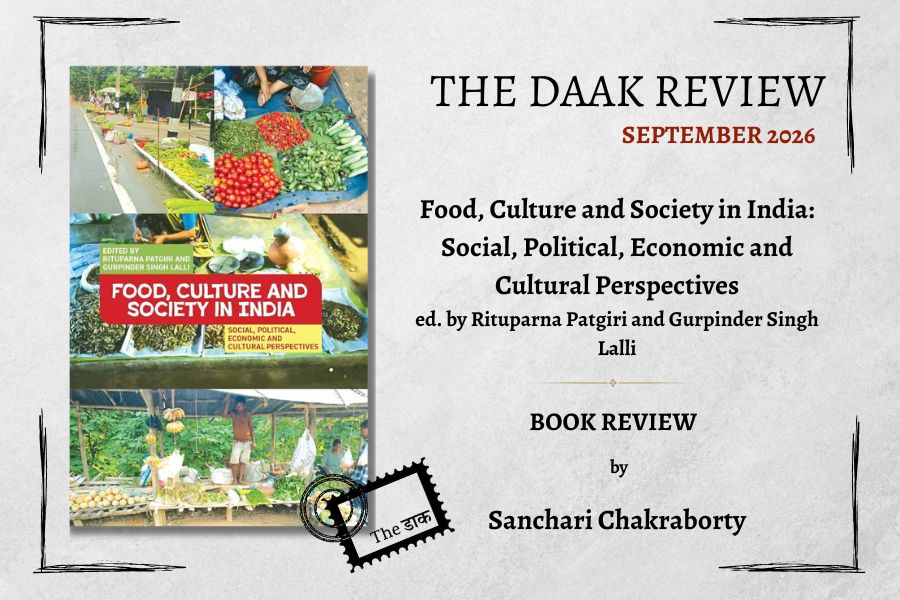
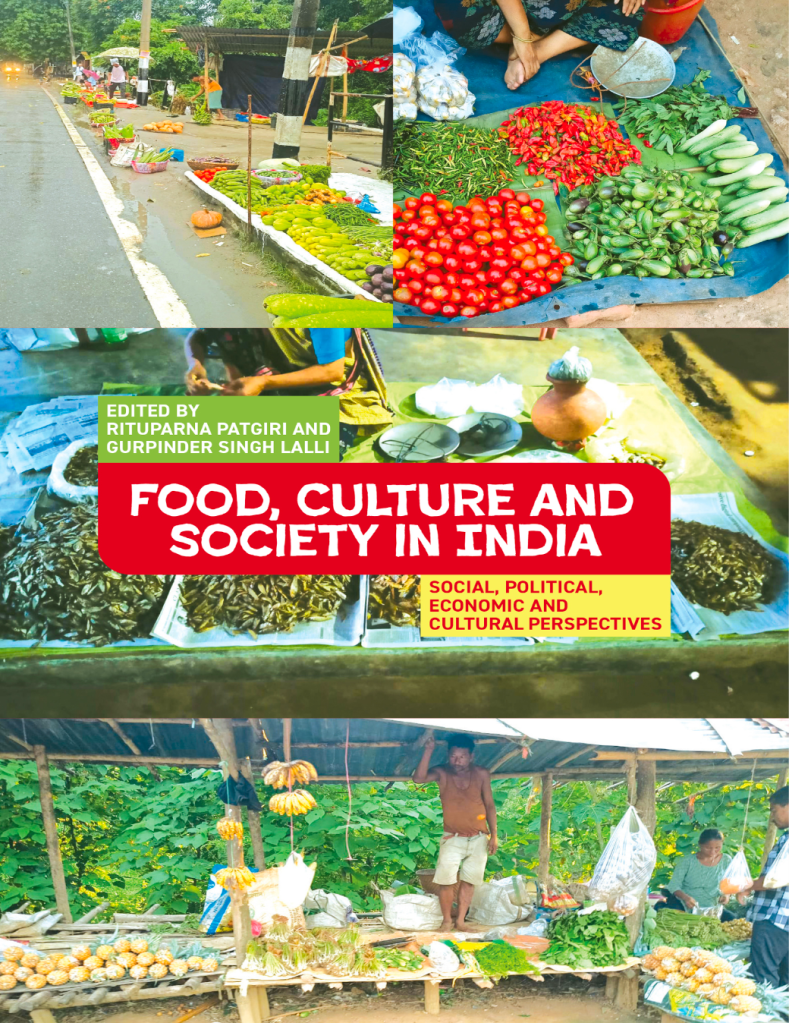
Food, Culture and Society in India: Social, Political, Economic and Cultural Perspectives, edited by Rituparna Patgiri and Gurpinder Singh Lalli, Published by Berghahn Books, Pages: 332. ISBN 978-1-83695-254-1
Reviewed by Sanchari Chakraborty
Food, Culture and Society in India: Social, Political, Economic and Cultural Perspectives, published in 2026 by Berghahn Books, combines sociological and anthropological approaches to provide an in-depth examination of the intersection of food, culture and society in contemporary India. Editors Rituparna Patgiri and Gurpinder Singh Lalli invite their readers to think beyond the simple understanding of food as something that satisfies hunger and towards the relational and emotive dimensions of food. The volume reminds us that food, far from being mundane, is embedded in broader social and economic systems and carries with it historical, local and global narratives. The specific gap Patgiri and Lalli set out to address is the relative thinness of sociological attention to food within South Asian studies.
The primary arguments of the book are organized into four thematic sections. The first section titled, ‘Food, Culture and Identity’, is a collection of six essays variously exploring how gastronomical acts of ‘eating or not eating certain food items’ (p. 16) are important markers of caste, religious or cultural identity. Aniket Nandan’s chapter on the Bhumihars of Bihar shows how lower castes pursue social mobility through the Sanskritisation of dietary practice, most visibly by adopting vegetarianism. This sits alongside Neha Arora’s account of ‘culinary apartheid’, the process by which cookbooks on Indian cuisine reiterate ‘social hierarchies and caste logics’ (p. 56) by privileging region-specific, upper-caste eating habits while rendering Dalit food practices invisible within mainstream representations of ‘Indian’ food. Against this, the volume also shows cookbooks operating as a counter-archive. For women of the Jewish diaspora in India, writing about food ‘comes as a relief’ (p. 106) by becoming an act of community built through preserving recipes in written form. Kashyapi Ghosh and Sayan Dey extend this argument to Bengal’s fishing communities, whose culinary practices have been stigmatised as ‘disgusting food habits’ (p. 23) within a cuisine shaped by caste, class and colonial encounters, while Asif Uzzaman turns to the contested place of beef within Muslim foodways — popularly consumed yet excised from nationalist portrayals of Indian food, as in the routine omission of the Bihari beef samosa from that imaginary. The section closes with Videkhono Yokha’s chapter on globalisation’s effect on the Naga palate, where the growing popularity of cake among Naga youth signals how colonial and global forces have reshaped preferences once considered alien to Naga culinary culture.
The second section explores food, memory and migration through the idiom of ‘food-centred nostalgia’. Rituparna Ray recalls how shutki — a dried, cured fish tied to East Bengali partition refugees and economic hardship — was once a source of embarrassment but has since become a signifier of commensality and intergenerational loyalty, a transformation echoed in the paltry meal of Bhakri and salt among earlier generations of South Asian migrants in East Africa. For young Kashmiris across the Muslim and Pandit communities, social media offers a space to ‘transfer food knowledge out of the family and into a public space’ (p. 186), setting aside historic differences even if only provisionally. Preetha Thomas describes food as a ‘powerful place-making tool’ for migrants, with social media enabling ‘a means of physically connecting to and reclaiming culture’ (p. 207), while Shirin Mehrotra traces how Afghan refugees in Delhi have built a sense of home by running ethnic restaurants that draw not only fellow Afghans but Kashmiri and Irani migrants seeking a sensory re-creation of home.
The third section, on food, livelihood and nutrition, illustrates how global concerns over food security drive technocratic interventions in nutrition, hunger and affordability that routinely ignore food’s embedded, affective and ecological dimensions. India’s Mid-Day Meal scheme, for instance, treats school-going children as ‘passive recipients’ (p. 237), delivering state-defined nutritional adequacy while remaining insensitive to children’s tastes, dietary preferences and feelings about food. A parallel case is made of neo-liberal interventions promoting high-yield-variety rice as flood management in the Char areas of western Assam, which misclassify the socio-economic conditions of char-dwellers. Since High Yeilding Vareity (HYV) rice is fertilizer-intensive, it burdens small farmers financially while damaging soil health and contributing to rising incidence of gallstones among consumers.
The fourth section, ‘Food, Consumption and Media’, argues that ‘the way we consume, engage with, and experience food has changed drastically due to the digital world that surrounds us’ (p. 286). Vlogging, blogging and live-streaming have turned eating into an object of viewership, exemplified by the Indian fascination with Japanese food cultivated through anime, which also generates a culinary capital in which knowledge of Japanese cuisine becomes ‘a tool to impress others’ and ‘set them apart from the crowd’ (p. 266). Advertisements, too, shape consumption while reproducing gendered stereotypes of women as household culinary managers, even as online platforms such as e-Uttaranchal popularize lesser-known regional food cultures and organic food networks forge new ‘farm to fork’ (p. 304) relations between producers and consumers.
The book’s real ambition, thus, is to demonstrate that the sociology of food is inseparable from the sociology of caste, migration, gender and the state. While the volume’s broad range of methodologically diverse perspectives is a major strength, its extensive scope may feel slightly overwhelming to some readers. The chapters that are most engaging are those built on sustained ethnographic or textual engagement: Nandan’s exploration of food and Sanskritisation with respect to Bhumihar’s of Bihar, Arora’s reading of cookbooks as sites of ‘culinary apartheid’ works because it treats the cookbook as a primary text whose omissions can be documented, and Mehrotra’s account of Afghan restaurateurs in Delhi carries weight because it is anchored in observed social practice across a specific migrant community. By contrast, several chapters in the memory and migration section lean heavily on individual autobiographical recollection — Ray’s reflection on shutki, Thomas’s account of place-making — which is evocative but thin as sociological evidence. The nutrition and livelihood section is comparatively the most empirically grounded, citing policy data and field-level effects, yet even here the review gives little indication of sample size, method or causal mechanism, so the claim risks being asserted rather than demonstrated.
Moreover, in many instances, it may come across that the volume has as its focus a broadly urban, English-literate, and often diasporic or upwardly mobile subject — the migrant with access to social media, the cookbook-writing diaspora, the anime-watching consumer of culinary capital, the reviewer of restaurants. This is a productive standpoint for tracing digital and cosmopolitan food cultures, but it leaves the volume comparatively thin on an account of food practices of from below whose relationship to food is shaped less by nostalgia or media spectacle than by chronic material scarcity and agrarian distress. Gender, too, is treated unevenly: it surfaces clearly in the critique of advertisements reproducing women as culinary managers, but the book has comparatively less to say about intra-household food allocation, women’s labour in preparing the very foods that circulate as identity markers, or how caste and gender compound each other in determining who cooks versus whose eating is symbolically significant. The North-East is represented largely through the Naga chapter’s account of globalization and changing palates, which risks standing in as the section’s singular note on the region’s food politics rather than one perspective among several. These silences do not undermine the volume’s core claims, but they do shape its overall narrative toward a story of stigma, nostalgia and mediatized consumption more than one of hunger, labour and structural deprivation — an emphasis that sits somewhat uneasily beside the book’s own critique, in its third section, of technocratic approaches that ignore the lived, material stakes of food insecurity.
Overall, the book offers a wide-ranging and often persuasive account of the ways identity is shaped by what is eaten, avoided, remembered or displayed. Each thematic section demonstrates how eating is as much biological as it is social and relational, and the volume succeeds in bringing questions of caste, culture, migration, ecology and mediatisation into a single conversation. Its unevenness — stronger on documented textual and ethnographic ground than on autobiographical reflection, more attentive to symbolic stigma than to material deprivation, and occasionally overreaching in equating consumer taste with structural exclusion — is the unevenness typical of an edited volume drawing together contributors of differing method and register rather than a flaw in its central thesis. In sum, the book makes a significant and timely contribution to the emerging interdisciplinary field of food studies in India and beyond, even as it leaves open further work on the food lives of those furthest from its largely urban, mediatized vantage point.
Sanchari Chakraborty teaches at Sister Nivedita University, Kolkata and is a PhD candidate at the Institute of Development Studies, Kolkata.

 TheDaak review
Leave a comment